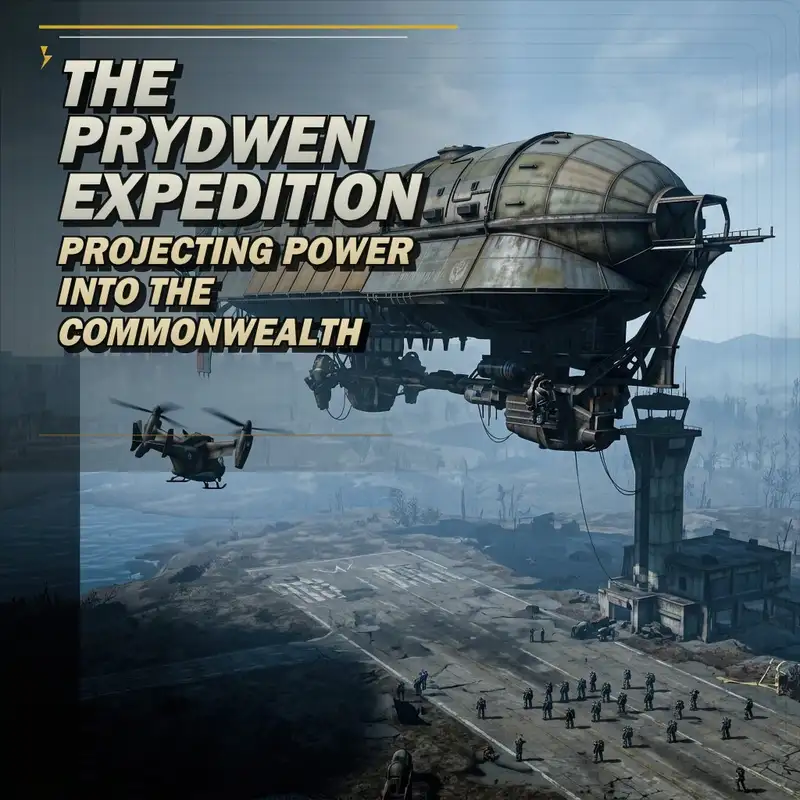
The Prydwen Expedition: Projecting Power Into the Commonwealth
Over Boston Airport, the Prydwen appeared to solve one of the wasteland’s oldest military problems. It could rise above broken highways, raider checkpoints, flooded tunnels, and the slow uncertainty of overland movement. From below, it looked like an airborne fortress, a steel city carrying Vertibirds, power armor, command staff, and enough institutional confidence to announce itself to an entire region. But the ship’s own engineering records tell a less triumphant story. While moored above the airport, its main engines could be shut down to manage cooling demands. Its systems depended on replacement parts, technical labor, salvage, and a secure installation on the ground. The Brotherhood of Steel had brought a spectacular instrument of power into the Commonwealth. It had not escaped the ordinary burdens of power. The Prydwen could move an expedition across the sky, but it still needed somewhere safe to rest, repair, resupply, and impose order.
That contrast explains what the Prydwen really was. It was not simply a very large weapon, and it was not a conventional battleship somehow transferred into the air. Its military value came from its ability to gather scarce capabilities in one place. It functioned as a headquarters, barracks, archive, workshop, clinic, research center, aviation platform, transport hub, and political symbol. It let the East Coast Brotherhood move senior command, technical specialists, aircraft crews, armed troops, and recovered technology together. In a continent where roads were unreliable and institutions were fragmented, that concentration mattered. It gave the Brotherhood a way to arrive in force without first winning every mile of road between the Capital Wasteland and Boston.
The airship’s arrival in late twenty-two eighty-seven also changed the political landscape before a single major battle was fought. The Commonwealth already had settlements, trade, local militias, criminal gangs, super mutant threats, and competing organizations operating in the shadows. The Brotherhood entered that existing society as an external military power with its own hierarchy, doctrine, and definition of danger. To Brotherhood personnel, the Prydwen represented organization, security, and the disciplined use of advanced technology. To many people on the ground, it could just as easily represent intervention by a heavily armed force that had not asked for a mandate.
The ship’s dependence on Boston Airport was not an embarrassing exception to its power. The airport offered a mooring point, open ground, access to damaged but valuable pre-War infrastructure, room for troops and equipment, and a defensible perimeter. Without a ground base, the Prydwen would have been a remarkable but limited transport platform. With one, it became the center of an expeditionary system. That system could launch patrols, receive aircraft, process intelligence, conduct repairs, stage recovery teams, and coordinate a campaign against enemies scattered across the Commonwealth.
The origins of that system lay to the south, in the Capital Wasteland. The East Coast Brotherhood that built the Prydwen had emerged from a difficult and sometimes divisive period. Under Elder Owyn Lyons, the Brotherhood had devoted substantial effort to protecting civilians and fighting super mutants in the ruins around Washington, District of Columbia.
The conflict with the Enclave gave the East Coast Brotherhood an opportunity to become something more capable than a defensive regional chapter. By the end of the campaign depicted in Broken Steel, the Brotherhood had defeated major Enclave forces at Adams Air Force Base. The base gave the Brotherhood access to Enclave facilities, equipment, aviation assets, and technical material. Capturing a base is not the same as mastering every system within it, and possessing advanced machinery is not the same as being able to manufacture replacement machinery at will. But Adams Air Force Base offered something rare in the post-War world: a concentration of military infrastructure that could be studied, stripped for parts, adapted, and put back into service.
The Prydwen was born from that opportunity. Brotherhood records describe a long project rather than a miraculous discovery. The work involved years of salvaging materials, followed by years of design and construction. The total effort took roughly six years. The Brotherhood did not simply find an intact airship, fuel it, and fly north.
That was an impressive accomplishment, but it was also a narrow one. The Brotherhood had concentrated technical expertise in its scribes, engineers, pilots, and maintenance personnel. Yet the Prydwen’s construction does not prove that the Brotherhood possessed the broad industrial depth of the old United States military. There is a difference between rebuilding one extraordinary platform from salvage and running a continent-wide economy capable of replacing such platforms in series. The Brotherhood’s strength was not unlimited production.
This distinction shaped the ship’s role. The Prydwen was a mobile command state, not because it carried every resource its expedition would ever need, but because it organized the resources the Brotherhood could gather. It put Elder Arthur Maxson and his senior officers close to the theater of operations. It carried specialists who could evaluate recovered technology, tend to wounded personnel, maintain equipment, and direct aviation operations. It gave the Brotherhood a protected location for records, planning, and command decisions.
Lancer-Captain Kells represented one of the essential functions concealed by the airship’s spectacle. An airship and its Vertibirds were not self-directing machines. They required trained crews, flight discipline, maintenance, scheduling, navigation, communications, and command authority. The Brotherhood’s ability to move quickly through the Commonwealth depended on an aviation organization that had to keep aircraft and crews functioning over time. The games do not establish precise numbers of aircraft, crew members, or flight hours, and none are needed to understand the point. A Vertibird was not merely a flying gun platform.
Proctor Ingram’s work exposed another side of that chain. She was not simply a mechanic standing beside a machine. The Prydwen required engineers who understood aging systems, improvised repairs, structural constraints, cooling problems, and the practical limits of salvaged technology. The Brotherhood could field sophisticated equipment because it had people capable of maintaining it. A weapon that cannot be repaired is a temporary advantage. A reactor that cannot be cooled is a liability with an impressive silhouette.
Before the Prydwen arrived over Boston, the Brotherhood had already been probing the Commonwealth. Paladin Danse later described earlier reconnaissance and recovery teams sent into the region over the preceding years. Another disappeared. These expeditions were small, vulnerable, and incomplete. They show that the Brotherhood did not launch its major deployment into total ignorance, but they also show that it had not mastered the territory. The Commonwealth was difficult ground even for trained personnel with advanced equipment.
Recon Squad Gladius made that problem visible. Danse’s team had established itself at Cambridge Police Station, but only after taking losses and suffering equipment damage. Raiders and super mutants had pressed the squad hard enough that its position was defensive rather than triumphant. The police station became an outpost, not a secure base. Its occupants were armed and disciplined, but they were still isolated in unfamiliar territory. Their experience complicates any image of the Brotherhood simply descending from the sky and taking control. The expedition began with reconnaissance, attrition, recovery work, and local uncertainty. Its later scale was a decision made in response to that uncertainty, not proof that the uncertainty had disappeared.
The Brotherhood’s reconnaissance mission also had a technological purpose. It sought artifacts, documents, and traces of pre-War knowledge because the Commonwealth contained research institutions, military sites, corporate laboratories, and ruins associated with advanced science. For the Brotherhood, this was never only a geographic expedition. Proctor Quinlan’s archive aboard the Prydwen helped turn the Commonwealth into a searchable theater of technical evidence. His personnel sought manuals, research data, weaponry, and records that might reveal useful capabilities or point toward the Institute.
This work reflects a core Brotherhood assumption. Knowledge was not merely a public inheritance to be shared widely. It was potentially dangerous material requiring oversight by an organization that believed itself uniquely qualified to control it. That belief gave the Brotherhood cohesion. The organization could look at a cache of technology and see a threat that needed containment. A Commonwealth scavenger, farmer, merchant, or local militia might see the same object as a tool for survival, defense, or trade. The disagreement was not just about property.
The Institute gave that argument its greatest urgency. Elder Maxson treated the Institute as the central threat in the Commonwealth. From the Brotherhood’s perspective, it was an underground power with advanced laboratories, the capacity to create synths, access to technology beyond the reach of most surface communities, and a record of operating through secrecy, infiltration, kidnapping, and coercion. The Institute was difficult to find, difficult to understand, and difficult to deter through conventional means.
An enemy hidden underground presents a different intelligence challenge from an army holding a visible fortress. The Brotherhood could identify ruined universities, factories, military sites, and settlements. It could put patrols in the streets and aircraft in the sky. Yet none of that automatically revealed where the Institute was, how one entered it, who worked for it, or what defenses it could deploy. The Institute’s ability to move personnel through teleportation made the problem more severe.
The Brotherhood responded by centralizing information. The Prydwen gave Maxson and his staff a place to collect reports, compare recovered documents, issue priorities, and direct personnel toward promising leads. Quinlan’s recovery effort reflected the logic of a command organization trying to turn fragments into a campaign picture. The ship did not make intelligence certain.
That distinction is important because the Brotherhood’s certainty about the Institute often exceeded its knowledge of the Commonwealth itself. It had identified a real and serious threat. Some synths were agents of the Institute. Some Commonwealth residents feared synth replacement. Others feared the Brotherhood’s willingness to treat an entire category of beings as an existential danger. The Prydwen’s command structure could process evidence, but it could also transform suspicion into policy with remarkable speed.
The decisive public escalation came after the events surrounding Kellogg and the search for the Institute. The Prydwen arrived over Boston accompanied by a Brotherhood broadcast. The message identified the Brotherhood of Steel, declared peaceful intentions, and instructed Commonwealth residents not to interfere with its operations. The language was carefully chosen. But peaceful intentions, in this context, did not mean the Brotherhood was arriving as a neutral aid mission.
The airship itself was a form of coercive diplomacy. It announced that the Brotherhood could project force across regional distance and sustain a presence far from the Capital Wasteland. It signaled to raiders, super mutants, the Institute, the Railroad, and local settlements that a major external actor had entered the field. Its height mattered symbolically even more than it mattered tactically. It made Brotherhood authority visible from across Boston’s skyline. The organization did not need to occupy every neighborhood to demonstrate that it had resources no ordinary settlement militia could match.
For Brotherhood personnel, that display could be understood as deterrence. A visible, disciplined force might discourage attacks, reassure frightened communities, and make hostile factions think twice before acting openly. The Brotherhood had reason to believe that fragmented settlements faced dangers they could not easily manage alone. Raiders, feral ghouls, super mutants, and Institute operations had all helped create a climate of insecurity. An expeditionary force with air support and technical expertise could offer a measure of protection that local communities lacked.
But deterrence and legitimacy are not the same thing. A military force can make itself impossible to ignore without becoming welcome. Commonwealth residents had not elected Elder Maxson. They had not negotiated a formal agreement granting the Brotherhood authority over Boston Airport, Institute-related investigations, or the recovery of local technology. The Brotherhood’s announcement asked residents not to interfere, but it did not invite them into a shared political process. Its presence was therefore protective for some people, threatening for others, and ambiguous for many who had learned that armed organizations rarely arrive without expectations.
Diamond City residents might see the Prydwen as evidence that the Institute finally faced an opponent with the means to challenge it. Settlers living near dangerous roads might welcome patrols or the possibility that super mutants would be pushed back. The Minutemen ideal, where it survived, might find common ground with an organization willing to fight threats beyond the capacity of individual settlements. Yet the Brotherhood was not a local mutual-defense association. Cooperation could be useful, but it would take place on terms largely set by the force that owned the airship.
The Railroad had even greater reason to read the Prydwen as a threat. The Brotherhood’s anti-synth program did not distinguish easily between Institute power and synth personhood. To the Railroad, the arrival of a force dedicated to the elimination of the Institute could also mean an expanded danger to escaped synths and the people sheltering them. Brotherhood personnel and policy reflected a broad suspicion of populations considered dangerous, contaminated, or difficult to categorize. Not every individual Brotherhood soldier held the same views, but an institution’s rhetoric matters when it is backed by Vertibirds and armed patrols.
The message in the sky had to be converted into an operating system on the ground. Boston Airport became the key to that conversion. The Brotherhood secured the airport from feral ghouls and established it as its Commonwealth headquarters. This was not simply a convenient parking space for an airship. The airport provided the fixed facilities through which the Prydwen could be moored, supplied, maintained, and defended. It offered a location for engineering activity, storage, troop staging, and the handling of recovered equipment.
An airport is valuable in post-War warfare for reasons that extend beyond runways. Open ground makes movement and security easier than the dense ruins of central Boston. Existing structures can be adapted for workshops, storage, command spaces, and defensive positions. Its location near the city gives access to routes and targets while preserving some separation from the most congested urban terrain. The Brotherhood could bring people and equipment into the area by air, but it still required a place where those people and machines could be organized after arrival.
The Brotherhood’s control of Boston Airport also reveals the limits of what the Prydwen controlled. Holding the airport was a tactical achievement. It gave the expedition a base. It did not mean the Brotherhood controlled Boston’s neighborhoods, its trade routes, its civilian politics, or the Commonwealth as a whole. It did not eliminate the Institute’s hidden presence. It did not dissolve the Railroad, replace the Minutemen, or bring every settlement under Brotherhood administration. A military enclave can be extremely capable inside its perimeter while remaining dependent on a much larger region it does not govern.
For that reason, the airport had an occupation-like quality even when the Brotherhood presented itself as a protector. The Brotherhood did not need to declare a formal occupation for the political dynamic to exist. The question for Commonwealth civilians was not merely whether the Brotherhood could defeat enemies. It was what the Brotherhood would demand in return for the security it claimed to provide.
The Prydwen’s engineering records explain why that foothold was indispensable. At some point in its service, the ship’s original power plant was replaced with an updated fusion plant recovered from an aircraft-carrier wreck. The records do not identify that wreck by name, and there is no basis for confidently attaching it to a particular famous vessel. The replacement improved the ship’s efficiency, but it also produced excessive coolant consumption. The Prydwen had gained capability at the cost of a new maintenance burden.
While docked above Boston Airport, the Brotherhood could shut down the main engines and allow the ship to cool. If coolant were exhausted, the ship would have to land. This is one of the clearest pieces of evidence that the Prydwen was not an independent miracle of old-world engineering. It was a powerful machine operating within material limits.
The airship’s maintenance problems were not confined to one reactor or one coolant system. Other records describe improvised replacement components, including parts made to address air-conditioning failures. The Brotherhood could fabricate solutions, adapt old systems, and keep valuable machinery operating beyond the lifespan expected by its original designers. But improvisation is not the same as abundance. A homemade component may keep a system alive.
This was the Brotherhood’s technical paradox. Its personnel were more capable than most wasteland communities of preserving advanced equipment. They had scribes trained to understand old systems, engineers willing to adapt them, and a chain of command that could assign labor and protect scarce assets. Yet that very concentration of knowledge made its most valuable machines difficult to replace. The Prydwen was a strategic asset precisely because it was exceptional.
The same principle applied to Vertibirds, power armor, specialized weapons, and later technical projects. A power-armored knight still required armor technicians, spare parts, weapons, ammunition or power cells, medical support, and an organization capable of replacing trained personnel. A Vertibird required crews, repair facilities, secure landing zones, and a supply system. The Brotherhood’s technology gave it reach and protection. It did not exempt it from the constraints that had limited armies before the Great War.
Those constraints made salvage central to the expedition. The Brotherhood did not enter the Commonwealth merely to destroy the Institute. Recovery patrols and scribal investigations treated the region as a landscape of potential resources. The Commonwealth contained knowledge and equipment that could otherwise fall into the hands of raiders, the Institute, opportunistic merchants, or local factions with limited technical capacity.
Yet salvage is never a neutral activity when people already live among the ruins. A factory, military installation, or abandoned laboratory may be a source of dangerous equipment. The Brotherhood’s doctrine made it inclined to see technological control as a public necessity. Communities affected by that control might see it as extraction. The difference matters because a military expedition can secure a site and still alienate the people whose cooperation it needs to operate beyond that site.
The Prydwen projected power by connecting those recovery efforts to a larger command structure. Scribes could gather records. The airport could receive, sort, repair, and distribute materiel. Engineers could keep aircraft and ship systems functioning. None of these functions alone would have made the Brotherhood dominant in the Commonwealth. Together, they created an expeditionary organization capable of concentrating force where it believed the campaign required it.
For that reason, the ship was more important than a simple transport. A report gathered by a patrol did not need to disappear into a distant chain of couriers before reaching the people who could act on it. A recovered component could be evaluated by technical personnel attached to the expedition. An injured Brotherhood soldier could be treated within the organization’s own medical system. Reinforcements and equipment could move between the airport, the airship, and field positions more efficiently than they could through a purely overland network.
That ecosystem also helped the Brotherhood recruit and retain personnel. A disciplined military order requires more than weapons. The Prydwen embodied that system. It was a visible statement that the Brotherhood was not merely another armed gang competing for ruins.
Of course, bureaucracy does not automatically produce wisdom. A centralized command can coordinate resources, but it can also amplify its own assumptions. Elder Maxson’s certainty that the Institute had to be eliminated gave the expedition clarity of purpose. The Brotherhood’s command system could move quickly because it did not depend on Commonwealth consent. That was a military advantage.
Liberty Prime illustrates both the ambition and the limits of the Brotherhood’s expeditionary model. The giant war machine could become a powerful extension of Brotherhood force if it were restored, supplied, transported, and directed successfully. Its potential use in the Commonwealth reflects the organization’s ability to concentrate engineering labor and old-world military technology. But its activation and later deployment are not fixed outcomes of the Commonwealth campaign. They depend on player-driven events and faction paths. What can be said with confidence is that the Brotherhood saw exceptional technology as a way to overcome a strategic problem.
The Prydwen therefore changed the Brotherhood’s operational reach without granting it effortless control. Vertibirds could insert teams, conduct reconnaissance, and move supplies or personnel faster than a caravan traveling through hostile ground. Power armor could provide protected, heavily equipped troops for difficult missions. The ship could centralize command and make the Brotherhood appear everywhere at once, even when its actual manpower remained limited. Armor does not collect taxes, settle disputes, grow food, repair every road, or build trust with a frightened population.
This gap between military power and political legitimacy lies at the heart of the expedition. The Brotherhood presented itself as a guardian against dangerous technology. In some circumstances, that claim had real substance. The Institute’s activities endangered people across the Commonwealth. Raiders and super mutants threatened settlements that lacked strong defenses. Brotherhood patrols could suppress immediate threats, recover dangerous weapons, and provide disciplined resistance to forces that preyed on civilians.
But protection was conditional. The organization’s willingness to classify technology, synths, and certain populations as threats gave it a broad rationale for intervention. A settler endangered by raiders might welcome Brotherhood action. A synth seeking refuge might see the same patrol as an existential danger. A local community dependent on scavenged technology might fear that recovery teams would remove tools it needed. A ghoul might hear the Brotherhood’s language of purity and security differently from a human resident who expected to be included in its protection.
The Commonwealth’s political landscape made these tensions unavoidable. The Minutemen, where they remained active, embodied a more local model of defense. Their ideal was mutual support among settlements rather than centralized technological authority. The Railroad operated through secrecy because it understood that openly challenging larger powers could be fatal. Diamond City maintained its own civic identity despite fear of Institute infiltration. Smaller settlements survived through farming, barter, personal alliances, and improvised defenses. None of these institutions was perfect, but all had interests that existed before the Prydwen appeared over Boston.
The Brotherhood’s arrival did not erase those local systems. Some communities might seek protection or trade. Others might avoid attention. Some individuals could work with the Brotherhood against the Institute while rejecting its treatment of synths. Others might see the Brotherhood and Institute as two different forms of external domination, one hidden beneath the ground and the other unmistakably visible in the sky.
The Brotherhood’s policy toward synths is particularly revealing. The Institute had created synths as tools, infiltrators, workers, and, in some cases, people capable of independent judgment and escape. The Brotherhood regarded the Institute’s synth program as inseparable from the threat posed by the Institute itself. Infiltration can destroy trust, and an organization capable of replacing or impersonating people is dangerous to any society. But a security framework built entirely around classification can become cruel when it refuses to recognize individual circumstances.
The Prydwen made that framework operational. It gave the Brotherhood a place to collect intelligence, issue orders, detain or investigate suspected threats, and move armed personnel where it chose. A doctrine becomes more consequential when it has aircraft and logistics behind it. The danger was not merely that the Brotherhood might be wrong about a particular case.
The later Commonwealth campaign exposed both the Prydwen’s strengths and its vulnerabilities. The Brotherhood could organize complex operations because it had a central command platform, aviation support, engineering capacity, and a secure foothold at the airport. But the details of those operations are not one fixed history. The destruction of the Railroad, the battle over Mass Fusion, the final use of Liberty Prime, and the assault on the Institute all depend on player choices and faction paths. They cannot be combined into one clean Brotherhood campaign.
What those possible operations reveal is more important than any one branch. The Brotherhood’s strength depended on intelligence access, technical projects, field cooperation, and the ability to protect its own infrastructure. To reach its objective, it needed people on the ground, information from uncertain sources, access to facilities, and a way through defenses that air power alone could not penetrate. The Prydwen made large operations possible.
The ship’s destruction in some possible outcomes makes the point even more sharply. Under different player-dependent paths, the Railroad or the Institute can destroy the Prydwen. Neither should be treated as the single established fate of the ship. An expeditionary headquarters, however imposing, remains vulnerable if enemies can penetrate its defenses, exploit internal weaknesses, undermine its ground support, or gain access to the infrastructure that keeps it functioning.
The Prydwen’s vulnerability was not simply physical. It was institutional. Its survival depended on disciplined aircrew, engineers, security personnel, command cohesion, and a protected base. It depended on the Brotherhood’s ability to identify threats accurately rather than allowing fear to become a substitute for intelligence. The ship could intimidate Boston from above, but it could not guarantee that every person below would accept Brotherhood authority, share Brotherhood priorities, or remain outside the reach of its enemies.
This is the deeper limit of power projection in the Fallout world. A force can cross a wasteland, seize a facility, and make a dramatic entrance. But it still has to live within the territory it enters. The Prydwen’s mobility reduced the Brotherhood’s dependence on Commonwealth roads. It did not remove the Brotherhood’s dependence on the Commonwealth itself.
Later events provide only cautious perspective. By the year twenty-two ninety-six, the television series indicates that a powerful Brotherhood presence exists in the Commonwealth. That establishes that Brotherhood institutional power remained important in the region long after the events of Fallout Four. It does not establish every step between those years. It does not prove that the Prydwen survived. It does not confirm a complete Brotherhood victory over every rival faction. It does not identify the precise choices made by the Sole Survivor, nor does it settle every question about the Brotherhood’s command arrangements after the Commonwealth campaign.
That uncertainty is appropriate. Post-War history is rarely a clean chain of victories. Institutions survive through adaptation, replacement, recruitment, compromise, and sometimes sheer persistence. A Brotherhood chapter can remain powerful even if an individual ship is lost. An airship can survive while a campaign fails to create broad legitimacy. A faction can eliminate one threat while generating new resentment. The later Commonwealth Brotherhood shows continuity of organization, not the simple triumph of one ending slide.
The Prydwen’s enduring importance lies in what it demonstrated. The East Coast Brotherhood had become capable of building and sustaining an expedition beyond the Capital Wasteland. It could gather command authority, aviation, engineering, intelligence, medical support, recovery work, and military force into a single mobile system.
Yet the airship’s power was never independent. It relied on Boston Airport, coolant, repairs, salvage, skilled technicians, ground security, local intelligence, and a campaign that could compel obedience without necessarily earning consent. The Prydwen could project Brotherhood authority from above. Whether that authority became durable order depended, as it always does, on who controlled the ground beneath it.