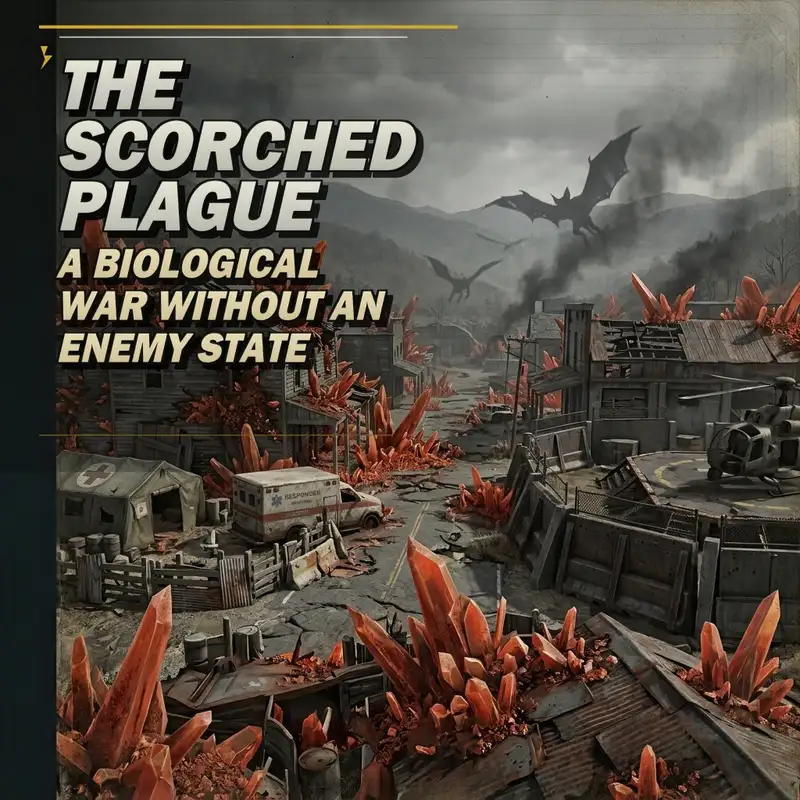
The Scorched Plague: A Biological War Without an Enemy State
At Morgantown Airport, the Responders were trying to hold together the last functions of a society already coming apart. The runways and terminals had become something more desperate than an airport. They were a refuge, a command post, a medical station, a supply point, and a defensive position for people with too few of everything. Doctor Claire Hudson’s work on an inoculation was still moving forward, but research did not occur in a protected laboratory far from the fighting. It took place amid shrinking ammunition stores, exhausted defenders, depleted medical supplies, disrupted communications, and the growing pressure of Scorchbeasts overhead. The crisis had reached the point where a medical breakthrough might not save the people still guarding the walls. It might only save whoever came after them.
That is what made the Scorched Plague so destructive. Appalachia had armed organizations, bunkers, radio networks, trained medics, fortified facilities, power armor, energy weapons, and surviving pieces of pre-War industry. It did not lack brave people or useful technology. What it lacked was time, coordination, and a secure system capable of linking medicine, intelligence, transport, food, shelter, and force. A conventional enemy might seize a town, raid a convoy, or threaten a bunker. Such an enemy could be mapped, watched, negotiated with, infiltrated, or defeated in battle. The Scorched Plague attacked the systems that made all of those responses possible. It infected people, broke evacuations, emptied clinics, isolated settlements, and forced every organization to spend its remaining strength on immediate survival.
The Scorched crisis was not merely a story about monsters appearing in the mountains. It involved three connected threats. There were Scorchbeasts, airborne creatures capable of ranging across difficult terrain and bringing terror to settlements that believed distance or fortifications could protect them. There was the plague itself, an infectious and mutagenic condition that transformed victims into Scorched. And there were the Scorched themselves, former people and altered creatures whose behavior suggested a disturbing degree of collective coordination. The precise biology and command structure remain incomplete. Appalachia’s surviving records do not provide a clean scientific explanation for every stage of infection, every behavioral change, or every connection between the creatures and their victims. But they establish enough to show that the defenders faced an integrated regional threat, not a collection of unrelated attacks.
The Scorched were not a state. They did not issue laws, collect taxes, negotiate treaties, operate a treasury, or build an industrial base. They had no known diplomacy, no political program, and no succession system that human opponents could exploit. Calling them an army would also mislead. They could attack in coordinated ways, and their hive-like behavior gave them an operational coherence that ordinary raiders lacked, but they were not a military institution with a staff, a doctrine, or a supply ministry. Their power came from something more difficult to confront. They turned the population itself into terrain. A town was no longer simply a place to defend. It could become a source of infection. A road was no longer merely a supply route. It could carry refugees, frightened civilians, infected travelers, or a force that knew the local landscape because it had once lived there.
This gave the plague an advantage that no conventional Appalachian faction could easily match. The defenders needed functioning communities behind their lines. They needed farms to produce food, medics to treat the wounded, radio operators to pass warnings, workshops to repair equipment, and civilians willing to shelter fighters or report danger. The Scorched did not need any of those institutions to function in the human sense. They benefited when roads became unsafe, when people stopped trusting one another, when hospitals became overwhelmed, and when local leaders could no longer tell whether a frightened survivor was a patient, a refugee, or a danger to everyone nearby. The plague’s strategic effect was not the occupation of territory for government. It was the destruction of organized life until no government, militia, or relief network could sustain a defense.
The roots of that disaster lie partly in the old world’s surviving machinery of power. In Appalachia, the Enclave faction associated with President Thomas Eckhart used automated emergency systems to elevate threats and justify an ever more aggressive defense posture. Eckhart’s project was shaped by paranoia, ambition, and the peculiar logic of an isolated remnant that wanted the authority of the United States government without the public institutions that had once made government meaningful. The available evidence connects this Appalachian Enclave to the release and escalation of threats involving Scorchbeasts. It does not provide a complete, uncontested biological history of every feature of the plague. There is no reliable basis for claiming that Eckhart personally designed every mutagenic effect, fully understood the later behavior of infected victims, or possessed a master plan for the catastrophe that followed.
What is clear is more than enough. A faction with access to old military systems and emergency authority helped create a danger beyond its ability to manage. This was a familiar pre-War failure, compressed into a post-War bunker. The Enclave possessed technical access, secrecy, weapons, and automated command systems. It did not possess legitimacy among Appalachian communities, a functioning civilian administration, or the ability to coordinate a region once its own internal order collapsed. It could escalate. It could not govern the consequences of escalation. The distinction matters. Powerful technology can create a strategic problem in a single act. Solving that problem requires durable institutions, trust, labor, medical capacity, logistics, and the willingness of ordinary people to cooperate under pressure.
The Scorchbeasts made Appalachia’s geography work against its defenders. The region was not an empty battlefield. It was a difficult network of hills, forests, industrial ruins, mining settlements, highways, bunkers, rivers, and damaged infrastructure. Communities were dispersed. Roads and rail lines connected some places, but only unevenly. Radio networks could extend warning across long distances, yet radios required power, operators, maintenance, and people at the receiving end who could act on the information. Ground forces had to move through terrain shaped by radiation, ruined bridges, hostile wildlife, raider activity, and the simple problem of distance. A fortified building could offer shelter. It could not guarantee that help would arrive before its food, ammunition, or medical stores ran out.
Scorchbeasts did not erase those constraints. They exploited them. Their aerial mobility allowed them to cross obstacles that delayed foot patrols and convoys. Their appearance could transform a local emergency into a regional panic because no settlement could easily know whether it was an isolated attack or the beginning of a wider movement. Meanwhile, infected victims could appear in human spaces. A threat that came from the sky was alarming enough. A threat that could emerge from a road, a farm, a medical station, or a refugee column was worse. The decisive military question was therefore not simply whether a squad could kill a Scorched creature after contact. It was whether Appalachia could detect danger early enough to move civilians, reinforce defenses, protect research facilities, and prevent infection from outrunning the response.
The Responders understood the civilian side of that problem better than most. They were not originally built as a conventional army. They emerged from emergency services, volunteer work, medical relief, food distribution, rescue operations, training programs, and communications support. Their authority came less from formal government than from usefulness. They fed people, treated them, trained them, and helped communities survive disasters that would otherwise have destroyed them. In a fractured post-War region, that kind of practical legitimacy was an important strategic resource. Civilians were more likely to share information with people who had previously helped them. Settlements were more likely to cooperate with an organization that arrived with medical aid instead of demands.
But the Scorched crisis forced the Responders into a role they were not designed to sustain alone. The Fire Breathers became their specialized anti-Scorched force. This was a rational adaptation. Someone had to enter contaminated areas, fight in close quarters, investigate outbreaks, and hold positions long enough for civilians to escape. Yet every trained person assigned to combat was also a person unavailable for medical transport, food distribution, radio maintenance, rescue work, or care for displaced families. A relief organization can militarize during an emergency, but it pays for that transformation from the same limited pool of labor, equipment, and trust that keeps civilian life functioning. The Fire Breathers gave the Responders a sharper military edge. They could not create an unlimited supply of trained replacements or secure every settlement across Appalachia.
Doctor Hudson’s inoculation project reveals the real scale of the Responders’ dilemma. The project was not merely a medical side effort. It was an attempt to change the strategic terms of the war. If people could be protected from infection, the Scorched would lose one of their most dangerous advantages. But research requires stability. It requires samples, equipment, trained personnel, clean working conditions, dependable power, secure storage, and time to test procedures. A collapsing emergency network provided none of those reliably. Each attack threatened the staff, the facility, the supply chain, and the population that might eventually benefit. Hudson was trying to build a future defense while the present was consuming the people and material needed to create it.
The Free States approached the crisis from another direction. Their communities had been shaped by distrust of centralized authority and by a deep belief in self-reliance, concealment, and technical preparedness. Bunkers offered some protection from the immediate collapse outside. Decentralization could help a small community survive when roads were unsafe and larger institutions were failing. A hidden group with stored supplies, skilled technicians, and local knowledge could outlast a disaster that destroyed a more visible settlement. But survival in separate bunkers was not the same as regional defense. A scattered network might preserve people and knowledge. It could not automatically produce shared command, common priorities, or the ability to move resources quickly from one threatened place to another.
Abbie Singh’s work on Scorched detection systems and Scorchbeast lures showed that the Free States had identified the correct operational problem. Warning mattered. The defenders needed to know where the aerial threat was moving, where it might emerge, and where they could draw it away from civilians or toward prepared defenses. Detection systems and lures were serious military ideas, not improvised curiosities. They sought to create reaction time, and reaction time was one of the few advantages a human organization could still manufacture. A warning received early enough might allow a settlement to shelter civilians, a patrol to prepare an ambush, or a medical team to avoid walking into an outbreak.
Yet warning only has value when someone can act on it. Sensors require maintenance. Communications require operators and power. A report requires a force that can move, ammunition that can be issued, medical support for the wounded, and political authority to decide who receives help first. The Free States could build parts of an intelligence network. They could not, by themselves, sustain the full command-and-support system that a regional campaign required. Their decentralization prolonged resistance in some places, but it also limited their ability to concentrate force or maintain common action as the crisis spread. In a biological war, isolation can preserve a pocket of survival. It can also leave every pocket alone when the threat becomes too large for local improvisation.
The Appalachian Brotherhood of Steel provided the most overtly military answer. Under Paladin Taggerdy, the chapter had disciplined personnel, power armor, energy weapons, fortified positions, and a culture built around military organization. At Fort Defiance and in operations connected to the Cranberry Bog, the Brotherhood could bring capabilities that civilian volunteers and isolated bunker communities often lacked. It could patrol, fortify, conduct reconnaissance, field trained fighters, and attempt containment in areas where ordinary settlers had little chance of standing their ground. Operation Touchdown reflected the chapter’s determination to strike at the Scorchbeast threat rather than wait passively for settlements to be destroyed.
Those advantages mattered. They were not enough. Power armor did not manufacture replacement troops. Energy weapons did not repair roads, deliver food, or keep a hospital open after its staff had been killed or scattered. Fortified sites could resist attack, but every defended position required water, medical supplies, ammunition, maintenance, communications, and people capable of holding it. The Brotherhood’s technology gave it a tactical edge. It did not give it strategic depth. The chapter could win engagements and still lose the wider contest because the wider contest involved too many places, too few secure routes, and a civilian population increasingly unable to support or be protected by military operations.
This was not simply a failure of courage or command. It was a mismatch between mission and resources. The Brotherhood could not defend every farm, clinic, relay station, bunker entrance, road junction, and refugee route across Appalachia. It could not remain concentrated enough to fight effectively while also dispersing enough to reassure every community that help would come. The chapter’s relationships with the Responders grew strained because scarcity forced different priorities into competition. The Responders needed personnel and supplies for rescue, medicine, and civilian survival. The Brotherhood needed soldiers, equipment, and operational freedom to contain an expanding threat. Neither requirement was frivolous. But in the absence of an integrated regional command, each organization could see the other’s demands as a dangerous diversion from the work it believed essential.
The result was a series of partial solutions that could not combine in time. The Brotherhood had force but not enough sustaining infrastructure. The Responders had legitimacy and medical purpose but could not survive as a military organization under permanent pressure. The Free States had warning systems and technical imagination but lacked the regional authority and logistical network to turn warning into coordinated action. No one faction could replace the functions of all the others. The Scorched did not need to defeat a unified Appalachia. There was no unified Appalachia to defeat. They only needed to keep the surviving institutions separate long enough for each to exhaust itself.
Raiders deepened that fragmentation. They were not one government or even one coherent military faction. Appalachia’s raider groups had different leaders, territories, grievances, and ambitions. Some sought loot, some sought domination over local communities, and some simply pursued survival through coercion. Their violence through areas such as the Savage Divide added another layer of danger to an already collapsing region. A refugee moving toward apparent safety might face infection, hunger, raider extortion, blocked roads, and the possibility that the destination itself had already fallen. A courier carrying information might be ambushed. A caravan carrying medicine might never arrive. A settlement considering cooperation might decide that exposing its location was more dangerous than remaining silent.
Some raiders appear to have misunderstood the Scorched threat as something closer to an ordinary rival, a danger to be avoided, exploited, or fought on local terms. That was a costly error. A raider gang could adapt to another gang’s territory, negotiate a temporary arrangement, or profit from a vulnerable route. It could not bargain with an infection. It could not seize a tribute from a Scorchbeast. It could not rely on intimidation when the enemy did not fear pain, reputation, or retaliation in the human sense. But the responsibility for Appalachian fragmentation does not belong to the plague alone. The disease exploited distrust and violence. It did not invent them. Human groups chose secrecy, coercion, exclusion, and short-term advantage at moments when cooperation was becoming a matter of collective survival.
For civilians, the distinction between military and medical collapse often disappeared. A town did not need to be overrun in a dramatic final battle to be lost. It could lose its food deliveries. Its radio might fail. Its clinic might run out of medicine. Its defenders might leave to reinforce a larger position. Its residents might flee, carrying fear and possibly infection with them. Families could be separated by evacuation, by blocked roads, or by the need to abandon someone who was already changing. The plague transformed ordinary acts of solidarity into difficult calculations. Taking in strangers could save lives. It could also endanger everyone inside. Leaving a settlement might offer a chance of escape. It could also expose people to raiders, hostile terrain, or another outbreak.
By the year twenty ninety-six, the collapse of Morgantown Airport represented more than the loss of one defended location. It marked the breakdown of one of the last major Responder strongholds. Doctor Hudson’s records speak from inside that pressure. They describe shortages, overwhelming danger, and the bleak recognition that the inoculation effort might outlive the people trying to protect it. Her perspective was necessarily limited. A medical officer under siege could not see every surviving community across Appalachia, and no single record can establish the exact fate of every person in the region. But the broader pattern is clear. Organized surface society had been shattered. The major networks that once provided relief, defense, communication, and mutual support had ceased to function at anything like their earlier capacity.
This was a systems collapse. Ammunition shortages mattered because defenders could not hold positions without ammunition. Medical shortages mattered because wounded people could not return to duty and infected people could not be safely managed. But the deeper failure was the loss of the relationships connecting all the parts. Hospitals required secure supply routes. Supply routes required escorts or local security. Security required intelligence. Intelligence required working communications. Communications required power, technicians, and communities willing to share information. Every function depended on civilians who needed food, water, shelter, and a reason to believe that cooperation still had a future. Once enough of those links failed, even a strong local defense became an island. Islands can hold for a time. They cannot sustain a region.
The opening of Vault Seventy-Six on October twenty-third, twenty-one oh two, changed the situation because it introduced a new population into a landscape where knowledge and infrastructure had survived more effectively than institutions had. The residents of the Vault were not one single hero with one fixed history. Their individual choices, personalities, and paths remain variable. What matters historically is the collective intervention associated with them. They could recover scattered research, reconnect abandoned facilities, rebuild access to technical systems, and complete work that earlier defenders had begun under siege. They entered Appalachia after the first war had already devastated its organized communities, but they inherited fragments of those communities’ effort.
That inheritance was crucial. The Responders had left medical research and a framework for inoculation. The Free States had left warning systems, technical knowledge, and an understanding that detection was central to survival. The Brotherhood had left military records, hardened positions, and evidence of how difficult direct containment had become. Even the Appalachian Enclave’s surviving automated systems, especially those connected to the Whitespring bunker, could be used as access points to old strategic infrastructure. None of these remnants were sufficient on their own. Together, they could be assembled into a campaign. The decisive change was not that one person became extraordinarily powerful. It was that information, medicine, transport, force, and strategic access could finally be linked after years of fragmentation.
The first line of that counteroffensive was inoculation. This mattered because it altered the human side of the conflict. A population vulnerable to new infection could become, under pressure, a source of new Scorched and a danger to every refuge. A population protected against infection could still be frightened, wounded, displaced, or attacked, but it was no longer exposed to the plague in the same way. Inoculation did not reverse established transformation. It was not a cure for people who had already become Scorched. It did not eliminate every contaminated place, every Scorchbeast, or every remaining hostile creature. But it prevented the enemy from expanding through an entirely unprotected human population at the same catastrophic scale.
The second line of effort was directed at Fissure Site Prime and the Scorchbeast Queen associated with it. The operation used inherited nuclear launch infrastructure accessed through the surviving systems around Whitespring. That fact should not be mistaken for the restoration of an Enclave state. The bunker’s machines and credentials outlasted the political authority that had once claimed to command them. Old systems can remain dangerous long after the governments that built them have become ghosts. In this case, access to those systems gave Appalachia’s defenders an exceptional strategic tool. The nuclear strike triggered the confrontation that culminated in the queen’s defeat.
On the ground, this was a battle against a major operational threat. The queen was not merely another hostile creature. She represented the focal point of a crisis that had overwhelmed settlements, military positions, and relief organizations for years. Her defeat removed a central source of pressure and gave human defenders a chance to act without being constantly driven backward by the same scale of aerial threat. Across the wider campaign, the strike and subsequent battle disrupted the primary fissure system’s role in the crisis. It created room for movement, recovery, and the rebuilding of networks that could not function while every effort was consumed by immediate survival.
In the larger struggle, however, neither the nuclear strike nor the queen’s death was a magic solution. One strike did not sterilize Appalachia. It did not erase every Scorched victim, close every danger, or restore every town that had already been lost. Nuclear destruction can remove an objective. It cannot rebuild trust, reopen a clinic, restore a farm, train medics, or tell displaced people where it is safe to go. The military value of the operation lay in buying time and reducing pressure. The political and medical work still had to be done afterward. This is the difference between a decisive battle and a durable recovery. The battle can make recovery possible. It cannot perform recovery on its own.
During the year twenty-one oh three, the broader vaccine effort brought that distinction into focus. Appalachia was no longer dealing only with the ruins of old factions. Settlers, Raiders, and other groups were returning or reemerging, each with its own fears, interests, and memories of betrayal. Distributing protection against the plague was therefore not simply a matter of producing doses. It required transport, trained personnel, secure handling, communication, and access to communities that might distrust outsiders. It required people to believe that the inoculation was real, that it was not a trap, and that accepting help would not place them under someone else’s permanent control. Public health is always political in this sense. A treatment that cannot reach people, or that people cannot safely accept, is not yet a strategic capability.
The vaccine campaign also exposed a more hopeful form of power. The strongest weapon in Appalachia was not the ability to launch another missile. It was the ability to make protection ordinary. A community becomes more secure when a traveler can enter without automatically becoming a source of catastrophe, when a clinic can treat the sick without becoming a death sentence, and when settlements can exchange labor and goods without every contact carrying the same fear of infection. Those conditions do not eliminate violence. They do not settle disputes between Settlers and Raiders, erase the legacy of the old factions, or ensure that every surviving community will cooperate. But they create the minimum confidence from which trade, governance, and recovery can begin.
Residual Scorched threats remained part of Appalachia’s danger. Their later presence should not be treated as proof that the original epidemic continued without interruption at the same historical scale. Repeatable conflicts and recurring hostile encounters belong partly to the practical demands of a living game world. The historical point is more restrained. The crisis was contained, not made unreal. The region still had to live with the consequences of transformed victims, damaged infrastructure, contaminated fears, and the knowledge that old strategic systems could create disasters as easily as they could be turned against them.
The Scorched Plague won its first war because it did not need to build a state. It only needed to keep everyone else from sustaining one. Appalachia’s defenders had courage, laboratories, bunkers, weapons, radios, and fragments of old-world power, but those assets remained divided while the plague turned people, roads, institutions, and time itself against them. The eventual reversal came not from killing one monster alone, and not from launching one nuclear weapon alone, but from combining prevention, intelligence, logistics, coordinated force, and public cooperation. Biological threats do not need flags or diplomats to become strategic powers. They become strategic powers when human institutions cannot protect the people who must keep those institutions alive.