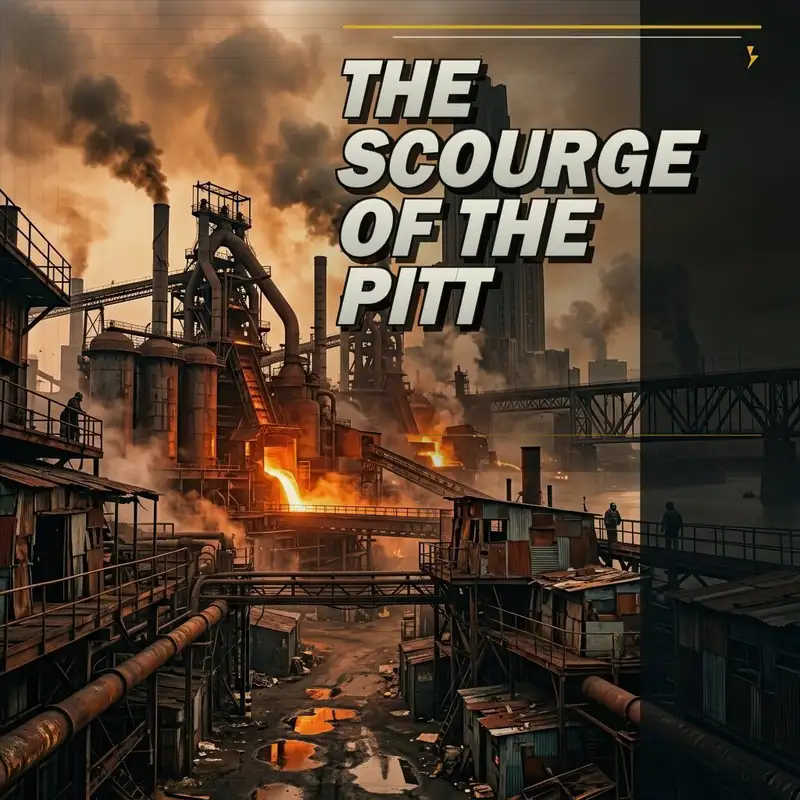
The Scourge of the Pitt
In the year twenty-two seventy-seven, the Pitt is one of the few places in the former United States where the old industrial age still visibly breathes. Smoke rises over the steel mill. Machinery still turns. Armed men patrol catwalks and streets. Caravans carry steel outward, proof that this poisoned city has something other regions want. But the system beneath that smoke is built on slave labor. Men and women are seized, bought, or driven into the Pitt, then forced through the mill’s furnaces, its cramped work camps, and its violent rituals of control. Above them rules Ishmael Ashur, known as Lord Ashur, a former member of the Brotherhood of Steel who promises that the suffering is temporary. His city, he claims, is producing not only steel, but a future. The Pitt is afflicted by the Troglodyte Degeneration Contagion, a poorly understood condition associated with the city’s toxic environment and the transformation of people into Trogs. Ashur’s daughter, Marie, appears immune. Sandra Kundanika, Marie’s mother, believes the child may offer a path toward treatment. That possibility gives Ashur’s regime its central justification. Endure the labor camps. Keep the mill running. Preserve the research. Accept cruelty now so that the Pitt may someday survive. It is a grim bargain, and Ashur enforces it with raiders, cages, executions, and a social order in which human beings become both workers and raw material. Yet the city Ashur rules was not simply inherited from the old world.
It was shaped by a Brotherhood assault remembered as the Scourge. Roughly two decades before the Lone Wanderer arrives, Owyn Lyons’s eastward expedition entered the Pittsburgh region, struck the city with overwhelming force, and then moved on. The Brotherhood broke something in the Pitt. It did not build a replacement. Ashur rose in the political vacuum left behind, turning a surviving steel mill into the center of a new order. The question is not whether the Scourge changed the Pitt. It plainly did. The question is whether it was a successful military operation that made recovery possible, or a massacre whose failure to secure the aftermath allowed one form of violence to be replaced by another.
The Pitt was already wounded long before Lyons’s expedition arrived. Pittsburgh had been a major industrial center before the Great War, and the post-War city retained the physical remains of that inheritance. Steelworks, rail lines, bridges, smokestacks, warehouses, and factories survived in pieces. But industrial ruins are not industrial capacity. A mill requires labor, tools, power, maintenance, transport, security, and an authority capable of coordinating all of them. The Pitt had fragments of those things, but not enough stability to unite them. By the time the Brotherhood encountered the city, the surviving accounts describe a place damaged by radiation, pollution, disease, mutation, and factional violence. That description should not be mistaken for a complete political map. The record does not tell us every group that controlled a neighborhood, every family that survived there, or every arrangement people made to obtain food and shelter. A violent city is still a city. It contains workers, children, scavengers, traders, refugees, local strongmen, frightened households, and people attempting to preserve ordinary life amid extraordinary conditions. Earlier history reinforces that point. In the early twenty-second century, the Pitt was home to organized societies, including the Pittsburgh Union and its enemies, the Fanatics. Their conflict belongs to a different period and cannot explain every detail of the later Scourge. Still, it demonstrates that Pittsburgh’s post-War history included labor organization, political struggle, and collective survival long before Ashur’s regime. The city was not empty ground waiting for a capable outsider to give it meaning.
It had repeatedly produced institutions, loyalties, and conflicts of its own. By the mid-twenty-second century, however, those institutions had either broken down, been displaced, or become too weak to impose broad security. The environment compounded the problem. Contamination did not merely make the Pitt unpleasant. It narrowed the margin for error. A community that loses clean water, healthy workers, medicine, or access to trade can fall apart quickly. In that setting, armed groups gain leverage because they can seize scarce resources and because frightened civilians may have few alternatives. Lyons’s expedition encountered the Pitt as a security problem. But a force can correctly identify danger while still misunderstanding the society trapped inside it.
Owyn Lyons’s Brotherhood expedition was moving eastward toward the Capital Wasteland during the middle decades of the twenty-second century. It was not a settled local government with a deep tax base, a large civilian population, or a permanent administrative apparatus. It was an expeditionary force, carrying the Brotherhood’s military traditions, technical knowledge, hierarchy, discipline, and equipment into territory where its members had limited local roots. In an urban wasteland fractured by violence, that combination could be decisive. Brotherhood personnel possessed better organization than most irregular groups. Their armor, weapons, training, and command structure gave them a substantial advantage in direct combat. Just as important, they could act collectively. A fragmented city may contain many armed people, but if they lack reliable communication, shared objectives, and a functioning chain of command, they cannot necessarily resist a disciplined force as one body. That does not mean the Brotherhood knew the Pitt well. The surviving material does not provide a detailed after-action report. We do not know the full size of Lyons’s force, the exact order that authorized the attack, or the precise intelligence that led the Brotherhood to view the city as a target. There is no basis for claiming that Lyons personally ordered the assault for one confirmed motive, whether humanitarian, punitive, strategic, or technological. The most cautious conclusion is that the expedition regarded the Pitt as a dangerous hostile concentration along or near its eastern route. The city may have threatened movement, posed a risk to the expedition’s security, or appeared too violent and unstable to bypass safely.
Those are plausible military concerns. They are not enough, by themselves, to establish what the Brotherhood understood about the people living there. An expedition can identify armed resistance and still fail to distinguish between raiders, coerced laborers, civilians, local defenders, opportunists, and people simply trying to survive. It can see ruins without seeing a recoverable industrial base. It can observe sickness without understanding a public-health catastrophe. This distinction matters because the Brotherhood’s strengths were concentrated in the act of striking. Its later failures were concentrated in what it did not remain to learn, protect, or rebuild.
The attack became known as the Scourge, and even the name carries judgment. It suggests not a limited skirmish, but a punishing campaign intended to clear away a threat. The available witnesses describe it in broad, painful terms rather than in the clean language of a military archive. Wernher, who later becomes one of Ashur’s enemies, recalls the Brotherhood as having killed a vast portion of the city’s inhabitants. Kodiak, another figure shaped by the Pitt’s later order, remembers the Brotherhood assault as an overwhelming use of force against a population already living in terrible conditions. Neither account is a neutral casualty ledger. Wernher has reason to emphasize Brotherhood brutality, and Kodiak’s memories emerge from a society built on its own violence and grievance. But the fact that accounts are perspective-bound does not make them worthless. It tells us what kind of event the Scourge became in local memory. It was remembered as devastation. The operational setting helps explain how an expeditionary force could impose that devastation quickly. The Pitt’s industrial terrain offered rubble, elevated works, narrow passages, broken buildings, poor visibility, and countless positions from which local fighters might ambush an outsider. It also made civilian life dangerously difficult to separate from armed activity. People sheltered where they could. Fighters could disappear into wreckage. Command and communication were likely fragmented. Yet urban complexity does not erase the advantages of a force with superior training and equipment. Brotherhood armor and weapons could break isolated resistance, especially if local groups lacked the means to coordinate against them.
The result, according to the surviving accounts, was the destruction or dispersal of much of the violent order then controlling the city. That may have been a tactical success. It may have reduced an immediate threat to Lyons’s column and helped the expedition continue east. But tactical success does not settle the moral question. A force can suppress hostile activity while killing civilians, destroying fragile local networks, and deepening the desperation that produced violence in the first place. Nor does it settle the political question. Destroying the authority that exists, however cruel or chaotic that authority may be, does not create a government. The Brotherhood did not establish a durable occupation. It did not remain to build civil institutions, secure food and water, organize medical care, protect survivors, or restore the mill. It struck, survived, and departed. Beneath the rubble of that operation lay one of the Brotherhood’s own, presumed dead. His survival would give the Scourge its most enduring consequence.
Ishmael Ashur was a Brotherhood member when the Scourge came to the Pitt. During the assault, he was trapped beneath rubble near the steel mill and believed lost. The exact sequence is not fully documented, and there is no need to turn a survival story into a legend of invulnerability. The key point is that Ashur emerged into a city where the Brotherhood’s attack had shattered existing power without replacing it. He survived not merely as an individual, but as a carrier of institutional knowledge. The Brotherhood had given him experience with hierarchy, discipline, technical specialization, armed command, and the practical relationship between organization and force. Those lessons were more valuable than any single weapon. In a ruined industrial city, the ability to make people work together under pressure can become a source of power equal to armor or ammunition. Ashur recognized what the Brotherhood expedition had not remained to exploit. The steel mill was not just a relic of Pittsburgh’s old economy. It was the Pitt’s strategic center of gravity. A functioning or recoverable mill could produce metal goods, support repair work, attract traders, and create leverage over neighboring settlements. It could provide a reason to defend territory, organize labor, and build a chain of command. But it could do none of those things by itself. Industrial machinery does not govern. It does not feed people. It does not persuade workers to remain at their stations, secure a road against raiders, or decide how the products of labor will be distributed.
Ashur’s achievement was to connect the mill to an armed political structure. That was the beginning of the later Pitt. The Brotherhood had demonstrated how rapidly an organized force could destroy local power. Ashur understood that durable power required a different task. It had to become productive. It needed workers, guards, technicians, scavengers, traders, and people willing or compelled to obey orders. It needed a story about why those orders should be obeyed. It needed to turn a shattered city into something that could produce enough value to survive its own isolation. Ashur did not restore Pittsburgh to its pre-War industrial glory. No evidence supports that kind of claim. He assembled a harsher and narrower system, one built from salvage, coercion, and the surviving possibility of steel production. But compared with the fragmentation that followed the Scourge, it was an institution. That made it more durable. It did not make it just.
Ashur gathered survivors, recruited raiders, imposed command, and established control around the mill. By the year twenty-two seventy-seven, that process had produced a militarized industrial regime. Armed enforcers secured Ashur’s authority. Workers were compelled into labor. The mill produced steel for trade, and that trade gave the Pitt access to goods it could not easily create for itself. Food, water, medical supplies, tools, replacement parts, and other necessities had to come from somewhere. The Pitt’s economy could not live on steel alone. A mill without transport routes becomes a fortress full of machinery. A ruler without supplies becomes merely another warlord presiding over shortages. Ashur’s system therefore depended on connections beyond the city, even as it presented itself as a self-reliant industrial project. That dependence helps explain why coercion became central. The Pitt’s contaminated environment reduced the available pool of healthy labor. Dangerous work consumed bodies. Security required armed personnel. Repairs required skill. Trade required goods worth moving through hazardous territory. Under those conditions, a ruler concerned with output could begin to see people less as citizens than as inputs. Ashur’s answer was enslavement. Outsiders were brought into the Pitt and forced to work. The city’s labor camps became the mechanism through which industrial recovery was financed. This was not an accidental abuse at the margins of an otherwise benign reconstruction project. Forced labor was woven into the regime’s economic model. Ashur offered order, but it was an order built on domination.
He offered work, but the people doing much of that work had no meaningful choice. He offered protection, but his armed forces protected the system that imprisoned them. The existence of organization should not be confused with legitimacy. Still, it is important to understand why Ashur’s regime endured long enough to become more than a raider camp. It connected violence to production, production to trade, and trade to survival. That is what the Brotherhood had not done. Lyons’s expedition had the power to clear a route and break resistance. Ashur developed the capacity to govern, in the narrowest and most coercive sense of that word. His government could issue orders, secure labor, defend an industrial site, and extract value from the population. The tragedy of the Pitt is that these real institutional capacities were constructed through a system that treated human suffering as both a means and an acceptable cost.
The Pitt’s medical crisis made that system still more brutal. The Troglodyte Degeneration Contagion, usually called T D C, is associated with the city’s poisonous environment and the transformation of afflicted people into Trogs. The exact mechanism remains unclear. The condition cannot be reduced to a neat real-world disease model, and the available evidence does not establish a precise route of transmission, predictable timeline, or universally effective treatment. What is clear is that the threat is pervasive enough to shape life throughout the Pitt. Trogs are not simply another hostile creature in the ruins. They are evidence of a society living under biological siege. The possibility of degeneration affects workers, families, guards, children, and anyone trying to imagine a future in the city. A community already short of food, medicine, and security must also contend with the fear that its people may be physically transformed by the environment around them. For Ashur, this creates both a practical and ideological problem. A steel economy requires labor, but the Pitt is a place where labor is dangerous, unhealthy, and potentially self-eroding. The local population cannot be treated as an inexhaustible workforce. The regime’s response is to import enslaved outsiders. Those slaves become replacement labor for a city whose own human base is endangered by disease, pollution, and violence. That makes the Pitt’s public-health crisis inseparable from its political economy. The workers are not merely oppressed because Ashur is cruel. They are oppressed because the regime has decided that industrial production must continue despite a contaminated environment and an insufficient voluntary labor force.
This explains the system’s logic. It does not excuse it. Scarcity can explain why a ruler faces terrible choices. It does not prove that slavery was the only choice, or that it became morally permissible because steel production and medical research might benefit from it. Ashur’s regime turned environmental catastrophe into an argument for authority. The city is dying, therefore command must be centralized. Labor is scarce, therefore workers must be compelled. The mill is valuable, therefore the people around it must be subordinated to its needs. This is the old logic of emergency rule, stripped of its pre-War paperwork and dressed in rust, smoke, and raider armor. The civilian cost is immense. Enslaved people bear the most visible burden, but they are not the only victims. Workers live under contamination. Families live under uncertainty. Children grow up in a city where survival is tied to a ruler’s research program. Raiders are themselves bound to an economy of intimidation and violence. Even those who benefit from Ashur’s order inhabit a society built around fear. The Pitt becomes productive, but its productivity is inseparable from human disposability.
Ashur’s most powerful answer to that charge rests in a crib. Marie, the daughter of Ashur and Sandra Kundanika, appears immune to the condition afflicting the Pitt. Sandra’s research treats Marie’s immunity as potentially crucial to understanding resistance to T D C and perhaps developing a treatment. The significance of this discovery cannot be dismissed. If Marie’s biology offers a path toward protecting the Pitt’s population, then the research could represent the most important medical opportunity the city has seen since the Great War. But possibility is not certainty. The evidence establishes that Marie is important to the research. It does not establish a guaranteed cure, a fixed timetable, or a method for reproducing her immunity safely across the population. The Pitt’s future rests on a hypothesis that may be promising, but remains incomplete. Ashur nevertheless makes that hypothesis the moral foundation of his rule. His system presents itself as a temporary burden imposed for a greater purpose. The mill must run because the research requires resources. The slaves must labor because the city requires steel. The raiders must maintain order because the future cure must be protected. In this telling, brutality becomes a form of sacrifice, and Ashur becomes the necessary guardian of humanity’s last chance in the Pitt. The flaw is not that the medical work is necessarily fraudulent. Sincere research and abusive government can coexist. Sandra may genuinely believe that Marie can lead to a treatment. Ashur may genuinely believe that preserving the project matters.
The flaw is that the regime treats an uncertain future benefit as permission to deny present human beings their freedom and dignity. Marie herself embodies that contradiction. She is a child, the daughter of two people who clearly have personal reasons to protect her. She is also the Pitt’s most valuable biological asset. Everyone who wants the cure sees her as a person and as a resource. That tension is not resolved by good intentions. A society that depends on one child’s immunity is already in a dangerous position. A society that builds forced labor around that child’s potential turns medical hope into political leverage. The question is not whether the Pitt should seek a cure. It plainly should. The question is who has authority over the research, how its burdens are distributed, and whether saving a future population can justify enslaving the present one. Ashur answers with command. His enemies answer with revolt. Neither side fully escapes the temptation to treat Marie as the key to power.
Wernher is the clearest example of how resistance can emerge from inside an oppressive institution without automatically becoming a sound alternative to it. He was once one of Ashur’s senior associates, a man with knowledge of the regime and ambitions of his own. He challenged Ashur, failed, and was enslaved. After escaping, he becomes an organizer of revolt against the Pitt’s ruler. His personal history gives him valuable insight. He knows how Ashur’s command structure works, understands the importance of the mill, and recognizes that Marie’s medical significance could determine the city’s future. It also gives him reasons beyond liberation to seek Ashur’s downfall. Wernher is not simply a voice of the oppressed. He is a former insider with a grievance, a rival claim to influence, and a willingness to seize control of the same critical assets that sustain Ashur’s regime. Midea offers a different kind of legitimacy. As a leader among the enslaved, she is more directly connected to the people who suffer under the Pitt’s labor system. The resistance has genuine cause. Slavery, violence, repression, and the denial of consent are not minor defects in Ashur’s reconstruction project. They are its foundation. The revolt therefore represents more than a contest between two ambitious men. It is an effort by people treated as expendable labor to reclaim authority over their own lives. Yet the resistance faces a severe institutional problem. It has not demonstrated a complete plan for what comes after victory.
A successful uprising would have to answer difficult questions immediately. Who secures the mill? Who keeps food and water moving? Who protects former slaves from retaliation by raiders? Who manages medical research? Who negotiates trade? Who decides whether steel production continues, and under what labor conditions? How does a revolutionary coalition prevent its armed leaders from becoming the next ruling class? The game does not establish a full post-revolt constitution, administration, or economic program. That absence does not undermine the justice of resisting slavery. It does mean that liberation is not the same thing as governance. Wernher’s interest in Marie sharpens the problem. He criticizes Ashur’s use of the child, but he is prepared to place her into another research program. The person at the center of the Pitt’s medical hope risks becoming a prize passed between competing power centers. The conflict is therefore not a simple choice between tyranny and a ready-made successor state. It is a struggle over the machinery of survival, and over whether anyone involved can build a future without repeating the logic that made the Pitt monstrous.
The Lone Wanderer enters that struggle from outside. By the time of their arrival, the city’s central institutions already exist. Ashur rules from above the mill. Sandra continues her research. Marie remains at the center of the medical crisis. Wernher and Midea organize resistance among the enslaved. The Lone Wanderer can change the balance between these forces, but should not be treated as the sole author of the Pitt’s history. The player may support Wernher’s revolt and help remove Ashur’s regime. The player may support Ashur and preserve his authority, his mill, and the research centered on Marie. Other choices can leave the city’s political future uncertain in ways that no later released source has fully resolved. There is no confirmed single outcome for the Pitt uprising. That uncertainty matters because each immediate result carries a different set of long-term risks. Supporting Ashur may preserve administrative continuity, industrial production, and the research program already underway. It may also preserve slavery, raider domination, and a political order that has made brutality routine. Supporting Wernher can strike directly at that order and offer slaves an opportunity to escape or overthrow their captors. But the removal of a ruler does not automatically create food distribution, security, technical expertise, medical safeguards, or a legitimate civilian government. If Marie is taken from Ashur, the research may continue under different authority, but its success is not guaranteed. If Ashur remains, the promise of a cure remains only a promise.
From a military perspective, the Scourge was successful only within a narrow frame. The Brotherhood appears to have broken or driven out much of the immediate violent opposition it encountered. It survived the engagement and continued its eastward movement. For an expedition passing through a dangerous region, those outcomes mattered. A force does not need to conquer every city it encounters in order to achieve its mission. It may only need to reduce a threat, preserve its personnel, and maintain momentum toward a larger objective. But the Pitt shows the limits of that logic when military clearance is treated as an endpoint rather than a transition. The Brotherhood had no lasting security architecture in the city after it departed. It did not leave behind a civil authority capable of mediating disputes or protecting survivors. It did not establish a public-health response to contamination and T D C. It did not secure the mill as a shared regional asset. It did not create institutions that could distinguish protection from predation. The expedition’s intelligence may have been sufficient for combat, but it was not sufficient for reconstruction. There is no evidence that the Brotherhood understood how disease, labor scarcity, industrial potential, and the surviving population would combine to shape the Pitt’s future. Ashur did understand enough to exploit those conditions. He inherited a politically emptied field and a strategically valuable industrial site. The Brotherhood did not create his dictatorship in the sense of ordering it or designing it.
Ashur made his own decisions. He chose forced labor. He chose terror. He chose to construct a regime that treated people as instruments of production. Responsibility for those choices belongs to him and to those who enforced them. Yet the Scourge narrowed the range of futures available after it. By destroying the existing order and declining to remain, the Brotherhood left space for the person best able to connect violence, organization, and industry. Ashur filled that space. This is the difference between defeating an enemy and securing an outcome. The Brotherhood won the fight it chose to fight. It did not secure the peace that followed. In the Pitt, that gap was filled by a ruler who understood that a steel mill could become a state, provided someone was willing to make enough people suffer for it.
The Scourge was not meaningless because it failed to govern, and it was not a total failure because it did not produce a humane Pitt. It achieved something real in the immediate military sense. A dangerous and fragmented local order was shattered. Lyons’s expedition continued east. But the operation’s enduring legacy was abandonment. The Brotherhood cleared the city without building a replacement capable of protecting the people left behind. Ashur then made reconstruction possible on his own terms. He brought hierarchy to fragmentation, production to ruin, and trade to isolation. But he financed that reconstruction through slavery, enforced it through armed domination, and defended it through a medical future that remained uncertain. The existence of a possible cure did not transform the Pitt into a just society. It revealed how easily hope can become an instrument of power when one authority monopolizes both the problem and the proposed solution. Wernher’s rebellion exposes the cruelty at the heart of Ashur’s regime, yet it also shows that overthrowing a tyrant does not automatically create a durable order. A resistance can possess moral urgency while lacking the institutions needed to govern a contaminated industrial city. The Lone Wanderer may determine who wins a moment of crisis, but the larger question remains unresolved. Who can control the mill without turning labor into bondage? Who can pursue medical research without reducing Marie to a biological resource? Who can protect the Pitt without demanding that its people surrender their freedom in exchange for survival?
The Scourge did not predetermine every answer. But it transferred political possibility to whoever could unite violence, labor, and industrial infrastructure after the Brotherhood left. In the Pitt, the rubble of a military victory became the foundation of a state that could make steel, promise salvation, and consume its people at the same time.