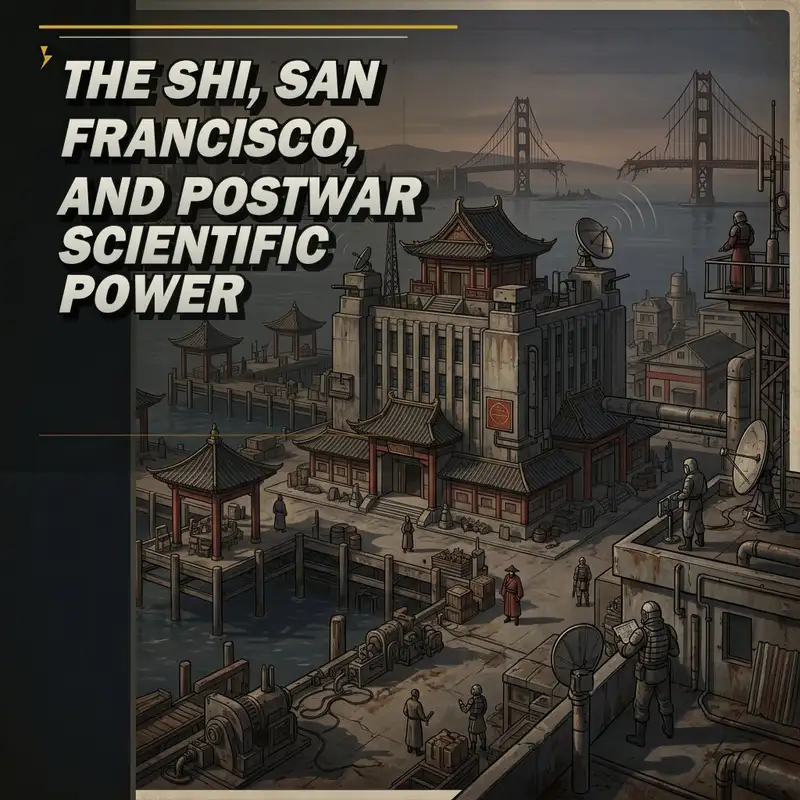
The Shi, San Francisco, and Postwar Scientific Power
Beneath the Steel Palace in ruined San Francisco, a community descended from a Chinese submarine crew consults a naval computer before it makes important decisions. The arrangement sounds like one of the old world’s more extravagant procurement mistakes. In practice, it is a serious answer to a serious postwar problem. The Shi possess records that most settlements lost, technical specialists who can interpret them, workshops that can repair sophisticated equipment, and a machine called the Emperor that can compare information and project possible futures. Yet even the Emperor cannot grow crops, recruit a population, guard every road, or decide what kind of political order its human caretakers ought to create. That is the central paradox of Shi power. By the year twenty-two forty-one, the Shi are among the most scientifically capable societies encountered in the western wasteland. Their district contains research programs, advanced weapons, restored power armor, fuel infrastructure, and a political leadership that treats information as a strategic resource. But San Francisco is not presented as the capital of a vast Shi empire. The Shi are powerful precisely because their expertise is concentrated and protected. That concentration also limits them. Their story is not about a forgotten superpower waiting to reclaim the coast. It is about a small society that preserved the machinery of science after the world that built it had died, then discovered that knowledge alone does not solve the harder problems of government.
The Emperor sits at the center of that system, but it should not be mistaken for an all-knowing artificial ruler. The Shi describe it as a naval computer inherited from their submarine, a system holding historical records, research data, and predictive models. It can identify patterns and generate possible outcomes. That gives its recommendations considerable weight in a world where most governments operate with damaged maps, oral memory, unreliable couriers, and whatever intelligence their scouts can bring home alive. But its predictions depend on the information fed into it. Its old naval records are corrupted in places. Its calculations cannot overcome deception, missing evidence, human ambition, or the simple fact that the wasteland changes faster than any archive can fully record. The Emperor is useful because it preserves institutional memory. It is not infallible because memory is not the same as understanding.
The Shi do not surrender all responsibility to the machine. Ken Lee serves as the Emperor’s public representative and practical interpreter. He explains the computer’s judgments, receives visitors, and turns technical forecasts into political decisions. That makes Shi government less like rule by a machine than rule through a machine. The computer supplies continuity, data, and an aura of long calculation. Human leaders decide what risks to accept, what secrets to keep, and whose interests to protect. This arrangement gives the Shi a considerable advantage over communities forced to rediscover every lesson through disaster. It also concentrates authority. A small circle that controls the archive, understands the system, and decides how to interpret its forecasts can make itself very difficult to challenge. The Emperor’s value is real. So is the political power gained by those who speak in its name.
That unusual government began with an unusual inheritance. The Shi trace their origins to the Shih-huang-ti, a Chinese nuclear submarine caught in the aftermath of the Great War. According to the Shi account preserved through Doctor Fung and others in San Francisco, the submarine survived the initial exchange but suffered failures that left it drifting for an extended period. Eventually, its surviving crew and associated personnel reached the ruins around San Francisco. The detailed record is limited, and it comes to later generations through Shi memory rather than a complete neutral archive. Still, the broad outline matters because it explains why this community possessed resources that few postwar settlements could match.
The submarine was more than a hull full of salvage. It offered shelter during the first dangerous years after the bombs. It provided metal, machinery, computer systems, technical documentation, and trained people accustomed to working within a disciplined organization. A submarine crew is not automatically a government, and military or naval training does not by itself make people wise rulers. But it does create habits that matter in a collapse. Personnel understand maintenance schedules. They understand that machinery fails when filters go unchanged, seals crack, power fluctuates, and spare parts disappear. They understand hierarchy, compartmentalized information, emergency procedure, and the difference between having equipment and keeping it operational. Those habits could be passed on, adapted, and eventually transformed into a civilian political culture.
The Steel Palace embodies that transformation. Built from salvaged material, it is both a fortified center and a founding monument. Its name evokes strength, but its real importance is institutional. Within and around it, the Shi preserved the means to organize technical labor. The submarine’s computer systems became the foundation of the Emperor. The survivors’ knowledge became the beginning of a specialist class. Their shared history became a claim to authority. In many wasteland settlements, an intact prewar machine is a treasure. In Shi-town, an intact machine can become part of a system of records, workshops, trained personnel, and political command. That is a far more durable advantage.
It is also why the Shi should not be understood merely as Chinese survivors living among ruins. By the year twenty-two forty-one, they are a postwar society with its own hierarchy, routines, interests, and political identity. Their founding story links them to the submarine and to a remembered China, but generations of life in San Francisco have made them something distinct. They are not a restored prewar navy, and they are not a simple remnant waiting for orders from across the Pacific. They are a local power shaped by inherited discipline and technology, but also by the needs and dangers of the California wasteland.
San Francisco gave that community opportunities that an inland bunker could not provide. The city’s coastal position offered access to docks, maritime facilities, commercial traffic, and the remains of industrial infrastructure. Its ruined urban core contained salvage, workshops, storage sites, and technical systems worth recovering. The harbor connected the Shi to ships, tanker facilities, and a wider world of movement and trade. A coastline does not guarantee prosperity, especially after nuclear war, but it creates possibilities. Goods can move by water. Fuel systems can serve maritime traffic. Docks can become marketplaces, repair yards, or points of control. A settlement that can maintain even part of that infrastructure holds leverage over people who cannot.
That leverage should not be exaggerated into territorial rule over all San Francisco, much less the entire Bay Area. The city contains multiple communities, competing institutions, transients, traders, and groups with their own interests. The game presents Shi-town as a major local district, not as a complete survey of every neighborhood, shoreline, or inland route. Even a technologically capable community could not simply declare a ruined metropolis its possession and make that claim meaningful. Control requires patrols, food distribution, dispute resolution, taxation or trade agreements, labor, and enough force to enforce decisions beyond the palace walls. The Shi have influence. They have protected assets. They have local authority. That is not the same thing as governing every mile of surrounding territory.
The geography that gave San Francisco its advantages also imposed limits. Harbors and docks require maintenance. Pipelines need technicians, tools, replacement parts, and security. Ruined streets can conceal valuable facilities, but they also complicate movement and create places where rivals can hide. The wider wasteland remains difficult to cross. Roads are unreliable. Long supply lines are vulnerable. Trade depends on escorts, reputation, repair capacity, and the willingness of neighboring communities to exchange goods rather than seize them. San Francisco could function as a technological and commercial node without becoming a self-sufficient industrial nation. Its importance came from connection, not isolation. The Shi were strongest where they could keep those connections working.
Their scientific culture was the most important of those connections. The Shi do not merely possess a few advanced devices recovered from prewar ruins. They maintain research as an organized social activity. Their work extends across physics, chemistry, biology, botany, medicine, armor development, alternative fuels, radiation-resistant plants, polymers, nuclear power, and space-related technologies. Not every project succeeds. Some are discontinued. Some produce only partial results. Some reveal that an attractive theory cannot survive contact with contaminated soil, limited materials, unstable power, or the practical needs of a population trying to eat and defend itself. That uneven record is evidence of genuine research rather than evidence of failure.
Science is not a cabinet of finished inventions. It is a process of asking questions, keeping records, testing possibilities, identifying mistakes, and changing direction when a project does not work. The Shi retain enough institutional continuity to preserve that process. They have specialists who can build on earlier work rather than beginning from rumor. They have departments that can divide labor. They have archives that retain results, including unsuccessful ones. They have political leaders willing to allocate scarce labor and resources to work whose payoff may be uncertain. In a postwar world, that is an extraordinary form of power.
A farmer who knows how to improve one field has knowledge. A mechanic who repairs one generator has knowledge. A scavenger who can identify a useful circuit board has knowledge. The Shi possess those kinds of knowledge, but their advantage lies in organizing them. They can connect biological research to agriculture, materials research to armor repair, chemistry to fuel systems, and computer records to planning. The result is not technological omnipotence. It is an ability to make technical decisions with more depth than most nearby communities can manage. That gives them options. It does not remove constraints.
Their restoration of T fifty-one power armor is a useful example. Restoring a prewar suit to working condition requires more than finding it in a warehouse. It requires compatible parts, tools, diagnostics, materials, and people who understand what they are repairing. The Shi can perform that kind of work, and they trade advanced equipment that confirms their unusual repair and fabrication capacity. But a restored suit is not a factory line. A merchant’s inventory is not proof of mass military issue. The evidence establishes that the Shi can repair, modify, and make sophisticated equipment. It does not establish that they can equip a large army with power armor or replace every loss in a sustained campaign.
The same distinction applies to Shi research into alternative fuels, advanced materials, and nuclear systems. A laboratory can investigate a fuel source without building a stable regional energy grid, develop a promising polymer without possessing the mines, refineries, transport, and quality control needed for large-scale production, or study nuclear power without operating a secure network of reactors. In the wasteland, technical success becomes a logistical test of materials, maintenance, training, security, and distribution. The Shi understand that a discovery that cannot be sustained or shared without creating new dependencies is not yet a durable capability. That is one reason they remain cautious.
The Emperor helps them manage caution. A computer that stores history and runs projections can identify opportunities that a human leader might overlook. It can compare present conditions with old records. It can model possible outcomes. It can preserve data through the death or retirement of individual experts. For a small society, that continuity is invaluable. A settlement whose only engineer dies may lose the ability to repair its water system. A research culture that keeps records can train a successor. A government that can consult centuries of retained information is less likely to lose every lesson with one bad season, one assassination, or one damaged terminal.
But the Emperor’s limits are just as important as its abilities. It cannot see beyond its available data. If scouts report incomplete information, its forecasts begin with incomplete information. If an enemy deceives the Shi, the computer may calculate from false premises. If a new threat appears outside the models stored in its archives, its predictions may be less useful than the confidence placed in them. Its damaged naval files are a reminder that even sophisticated systems inherit the failures of the old world. A computer can preserve records, but it cannot guarantee that the records are complete, accurate, or still relevant.
Nor can it settle political questions. The Emperor may identify the likelihood that a policy produces stability, but stability for whom? It may calculate the risk of admitting outsiders, but it cannot decide whether exclusion is just. It may project the benefits of secrecy, but it cannot determine whether a society can remain healthy when knowledge is concentrated in a closed elite. Those choices remain human. Ken Lee and the Shi leadership retain judgment, and therefore retain responsibility. The Emperor’s authority depends partly on its demonstrated usefulness, but also on the willingness of Shi society to accept the political system built around it.
That system appears hierarchical, guarded, and suspicious of outsiders. The Shi can claim legitimacy through competence. They provide security within their district. They maintain technology that other communities value. They preserve a historical identity. They offer visible evidence that organized knowledge can survive in a fractured world. For residents who remember hunger, raiding, broken machines, and unsafe water, competent administration is not an abstract virtue. It is a form of protection. A laboratory that improves crops, a workshop that repairs equipment, and a guard force that keeps predators away all make political claims in practical language.
Yet competence is not the same as broad consent. Shi society is not simply a community of equal scientists gathered around a helpful computer. It includes leaders, researchers, guards, merchants, workers, dock personnel, food producers, and people whose access to information and influence is uneven. The palace and its technical institutions stand above a wider civilian economy. People must still work, trade, maintain facilities, prepare food, move supplies, and live with decisions made by others. The Shi’s scientific achievements depend on that labor even when the political story of the community emphasizes the palace, the Emperor, and the specialists.
Their security practices reveal the harder edge of their system. The Shi are willing to use surveillance, covert action, and coercive measures to protect their interests. That does not make them uniquely monstrous by wasteland standards, but it does prevent any easy picture of enlightened technocracy. A small community holding valuable knowledge has reason to fear theft, infiltration, sabotage, and outside domination. It may also use those fears to justify secrecy and harsh control. The same concentration that protects specialists can isolate them from criticism. The same intelligence network that warns of threats can become a tool for enforcing obedience.
Their command of fuel and maritime infrastructure demonstrates what their technological power looks like in practical terms. The Shi have access to elements of the Poseidon fuel network and can work with systems connected to the tanker facilities around San Francisco. This matters because fuel is not merely an object stored in a container. Its strategic value comes from the network around it. Someone must know where it is. Someone must maintain the pipes, pumps, storage systems, and controls. Someone must secure the facility from theft and sabotage. Someone must have the tools and expertise to determine whether the fuel remains usable and how it can be moved. The Shi’s advantage lies in operating that connected system.
The tanker and its vagrant population make the point clearly. A ship can be a refuge, a transport platform, and a symbol of mobility. It can also become a trap when it lacks fuel, navigation capacity, repairs, or a safe place to dock. The people associated with the tanker occupy an uncertain social position. They are mobile, marginal, and dependent on technical systems they do not fully control. Their need for assistance gives the Shi bargaining power. In the postwar economy, the group that can repair a navigation system or redirect fuel may hold more influence than the group that owns the hull.
That does not mean the Shi control everyone who needs their services. Infrastructure creates leverage, not absolute command. A tanker crew or dockside community can negotiate, evade, seek another patron, or become a problem in its own right. The Chosen One can also influence specific events involving the tanker and its future. Those possible outcomes depend on player action and should not be treated as one settled history. What is fixed is the larger relationship. The Shi possess the technical competence to interact with fuel and tanker systems that most wasteland communities could not manage. That competence makes San Francisco relevant far beyond the walls of Shi-town.
That connection puts the Shi in competition with the Hubologists. It is tempting to treat the Hubologists as a joke because their beliefs and language can be absurd, and because their project carries the extravagant confidence of a prewar sales pitch that survived the apocalypse. But they are not harmless comic relief. They are a wealthy and organized local institution with recruitment systems, coercive practices, access to resources, and an ambitious spacecraft project. Their interest in advanced technology, fuel, and infrastructure brings them into direct conflict with the Shi. This is not simply rational scientists arguing with eccentric believers. It is a struggle between rival organizations over who will control scarce technical capacity and what that control will mean.
The Shi seek to preserve knowledge within a guarded research-oriented system. The Hubologists pursue transcendence through a mixture of doctrine, wealth, technical ambition, and manipulation. Both understand that old-world technology can create political authority. Both recognize that infrastructure can transform claims into influence. A functioning spacecraft project, or even the credible promise of one, can attract followers, labor, money, and loyalty. It can persuade desperate people that escape is possible. It can make a faction appear connected to a future beyond the ordinary scarcity of the wasteland.
The difference lies partly in institutional method. The Shi emphasize research administration, technical specialization, and controlled access to information. The Hubologists combine technological aspiration with a hierarchy that can exploit vulnerable recruits. Their conflict is therefore about more than who has the better engineers. It is about what kind of authority advanced technology will serve. One system offers security, expertise, and secrecy. The other offers revelation, advancement, and a path out of misery, while also placing followers inside a coercive organization. Neither can be understood only through its public language.
The people caught between such institutions matter. Residents, workers, transients, dock laborers, and recruits can become assets in a contest over fuel, information, and machinery. Technical projects require labor. Research compounds require supplies. Security operations require informants and people willing to take risks. A faction’s claim to a better future can be sincere and still turn human beings into instruments. The Shi’s dealings with the Hubologists can involve covert action and outside assistance, including possible intervention by the Chosen One. Those specific resolutions vary. The fixed historical point is that San Francisco contains a genuine local struggle over advanced infrastructure and political influence, not a simple clash between wisdom and foolishness.
The Shi Guard is the force that protects the community’s core. It is described as small but effective, equipped with high-technology weapons and oriented toward the defense of Shi-town. That role fits the Shi’s broader strategy. A compact, well-armed guard can defend key entrances, leadership centers, research facilities, workshops, and stores of valuable equipment. It can deter opportunistic raiders. It can enforce local order. It can protect negotiations by making clear that visitors are dealing with an organized authority rather than an undefended market.
What it cannot automatically do is become an army of regional occupation. No reliable record provides a full Shi order of battle, and there is no reason to invent one from the number of guards visible in a single district. But the strategic problem is clear. Holding a compact urban center is different from controlling distant roads, patrolling the entire Bay Area, escorting every caravan, suppressing rival communities, or replacing losses over a prolonged campaign. Advanced weapons improve a guard’s tactical performance. They do not create unlimited manpower, transport, food, medical support, ammunition, repair capacity, or administrative reach.
The Brotherhood of Steel outpost in San Francisco illuminates another aspect of Shi power. The relationship between the two groups is cooperative, but limited. The Brotherhood recognizes the value of advanced technical knowledge and seeks information, especially material connected to Vertibird technology. The Shi possess archives, specialists, and facilities that make them worth dealing with. This suggests a relationship between technological peers or near-peers in a narrow field, not a relationship of simple subordination. The Brotherhood does not own the Shi. The Shi do not command the Brotherhood. Each has something the other values, and each has reasons to restrict what it shares.
That is an important difference from the usual image of postwar technology as a prize to be grabbed. Technical information is useful only when an institution can interpret, protect, and employ it. A set of plans may be priceless to one faction and nearly meaningless to another. Without skilled labor, tools, materials, test facilities, and a secure industrial base, even excellent blueprints remain paper or data. The Shi understand that problem because their entire society is built around the gap between inheritance and use.
The Vertibird plans recovered from Navarro make the point with unusual clarity. The Chosen One can obtain those plans and can deliver them to the Shi. If that occurs, Doctor Wong stores the material in the Shi database, and the Emperor’s records project the possibility of producing a prototype within roughly a year, followed by wider production later. But those are technical forecasts made under particular conditions. They are not evidence that the Shi later fielded an air force, established a mature aircraft industry, or covered California with Vertibird patrols. The transfer itself is player-dependent. Even if it occurs, the plans represent an opportunity, not a completed strategic transformation.
Building a working aircraft is among the most demanding forms of industrial activity. It requires suitable materials, precision tools, engines or power systems, skilled mechanics, testing procedures, maintenance crews, replacement parts, secure landing areas, trained pilots, fuel or energy supply, communications, and doctrine. An aircraft that can fly once is not necessarily one that can fly safely, repeatedly, and under hostile conditions. A small fleet is not the same as a regional air arm. Even a successful prototype can consume resources that might otherwise sustain workshops, defenses, or civilian infrastructure.
This is where the Shi’s scientific strength and political limits meet. They can absorb complex information into an existing research system. They can assess it, model possibilities, and perhaps develop it further. That is remarkable. But scaling technology requires a broader base than a protected enclave can easily provide. It requires workers beyond the laboratory, secure supply chains beyond the city district, and a governing structure capable of supporting expensive systems over time. The Shi can preserve and advance knowledge without necessarily possessing the territory, population, and economic depth needed to turn every breakthrough into regional military power.
The later record supports caution. Fallout: New Vegas confirms the destruction of the Enclave oil rig, but it does not provide a definitive political history of San Francisco after the events of Fallout 2. It does not establish which local endings occurred, whether the Hubologists prevailed or failed, how the tanker’s story concluded, or whether the Shi expanded, contracted, or simply endured. The absence of a detailed later account is not proof that the Shi vanished. It is also not permission to invent their empire.
Fallout 4 provides one narrow but useful confirmation. Conrad Kellogg spent part of his early adult life in San Francisco and worked for the Shi before moving east. His memories are personal and far from neutral. They do not offer a census, a constitutional history, or a reliable survey of the city’s political boundaries. But they confirm that the Shi remained relevant enough, decades after the year twenty-two forty-one, to employ capable outsiders. They also support the impression that San Francisco remained politically distinct from direct New California Republic rule during at least part of Kellogg’s time there.
That is meaningful, but limited. It does not tell us how far Shi authority reached, how their government changed, what became of the Emperor, or whether their research programs produced lasting industrial growth. It does not settle their relationship with the New California Republic. It does not reveal their population, military strength, or final fate. The surviving record allows a picture of persistence, not a complete chronicle. That uncertainty fits the subject. Small postwar powers can remain important without leaving the kind of history written by large states and conquering armies.
The Shi demonstrate that scientific power in the wasteland comes less from possessing intact machines than from preserving the capacity to understand them. Their submarine inheritance mattered because trained survivors could organize it. The Emperor mattered because it preserved information across generations. Their laboratories mattered because specialists could test ideas, record results, and learn from failure. Their restored armor mattered because workshops could repair complex systems. Their access to fuel mattered because technicians, docks, pipes, and security turned an old resource network into practical leverage. Their dealings with the Brotherhood and the Hubologists mattered because technology is never only technical. It is always tied to authority, labor, trade, coercion, and the question of who gets to decide how a scarce capability will be used.
The Emperor gives the Shi continuity, but it also helps centralize power. The system depends on confidence in a secretive governing circle and in the judgments of people who interpret the machine’s forecasts. Civilians within Shi society may benefit from unusual security and technical capacity, but that does not make their community an open scientific commonwealth. Outsiders encounter a guarded hierarchy. Lower-status workers and vulnerable transients live in a city where advanced knowledge is both a source of protection and a source of control.
San Francisco’s Shi did not fail because they lacked intelligence, ambition, or technology. Their limits came from the same conditions that constrain every postwar state. Knowledge must be fed. Machines must be repaired. Experts must be replaced. Roads must be secured. Trade must be maintained. Neighbors must be persuaded, deterred, or accommodated. A laboratory can defend a district without governing a region. A computer can preserve the past without deciding a just future. The Shi endured because they made science into an institution. They remained a concentrated power because preserving knowledge is not the same thing as distributing power.