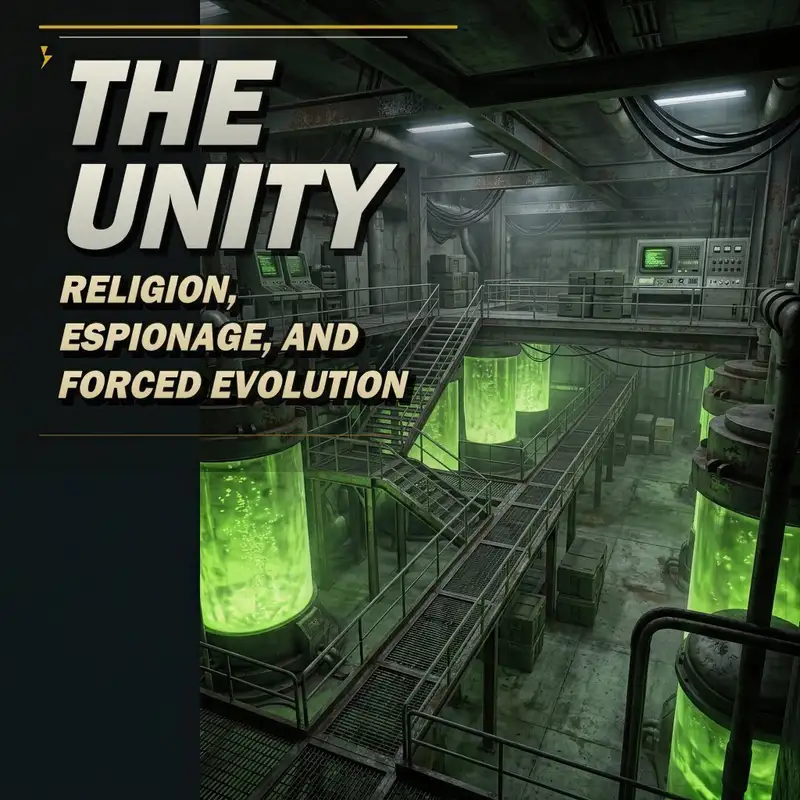
The Unity: Religion, Espionage, and Forced Evolution
A traveler entering a settlement in southern California might have encountered the Unity first as a kindness. The Children of the Cathedral offered healing, food, shelter, spiritual reassurance, and a language for making sense of a wounded world. They spoke of the Holy Flame, rebirth, and the end of division. In a region where medicine was scarce and danger traveled the roads with every caravan, that message had practical weight. A person did not need to be foolish, desperate, or corrupt to listen. They might simply need treatment, safety, or a place to belong.
Behind that charitable face stood a very different institution. The Children did not merely preach salvation. They helped identify recruits, observe communities, conceal the existence of the Master, and direct selected people toward a program of forced transformation. The movement promised peace by ending the divisions of humanity. Its method was to erase humanity as it existed, one captive, convert, and conquered settlement at a time. The Unity did not arrive first as an army at the gate. It arrived as a service organization, quietly learning who lived behind the gate and what they could be made to become.
That method made sense in the California of the late twenty-second century. The region was not empty, and it was not without order. Settlements such as Shady Sands, Junktown, the Hub, and Necropolis had leaders, customs, defenses, trade, and social life. The Hub supported caravan commerce. Junktown enforced a rough local authority. Shady Sands had begun to build a more stable agricultural community. Even isolated places retained networks of kinship, labor, barter, and memory.
But these communities did not form a unified security system. Roads were dangerous. Information moved slowly and unevenly. A caravan master might know more about conditions along one route than a town leader knew about events a short distance beyond the next ridge. Medical facilities were limited. Radio communication existed, but it was neither universal nor automatically trusted. Local leaders had immediate concerns: water, crops, raiders, trade disputes, hired guards, and the next shipment of supplies. A regional threat could grow inside those gaps before anyone possessed a complete picture.
The Unity exploited fragmentation without needing to control every settlement. A visible super-mutant force would have announced danger immediately. Human missionaries, healers, and followers could move through ordinary communities with far less alarm. They could offer help, hear rumors, identify vulnerable people, and study the movement of caravans. The Cathedral’s public presence gave the Unity something that an army of heavily armed mutants could not easily create on its own. It gave the organization access.
The man at the center of this project had not begun as a warlord. Richard Grey had been a human doctor and philosopher associated with Vault Eight. The surviving account of his early life is incomplete, and some detailed timelines come from supplementary developer material rather than the released narrative itself. The broad outline, however, is clear. In the years after the Great War, Grey joined an expedition investigating the old Mariposa Military Base, a pre-War installation connected to the Forced Evolutionary Virus.
At Mariposa, Grey fell into a vat containing the virus. The exposure did not produce a simple or immediate transformation. Over time, his body and mind changed in ways that left him no longer recognizably human. He became the being later called the Master, a composite and increasingly powerful intelligence embedded within the remnants of the base. The physical transformation mattered. Yet the political transformation mattered more. Grey did not merely survive exposure to F E V. He came to see F E V as an answer to the problems that had destroyed the old world.
The Forced Evolutionary Virus had been created before the war for military purposes. In the Master’s hands, it became the machinery of a new social doctrine. The transformed beings produced through it appeared, in many cases, stronger, more resistant to disease and radiation, and physically better adapted to the wasteland than ordinary humans. Those qualities were real enough to make the Master’s argument seem plausible to himself and to some of his followers.
But he drew a much larger conclusion from them. The Master believed that humanity had destroyed itself because it was divided: by nation, race, class, ideology, fear, and competing interests. If humanity could be remade into a single new population, he reasoned, those divisions could be ended. The Unity would not merely defeat its enemies. It would eliminate the conditions that made enemies possible.
This was not a conventional program of conquest. A conventional conqueror seeks tribute, territory, labor, obedience, or security. The Master wanted replacement. His intended state was a world in which ordinary humanity had been absorbed, transformed, or removed as a political force. The new population would be biologically similar, directed toward a common purpose, and freed, in his view, from the old world’s destructive distinctions.
There is a cold internal logic to that idea. The Master had seen the ruins of human civilization. He had seen evidence of military experimentation, nuclear destruction, and post-War brutality. He was not wrong to conclude that humanity had produced systems of extraordinary violence. His failure was to treat difference itself as the cause of that violence. He mistook uniformity for peace. He treated consent as an obstacle to survival. And he treated resistance to transformation as proof that the untransformed could not be trusted with their own future.
That made the Unity’s promise of equality fundamentally coercive. Everyone could join, in theory, but only by ceasing to be what they were. The movement condemned prejudice while dividing the world into those fit for transformation, those useful as raw material, and those who stood in the way. It claimed to abolish hierarchy, yet it placed the Master above every decision and gave his military officers the authority to impose his vision by force.
An ideology this ambitious required more than a laboratory and an army. It required a way to make transformation appear meaningful, even sacred. That was the role of the Children of the Cathedral. Their public faith translated the Master’s biological program into a moral language that ordinary people could hear. Mutation became rebirth. Submission became enlightenment. The destruction of the old self became the beginning of a more unified world.
Morpheus served as the visible human leader of the Children. He managed the human-facing side of the organization while the Master remained concealed as its ultimate authority. This separation was politically useful. The Cathedral could appear to be a religious movement with its own rituals, healers, guards, and followers. It did not need to announce that it served an expanding super-mutant state operating from an old military base.
The Children were not all identical, and treating them as identical misses why the organization worked. Some followers appear to have been committed believers. Others may have been frightened, dependent, opportunistic, or drawn in by real material benefits. A guard could be employed for protection rather than theological conviction. A sick person could accept medical care without understanding the larger system behind it. A person facing hunger or isolation might find the Cathedral’s order more attractive than life beyond its walls.
That complexity does not excuse the organization. It explains its strength. Authoritarian movements rarely survive on deception alone. They build influence when they meet needs that existing institutions fail to meet. The Cathedral could offer food, healing, discipline, companionship, and certainty. In a fractured wasteland, those were not trivial gifts. They were the foundations of social power.
Religion also provided a vocabulary for obedience. A medical procedure can be questioned. A sacred rebirth is harder to question when everyone around you has been taught that doubt is fear, fear is weakness, and weakness belongs to the dying world. The Unity did not invent the use of belief for political control. Pre-War governments, corporations, and military institutions had all wrapped power in reassuring language. The Cathedral simply adapted that old habit to a new form of rule.
Its espionage work grew naturally from its public role. Human missionaries could travel through settlements, speak with residents, offer aid, and observe conditions without provoking the reaction that a super-mutant patrol would provoke. They could learn which communities were divided, which routes carried valuable traffic, where defenses were weak, and which people might be recruited or abducted with limited resistance.
Supplementary material outside the released games describes the Children as the Master’s eyes and ears. That description should be treated cautiously, because it comes from the Fallout Bible rather than binding game narrative. Yet the broader conclusion does not depend on that phrase. The released story shows the Cathedral’s hidden affiliation, its recruitment role, its concealment of the Master, and its presence in the same political environment targeted by the Unity. The organization plainly functioned as more than a church.
Its intelligence network had limits. The Unity was dangerous, but it was not omniscient. Communities could be suspicious. Local leaders could resist. Travelers carried rumors. Caravan traffic could spread warning as well as provide targets. The Brotherhood of Steel, despite its isolation and narrow institutional priorities, retained scientific and military knowledge that the Unity had to take seriously. The Master’s organization had penetrated parts of the region, but it had not converted California into a perfectly monitored police state.
Information mattered because the Unity needed a continuing supply of people. The Master’s project depended on F E V conversion, and conversion depended on access to human bodies. The organization did not simply recruit a population that volunteered to become super mutants. It seized people, tested them, transformed some of them, and disposed of others when they failed to serve the project.
At this point the language of salvation becomes a system of extraction. The Unity needed intelligence on settlements, caravan routes, and Vault locations because it viewed human beings as both potential subjects and biological resources. A healthy captive might become a soldier. A Vault population promised people with less environmental exposure. Every disappearance could feed another attempt to expand the mutant population. The Cathedral’s humanitarian face therefore supported something much harder beneath it: a network that converted knowledge about ordinary communities into access to bodies the Master’s project required.
The Master and his officers placed particular value on what they called prime normals. Their reasoning was straightforward. People who had spent generations in sealed Vaults were thought to have experienced less radiation and mutation than the wider wasteland population. The Unity believed they would produce better results when exposed to F E V. That made Vaults strategically important, not merely as shelters full of supplies or records, but as reservoirs of human beings the Unity considered biologically useful.
The search for Vault populations reveals the true character of the project. The Master’s vision was universal, but it could not proceed through persuasion alone. It required intelligence collection, kidnapping, secure transport, guards, laboratories, and a facility capable of carrying out transformation. It also required a willingness to treat the disappearance of a caravan guard, a traveler, or a Vault resident as an administrative step toward a better future.
For civilians, this was not an abstract ideological conflict. It changed the meaning of travel, trust, and care. A stranger offering help might be sincere, compromised, or part of a hidden network. A missing relative might not have been killed in a raid. They might have been taken alive for conversion. A settlement’s need for medicine could create an opening for the very organization that intended to erase its independence.
The Unity’s military arm gave this system its coercive force. Super-mutant soldiers could be formidable opponents. Their physical strength, resilience, heavy weapons, and intimidation value gave them a major advantage over isolated communities with limited defenses. A settlement militia might be able to deter raiders, escort a caravan, or defend a barricade. It was far less prepared to face disciplined or heavily armed mutant forces connected to a larger ideological project.
The Lieutenant represented the hard military edge of the Unity. He was not merely a guard posted near the Master’s base. He was a senior officer who understood the transformation program as a strategic necessity. In his view, the Unity was not committing senseless brutality. It was imposing a harsh cure on a species too divided and fragile to survive. That conviction made negotiation difficult. The organization’s leaders did not see resistance as a legitimate political choice. They saw it as evidence of the very human disorder they claimed to be ending.
Still, the super-mutant army should not be imagined as a flawless modern force. The exact size of the Unity’s military is not established, and the number of enemies encountered in the game cannot be treated as a census. Its soldiers also varied. Some were intelligent and disciplined. Others suffered losses of memory, personality, or cognitive ability after transformation. Some believed deeply in the Master’s mission. Others may have understood only their immediate orders, loyalties, or need for survival.
Military strength did not remove dependence. The Unity still needed weapons, ammunition, food, secure movement, command relationships, intelligence, and facilities where new mutants could be created. It needed officers capable of organizing force. It needed routes through a dangerous landscape. Most importantly, it needed access to Mariposa. Without the base and its F E V systems, the Unity could inflict violence, but it could not sustain its central demographic project.
That distinction is essential. The Unity possessed battlefield capability, but it did not possess self-sufficiency. It could overmatch many fragmented local defenses. It could raid, intimidate, abduct, and seize ground. Yet every new super mutant depended on an older chain of systems: pre-War research, surviving equipment, functioning vats, human captives, trained personnel, and security around a single critical installation. The movement that claimed to have surpassed the old world was, in practical terms, dependent on one of the old world’s most sinister military laboratories.
Mariposa was therefore more than a headquarters. It was the Unity’s industrial bottleneck. The base held the means by which the Master intended to turn a regional movement into a replacement civilization. Possessing F E V was not the same as understanding every aspect of it. Understanding it was not the same as manufacturing it freely. And using the existing vats was not the same as building a resilient, distributed system capable of surviving the loss of a single site.
The Unity’s apparent biological future was concentrated in a vulnerable piece of inherited infrastructure. That created a strategic weakness. A state can survive the loss of a command post if it has institutions, trained replacements, local legitimacy, and multiple sources of supply. The Unity had none of those in reliable form. Its authority was centralized around the Master. Its transformation process centered on Mariposa. Its military expansion depended on a pipeline that could be interrupted at several points.
The Brotherhood of Steel mattered in this context because it retained scientific knowledge and access to technical expertise. The Brotherhood’s relationship to the crisis was not simple altruism. It was a secretive military order with its own traditions, fears, and interest in controlling dangerous technology. Its priorities were not automatically identical to those of the Vault Dweller or the surrounding settlements. But its research capacity proved strategically important because it could identify a flaw in the Master’s central premise.
Head Scribe Vree’s work established that the super mutants she studied could not reproduce. The biological details are less important than the consequence. The transformed population at the heart of the Unity was sterile. The Master had believed he was creating a new humanity that could replace the old one. Instead, he had created a population that could expand only by continuously transforming outsiders.
This discovery changed the meaning of every Unity success. A battle victory could still destroy an enemy force. A raid could still bring back captives. A converted human could still become a powerful soldier. But none of this created a self-replacing population. The Unity could grow only as long as it captured more people, held more facilities, and maintained the machinery of conversion.
Sterility did not merely expose a scientific error. It exposed a strategic impossibility. A society that cannot reproduce must either find another means of sustaining itself or remain permanently dependent on conquest. The Master’s promised peace could never arrive. Even if the Unity had conquered every settlement within reach, it would still need to seize future generations, control every surviving human community, and preserve the aging machinery of Mariposa.
The political implications were just as severe. The Unity claimed to offer a final end to conflict, but its demographic model required endless coercion. It could not tolerate independent human populations because those populations were both ideological rivals and the only source of future members. It could not allow consent to matter because many people would refuse transformation. It could not stop expanding because cessation meant decline.
This was the deeper contradiction at the center of the Master’s vision. The Unity condemned humanity for cycles of violence while building a state that required permanent abduction. It promised equality while making bodily autonomy conditional on obedience. It claimed to end the struggle for survival while depending on the continued existence of vulnerable people to convert. The moment the Master accepted sterility as true, the project ceased to be a difficult dream and became a dead end.
The collapse of the Unity did not occur through one single, universally established sequence of events. The Vault Dweller is a player-defined figure, and the paths through the conflict can vary. The Master can be confronted with the evidence of mutant sterility. The Cathedral can be exposed and destroyed. Mariposa can be attacked and sabotaged. Key officers can be killed. The details depend on choices made during the course of the game, and those possible routes should not be compressed into one invented historical biography.
The broad consequence is clearer. The Master was destroyed, and the Unity collapsed as a centralized organization. Its principal leadership, its covert human network, and its critical conversion infrastructure could not absorb the loss. The organization had been designed around a single ideological authority and a narrow set of essential systems. Once those systems failed, there was no durable civilian government, local administration, or accepted political structure ready to carry the project forward.
Destroying the Unity’s key leaders and facilities did more than win a sequence of fights. It severed the chain that connected human intelligence, abduction, transport, and F E V conversion, and it ended the Master’s attempt to replace humanity with a single transformed population. The speed of the collapse exposed the organization’s underlying weakness. What had looked like an emerging state was still a tightly controlled emergency regime built around one leader, one doctrine, and one inherited military installation.
For civilians, the immediate danger receded, but the damage did not vanish. Communities had lost people. Caravan routes had been threatened. Trust had been poisoned by the revelation that a charitable religious movement had served a violent program of transformation. Former Unity members remained in the region. Some were dangerous. Some were confused, displaced, or left without the authority structure that had given their lives purpose. The end of the Master did not restore every person who had been taken.
Later history makes that final point important. The destruction of the Unity did not erase all of its super mutants. They did not disappear into a single fate. Some became isolated, violent, or predatory. Others found ways to live among humans or build communities apart from the Master’s doctrine. Broken Hills, and later Jacobstown, show that former Unity members could participate in societies not founded on forced conversion.
Marcus is especially useful in understanding that distinction. As a former member of the Unity, he could recognize part of the Master’s diagnosis without accepting the Master’s solution. The wasteland remained divided. Human societies remained capable of greed, cruelty, war, and exclusion. The failure of the Unity did not prove that the old world’s problems had vanished. It proved that biological supremacy and conquest could not solve them.
The Unity failed because it tried to make peace by abolishing consent, diversity, and autonomy. Its Cathedral could persuade, comfort, recruit, and observe. Its army could intimidate and seize. Mariposa could transform the captured into soldiers for a new order. But none of those systems could turn coercion into legitimacy. Sterility exposed the final weakness, yet the flaw had been present from the beginning. The Unity was not a civilization capable of sustaining itself. It was a permanent emergency regime, dependent on conquest, abduction, and the old world’s machinery of control.