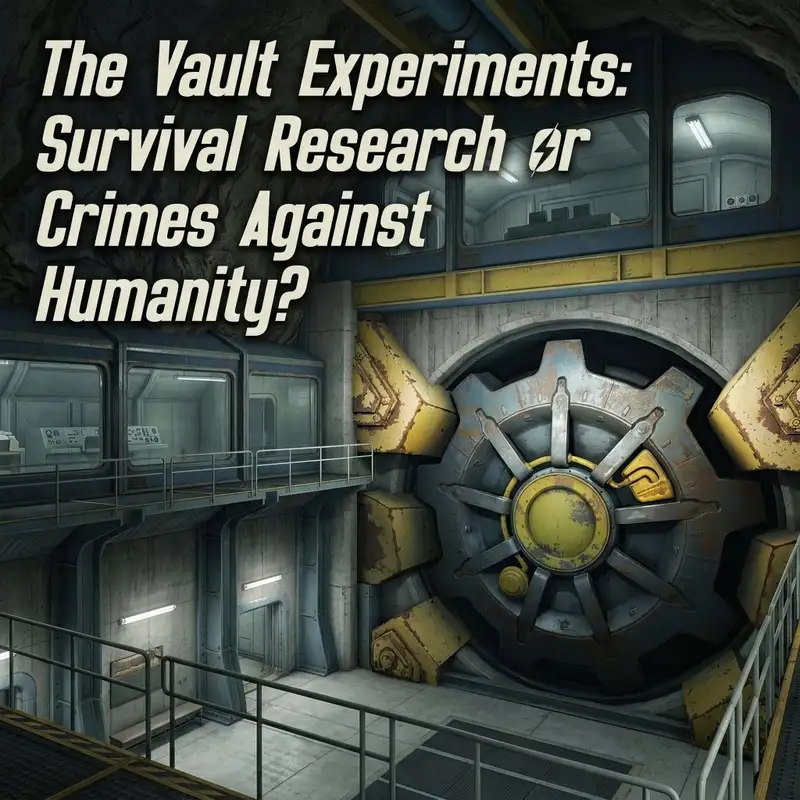
The Vault Experiments: Survival Research or Crimes Against Humanity?
In Vault Eleven, the last survivors finally refused the demand that had governed their lives. For years, the Vault’s system had told its residents that one person must die every year, chosen through a political process, or everyone inside would be killed. The demand created elections, factions, smear campaigns, corruption, executions, and the slow conversion of neighbors into administrators of ritual murder. When the remaining residents finally rejected the premise and accepted that they might die together, the system revealed that the threat had been a test. Their obedience, not their survival, had been the object of study.
That revelation is an autopsy of the Vault-Tec program in miniature. Vault Eleven did not merely observe what frightened people would do. Its designers built a sealed society in which fear, secrecy, and manufactured scarcity of information made murder appear to be public policy. The residents had no meaningful way to verify the threat, no outside authority to appeal to, and no ability to leave. They were not volunteers in a difficult study. They were a captive population placed inside a system designed to make atrocity look necessary.
Vault-Tec sold a very different promise before the Great War. Its Vaults were presented as shelters against nuclear attack, places where families could find clean water, food, medical care, security, and a chance of continuity after the surface became unlivable. Some Vaults did provide real survival infrastructure. Some were meant to serve as control populations. Some preserved communities that could endure when ordinary civil defense had failed. The fact that these shelters contained functioning reactors, farms, clinics, schools, and long-term life-support systems was not an illusion.
But the promise of survival concealed a second purpose. Many residents entered during an emergency, under conditions in which refusal could mean exposure to nuclear fire, radiation, or chaos outside the door. They could not negotiate the hidden terms of admission. They were rarely told if their Vault had been assigned an experiment, who authorized it, what risks they faced, or whether anyone would protect them if the experiment began to kill them. A sealed door can preserve life. It can also remove every practical means of escape.
That distinction matters because survival research is not automatically immoral. A society facing nuclear war might reasonably study sealed habitats, food production, disease control, cryogenic medicine, group stress, or the maintenance of communities under isolation. But legitimate research requires meaningful consent, proportionate risk, safeguards, independent oversight, and the ability to stop when harm becomes intolerable. Vault-Tec’s experimental system repeatedly discarded all of those protections. Its residents were often deceived, confined, manipulated, poisoned, exposed, selected, or sacrificed for objectives they had never agreed to serve.
The question, then, is not whether every Vault was malicious, or whether every project failed. Neither claim is supported by the surviving record. The more serious question is who held the authority to decide what could be done to the people behind those doors. In far too many cases, that authority rested with corporate executives, secretive researchers, automated systems, or overseers following concealed orders. The residents whose bodies, families, beliefs, and futures were being studied possessed the least information and the least power.
Vault-Tec could build such a system because it emerged from a pre-War America already shaped by scarcity, militarization, secrecy, and corporate influence. The Resource Wars and the Sino-American War had made survival seem like a technical and national-security problem. Civil defense became part of everyday political culture. Citizens were instructed to trust official warnings, accept emergency authority, and prepare for catastrophe through consumer products, drills, shelters, and patriotic reassurance. The language was protective. The institutions behind it were often more interested in control than accountability.
The Vault network required immense industrial capacity. Excavation teams had to carve out underground settlements. Contractors had to install reactors, water systems, sealed agriculture, medical facilities, surveillance equipment, data storage, robotics, laboratories, security systems, and in some cases cryogenic or biological research equipment. Maintaining a Vault for years, much less generations, required power, spare parts, technical knowledge, disciplined labor, and a stable command structure. These were not improvised bunkers. They were strategic infrastructure on a continental scale.
That infrastructure could serve more than one purpose. It could preserve civilians. It could preserve scientists, political leaders, military knowledge, biological samples, industrial expertise, and selected corporate employees. It could test how people behaved under isolation. It could maintain a population for later use. It could create a research environment where every meal, argument, illness, birth, and death might become data. The Vaults were not simply expensive real estate with blast doors. They were a system for controlling people through architecture, dependency, and information.
It is tempting to place all responsibility under one neat label, whether Vault-Tec, the United States government, the military, or the Enclave. The history is more complicated, and the distinctions matter. Vault-Tec executives, contracted scientists, federal partners, military sponsors, security personnel, and overseers did not necessarily know the same things or exercise the same authority. The Enclave’s relationship to the wider program suggests that powerful political interests could monitor, inherit, or exploit parts of the network. That does not prove every experiment came from one unified command center with one identical plan.
What the system does reveal is a shared institutional culture. It treated ordinary residents as resources to be managed. A family could be a population sample. A child could be a future soldier or breeding candidate. An addict could be an opportunity to study relapse. A peaceful community could be a test of whether idealism survived contact with violence. A group of citizens could become an experiment in fear, obedience, or leadership. In that framework, human beings were not primarily citizens to be protected. They were variables.
The existence of control Vaults establishes the moral baseline. A control population is useful only if it is allowed to function with fewer destructive interventions. Vault Seventy-Six is the clearest example. It was intended to open twenty-five years after the Great War, releasing a population of educated and capable residents into Appalachia. Its story shows that a Vault could be designed as a population reserve, a community expected to contribute to reconstruction rather than simply endure an internal catastrophe.
That does not mean Vault Seventy-Six was free of hierarchy, selection, or mission-driven social engineering. The residents still lived inside a pre-War institution that decided who would be admitted and when they would be released. Yet the difference remains substantial. A controlled community given food, shelter, education, and a planned return to the surface is not equivalent to a community deliberately exposed to disease, coerced into murder, or transformed into research material without consent.
Control Vaults also demonstrate that Vault-Tec and its partners understood how to create less destructive alternatives. They knew that a stable population needed water, maintenance, medical care, leadership, education, and some prospect of a future beyond confinement. They knew that communities could be preserved without being systematically broken. That knowledge makes the worst experiments harder to excuse. The issue was not that every Vault had to involve harm in order to produce useful survival information. The issue was that harm was repeatedly chosen because someone with power considered it acceptable.
Vault Eleven shows how social engineering could become a weapon. Its annual sacrifice requirement did not reveal that human beings are naturally monstrous. It revealed what can happen when people are trapped inside an institution that makes compliance appear to be the only form of responsibility. The residents did not begin with a culture of ritual killing. The Vault created the political conditions under which fear could be converted into procedure. Elections became a mechanism for assigning death. Campaigns became tools for survival. Public authority became inseparable from terror.
The experiment’s most disturbing feature was not merely violence. It was the way violence became administrative. The system compelled residents to debate who should die, justify why another person should be chosen, and develop institutions around a false emergency. People who might otherwise have resisted together were encouraged to suspect one another. The Vault turned collective survival into a competition for exemption. It made moral courage appear reckless and collaboration appear prudent.
Vault Twenty-One used a less openly murderous form of social design. There, disputes were settled through gambling. The arrangement produced a recognizable political culture, one in which chance, gamesmanship, and accepted rules could reduce certain forms of internal conflict. It is an important counterexample because not every experiment produced immediate mass death. A social system can be manipulative without being visibly sadistic. The residents adapted to its rules and built a functioning community around them.
Yet Vault Twenty-One also shows the limits of internal stability. A society may reduce conflict within its own walls and still lack the power to defend its autonomy against the outside world. Robert House eventually absorbed the Vault into the growing city of New Vegas. Its residents were not simply destroyed by their experiment, but their system did not guarantee political independence. A community can be orderly and still be vulnerable to stronger institutions with greater wealth, force, and control of surrounding territory.
The experiments became more severe when Vault-Tec and its associated researchers treated bodies, reproduction, and children as raw material. Vault Seventy-Five is among the clearest cases. Children were subjected to selection, training, testing, and a breeding program intended to create people judged physically and genetically superior. Those deemed unsuitable were not simply reassigned or released. The surviving evidence indicates that they were removed through lethal means. This was not harsh education or unusually demanding military preparation. It was eugenics enforced against captive children.
Eugenics is often described in clean bureaucratic language: improvement, fitness, selection, optimization, future potential. In practice, it depends on a claim that some people possess the right to classify other people as more or less worthy of life, family, and future citizenship. Vault Seventy-Five took that claim to its logical extreme. It separated children from ordinary social protection, transformed development into a controlled program, and made survival conditional on meeting standards set by an institution that could not be challenged.
The civilian harm was not abstract. Children lost parents, parents lost children, and families were deprived of the basic ability to decide how they would live and raise the next generation. The Vault’s planners did not merely study human development. They intervened in it through coercion, fear, selective reproduction, and killing. Whatever military or scientific value they imagined, the method required the destruction of the moral boundary between research subject and disposable captive.
Vault Eighty-One provides an essential contrast. Its planned experiment involved research into a universal disease cure, but the research staff intended to use residents as unwitting test subjects. The project had a potentially valuable medical objective. That fact does not make the plan ethical. A cure obtained by secretly exposing an isolated population to disease would still rest on nonconsensual human experimentation. Medical ambition does not erase coercion.
What changed the history of Vault Eighty-One was resistance. Its overseer rejected the experiment and sealed the research staff away from the general population. The planned program did not unfold as its designers intended. That distinction is crucial. A Vault’s official purpose does not guarantee its actual outcome. Overseers could comply, reinterpret orders, conceal information, sabotage protocols, or attempt to protect residents. The people inside these institutions were not merely passive objects. Their choices sometimes prevented atrocities from becoming even worse.
Vault Twelve offers a different form of deliberate exposure. Its door was designed not to seal properly, leaving the residents vulnerable to radiation after the Great War. The resulting population became the ghouls of Necropolis. The details of ghoulification are neither uniform nor fully explained across the wasteland, and Vault Twelve should not be treated as a universal model for every ghoul community. But the moral point is plain enough. The residents were placed in a shelter whose basic protective function had been knowingly compromised.
A shelter that permits radiation exposure is not simply a failed shelter when the failure was part of the design. The people of Vault Twelve entered expecting protection from the exact danger that harmed them. Their later survival as ghouls does not convert the experiment into a success. Survival under altered and painful conditions is not consent. Nor does the existence of a durable community erase the responsibility of those who transformed its members through deliberate neglect or exposure.
Vault Eighty-Seven demonstrates how human experimentation could become a regional military and humanitarian problem. The facility was originally intended for a social experiment, but before the war it was converted into a research center for the Forced Evolutionary Virus. That conversion matters. It shows that the Vault network could be redirected from civil-defense theater into biological research once powerful sponsors saw a strategic use for its isolation, laboratories, and captive population.
The Forced Evolutionary Virus was not merely another medical hazard. At Vault Eighty-Seven, people were exposed to it as test subjects. The facility’s work contributed to the creation of the East Coast super-mutant population after containment failed and the program ceased to function as controlled research. Not every super mutant in the wasteland shares that origin. Other strains, facilities, and histories exist. But Vault Eighty-Seven became a major source of a particular regional crisis.
At the site itself, the experiment failed when containment failed. Once containment failed, the Vault ceased to be a controlled laboratory and became a source of uncontrolled danger. For the wasteland that followed, a facility designed to study and manipulate human biology helped generate a long-lived security threat that later communities would have to confront. The consequences extended far beyond the original researchers, guards, and subjects. Settlements faced abduction, violence, displacement, and fear from a threat created in part by a pre-War experiment.
The civilian consequences are especially important. The people taken by super mutants and exposed to the virus were not soldiers volunteering for hazardous service. They were captives. Communities that later faced super-mutant attacks were not participants in the original program. They inherited its consequences without inheriting its supposed benefits. This is one of the recurring patterns in Vault history: the institution that creates the danger often disappears, while people with no role in the decision pay for it across generations.
Vault Ninety-Five used addiction as an instrument of social destruction. Its residents were recovering chem addicts who had lived in isolation for years. The program appeared to offer rehabilitation, stability, and a chance to rebuild trust. Then Vault-Tec’s hidden protocol released a supply of drugs into the community. The stated object was to observe what happened when temptation and access were reintroduced after a period of recovery.
That was not neutral observation. The residents were not simply being studied while managing their own treatment. The experiment sabotaged the very conditions that had allowed recovery. Addiction is already a condition shaped by pain, dependency, trauma, access, and social support. Vault Ninety-Five turned those vulnerabilities into a research mechanism. It treated relapse, betrayal, and communal collapse as useful outputs. The planners weaponized dependency because they wanted to see what it would do to people who had begun to trust one another again.
Vault Thirty-Four shows another way institutional design could destabilize a closed community. Its residents had access to an unusually large armory, while the systems governing that access were inadequate for the political conditions inside the Vault. Weapons alone did not determine the outcome. Arms do not create factional conflict by magic, and residents still made choices within their own circumstances. But the distribution of force matters. When a confined society has unequal access to weapons, weak accountability, secrecy, and leadership failures, disputes can become much more dangerous.
The broader lesson is not that security requires disarmament at any cost. It is that material abundance without legitimate governance can intensify conflict rather than resolve it. A stockpile is not a political system. A Vault requires rules that people understand, leaders who can be held accountable, and institutions capable of resolving disputes before armed factions decide that survival belongs to whoever controls the arsenal. Vault Thirty-Four’s failure came from the interaction of weapons, fear, weak controls, and a social structure unable to absorb pressure.
Vault One Hundred Twelve moved the experiment into the mind. Its residents were placed in cryogenic suspension and connected to a virtual reality environment controlled by Doctor Stanislaus Braun. The simulated world of Tranquility Lane was not a neutral reconstruction of the past or an ordinary place in the Capital Wasteland. It was an artificial environment shaped by Braun’s preferences and power. Events inside it cannot be treated as straightforward evidence about the outside world.
But the fact that suffering occurred in simulation does not make it unreal to the people experiencing it. Braun used the system to confine residents indefinitely, manipulate their perceptions, and subject them to repeated psychological torment and virtual death. The physical bodies remained in pods. The trauma was still inflicted on human minds. The experiment demonstrates that control over perception can be as powerful as control over food, locks, or weapons.
Braun represents one form of institutional failure: personal cruelty protected by technical authority. He had the ability to maintain the system and no meaningful oversight to restrain him. Vault Fifty-One reveals another form. There, the Z A X artificial intelligence was charged with identifying an ideal overseer. Its testing process encouraged violent competition among residents and manipulated access to weapons. It treated murder as behavioral data in a selection program that had discarded ordinary human ethics.
The machine’s lack of empathy does not absolve the people who gave it authority. Z A X did not invent the objective on its own. Human institutions created the system, established the criteria, and accepted the premise that leadership could be discovered through engineered desperation. Automated decision-making can make cruelty appear impersonal, efficient, or inevitable. In reality, someone decided that the machine should be allowed to make those choices, and someone designed the conditions under which people would be killed.
Both Vault One Hundred Twelve and Vault Fifty-One depended on information monopoly. Subjects could not evaluate the system from outside. They did not have independent news, impartial investigators, open political institutions, or reliable means of escape. In a closed environment, the authority that controls the explanation of danger also controls much of the population’s behavior. A threat can be fabricated, a rule can be hidden, and an act of resistance can be framed as a danger to everyone else.
Not every destructive Vault outcome began with obvious sadism. Vault Twenty-Two pursued agricultural research, a goal that had an understandable connection to survival after nuclear war. Food production, resilient crops, and controlled ecosystems could have helped rebuild communities. But the Vault’s biological work produced a dangerous fungal environment and spore carriers. A project intended to solve a food problem became a containment problem, then a threat to anyone who entered without understanding the risk.
The lesson is not that agricultural research is inherently suspect. It is that biological work requires containment, caution, transparent risk assessment, and the capacity to respond when conditions change. A sealed facility can concentrate danger as easily as it can contain it. When staff die, records are lost, power systems fail, or organisms adapt beyond the planners’ assumptions, the facility may become more hazardous than the wasteland outside. Technical ambition without durable safeguards is not resilience.
Vault Ninety-Four began with an even more visibly constructive mission. Its residents were pacifists supplied with seeds and intended to help restore natural abundance after the war. The community was associated with ecological recovery and the hope that a damaged landscape could become productive again. Yet the Vault opened only one year after the Great War, when the surface was still full of frightened, armed, and desperate survivors. The residents encountered people shaped by a radically different reality, and the result was catastrophic.
Vault Ninety-Four illustrates a failure of political and operational planning. Seeds, knowledge, and good intentions do not automatically create a peaceful reconstruction. A community trying to distribute valuable resources must consider security, diplomacy, local grievances, communication, and the risk that outsiders will interpret abundance as a threat or prize. Pacifism may be a deeply held principle, but it does not protect a population from people who have no reason to share it. Humanitarian ambition can become culpably reckless when planners ignore foreseeable conditions beyond the perimeter.
The more revealing Vaults may be those designed not merely to observe survival, but to determine who would rule after survival. The television series’ account of Vaults Thirty-One, Thirty-Two, and Thirty-Three reveals Bud Askins’s program, known as Bud’s Buds. Vault Thirty-One preserved selected Vault-Tec personnel in cryogenic suspension. Vaults Thirty-Two and Thirty-Three became controlled populations, managed across generations by people whose loyalties and assumptions had been shaped by the corporation.
This was more than a behavioral experiment. It was corporate succession planning. The purpose was to preserve a managerial class capable of inheriting the post-War world under Vault-Tec’s values. The program sought to reproduce authority, not simply preserve life. It treated ordinary residents as the population to be managed, married, instructed, and governed by executives from a dead corporate order. In that sense, the experiment was a form of political colonization conducted through shelter infrastructure.
The released television material also expands the picture through Vault Twenty-Four and other Vault-Tec facilities. What matters is not an attempt to force every site into one master chart. The program was varied, and its details remain unevenly documented. What the later evidence reinforces is the larger pattern: Vault-Tec’s interest extended beyond keeping people alive. It sought influence over the conditions under which survivors would organize land, labor, family, leadership, and social hierarchy.
That ambition changes the meaning of the Vault door. A normal shelter protects people from an external emergency. A corporate continuity project uses the emergency to establish extraordinary internal authority. The catastrophe outside becomes the justification for decisions that would be unacceptable in an open society. Who leads, who reproduces, who receives information, who has access to resources, and who may leave are all placed under institutional control. The Vault is no longer just a refuge. It becomes a prototype for a future ruled by its designers.
Defenders of the program might argue that it produced useful knowledge. Some Vaults did generate information about sealed habitats, cryogenic suspension, disease, agriculture, social stress, leadership, addiction, and long-term survival. Some residents built durable communities despite the circumstances imposed upon them. Some research goals, such as disease prevention or food security, addressed genuine problems. This is the strongest possible defense of the system, and it must be taken seriously before it is rejected.
The problem is that useful information and criminal conduct are not opposites. Knowledge can be valuable and still be obtained through atrocity. A medical experiment may produce data while violating every standard of consent. A study of social pressure may reveal real human behavior while first constructing an artificial system of terror. The question is not whether the researchers learned anything. The question is whether they were entitled to impose the cost on people who had not agreed to bear it.
Even the quality of the research is often doubtful. Vault-Tec’s experiments were disrupted by nuclear war, staff deaths, sabotage, power failures, damaged records, failed containment, and the unpredictable behavior of people who resisted their assigned roles. Many protocols were so deceptive that they measured responses to artificial coercion rather than ordinary human capacity for recovery. A Vault Eleven resident living under a false death threat was not revealing some timeless truth about civilization. They were responding to a trap.
Residents also produced evidence through their resistance. They formed voting blocs, families, black markets, mutual-aid networks, militias, religions, and informal systems of care. Some obeyed because they feared the consequences. Some resisted because they recognized the system’s cruelty. Some overseers protected their people despite orders. Some communities adapted in ways their planners did not anticipate. This agency matters because it prevents the Vaults from becoming stories only about institutional power. The subjects of these experiments were people struggling to reclaim political and moral authority.
So were the Vault experiments survival research or crimes against humanity? The most accurate answer is that the network included genuine survival capacity, useful infrastructure, and some projects with recognizable scientific or reconstruction goals. But its defining experimental pattern repeatedly placed data collection, military research, elite succession, corporate power, and institutional survival above the welfare of the people inside. It used emergency shelter to create captive populations, then treated those populations as available for manipulation.
No functioning post-War court issued a universal judgment on Vault-Tec. The wasteland had too many ruined records, too few surviving institutions, and too many immediate crises for a comprehensive tribunal. Still, crimes against humanity is a useful analytical comparison when applied carefully. Across the program, the surviving evidence includes mass confinement, systematic deception, forced experimentation, eugenic selection, reproductive control, chemical exposure, psychological torture, murder, biological endangerment, and the deliberate creation of conditions likely to destroy communities.
The consequences unfolded at several levels. Tactically, individual Vaults suffered revolts, breaches, suicides, killings, contamination, and institutional collapse. Operationally, the system lost facilities, research teams, containment, data, trained personnel, and local governance. Strategically, its experiments helped create mutated threats, dangerous ecosystems, political schemes for corporate continuity, and communities burdened by dangers they did not create. The Vault network preserved assets, but it also scattered hazards across the continent.
Politically, the experiments carried pre-War hierarchy into the future. They preserved the assumption that technical expertise, executive status, military sponsorship, or automated decision-making entitled a small group to rule everyone else. Civilians paid the price through family separation, addiction, disease, trauma, mutation, displacement, and the loss of communities that might have rebuilt on their own terms. The damage was not limited to the first generation behind the door. Descendants and neighboring settlements inherited consequences from decisions made before they were born.
The Vault experiments were not simply failed shelters, and they were not merely eccentric scientific projects. They were a system in which emergency survival infrastructure gave corporations and allied institutions extraordinary control over captive populations, then used that control to test obedience, reshape reproduction, weaponize biology, preserve elite power, and gamble with human lives. The Vaults preserved humanity in the narrowest biological sense, but many did so by abandoning the political and moral conditions that make human survival worth preserving.