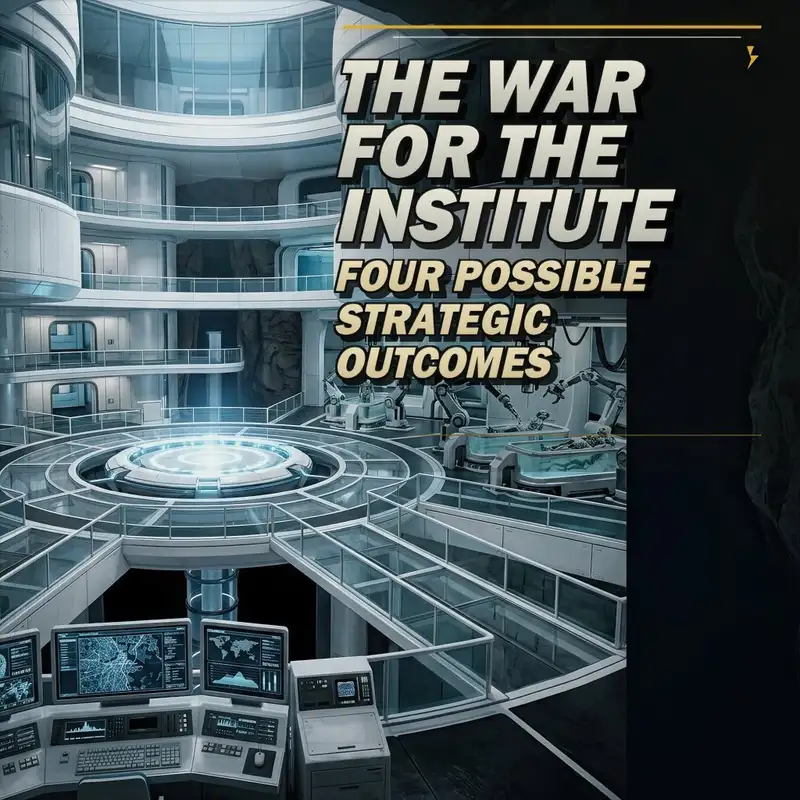
The War for the Institute: Four Possible Strategic Outcomes
The light reaches the Commonwealth before the meaning does. A sudden flare rises over the ruins of Boston, visible from settlements that have spent years looking over their shoulders. To some, it means the end of kidnappings, hidden laboratories, and the fear that a neighbor might not be who they seem. To others, it means the destruction of the only place in the region capable of producing scientific advances on a scale no farm, caravan, or militia can match. For synths, it may mean liberation, or the loss of a place where more of them might have been created. The Institute’s destruction is a decisive military event. It is not, by itself, a political settlement.
That distinction is the heart of the war for the Institute. In the year twenty-two eighty-seven, the Commonwealth does not face one simple choice between order and chaos. The Institute seeks security through secrecy, technical control, and managed intervention from below the earth. The Brotherhood of Steel seeks it through military force and the denial of dangerous technology. The Railroad seeks it through liberation from ownership and coercion. The Minutemen seek it through mutual defense among settlements that have learned the cost of standing alone.
Fallout Four permits four major strategic outcomes. The Institute can survive under new leadership. The Brotherhood can destroy it. The Railroad can destroy it. The Minutemen can destroy it. Each outcome answers an immediate wartime question.
The war existed because the Institute was not merely a hidden laboratory. Beneath the former Commonwealth Institute of Technology, it possessed protected facilities, specialized scientific knowledge, advanced robotics, synth production, and a teleportation system that allowed personnel and equipment to move in ways surface factions could neither easily observe nor reliably intercept. In a region where roads remain dangerous and every long journey carries risk, that was not a minor advantage. It changed the geography of power.
The Institute’s underground position also gave it a form of security that most Commonwealth communities could only imagine. Settlements had to defend walls, crops, wells, and travelers. Caravans had to negotiate with every roadblock, raider gang, and local authority between origin and destination. The Brotherhood had to maintain an airship, landing sites, aircraft, armor, weapons, trained personnel, and supply arrangements far from its eastern base. The Railroad had to hide its people in safehouses that could be compromised by one frightened informant or one successful search. The Institute, by contrast, had a concealed industrial and scientific base beneath territory it did not openly govern.
That protection made the Institute formidable, but it also made it politically alien. Commonwealth residents did not experience it as a distant ministry with public offices and visible laws. They experienced it through disappearances, rumors, infiltrators, synth replacements, destroyed communities, and evidence that someone beneath the ground could intervene in their lives without explanation or appeal. Fear of replacement did not make every suspicion true. The Institute was not shown to control every town, every caravan, or every conversation in the Commonwealth. But its known operations made paranoia rational enough to poison trust.
A government can survive public resentment when it has institutions that people recognize, services they rely on, and some accepted means of demanding redress. The Institute had little of that on the surface. It had capability, not consent. Its leaders could plausibly regard the Commonwealth as unstable, violent, and incapable of managing advanced science. The conflict was therefore not just over technology.
The Brotherhood, the Railroad, and the Minutemen each identified a real danger in the Institute’s power. They differed over what that danger meant and what had to be done about it. The Brotherhood saw a concentration of advanced technology, synthetic soldiers, and covert capabilities that no responsible military order could leave intact. The Railroad saw a system built on the ownership, control, memory alteration, and disposal of artificial persons. The Minutemen saw a threat to settlements already struggling to survive raiders, kidnappings, insecurity, and isolation. The Institute itself saw hostile surface forces attempting to destroy the region’s greatest remaining center of knowledge.
These were political programs, not merely different uniforms assigned to the same final mission. The Institute offered a future directed by experts operating behind closed doors. The Brotherhood offered protection through hierarchy, disciplined force, and control over technology judged too dangerous for ordinary society. The Railroad offered freedom to synths and resistance to systems that treated persons as property. The Minutemen offered local communities the means to defend one another, with all the promise and disorder that comes from relying on voluntary association rather than a permanent centralized command.
The military problem began with access. A conventional army can surround a fortress, cut roads, seize bridges, bombard walls, or starve a garrison of supplies. The Institute was not a conventional fortress. No faction could simply march an army to its front gate, establish a siege camp, and wait for surrender. To reach the Institute, an enemy needed intelligence, technical knowledge, infiltration, internal disruption, or access to its teleportation system.
That requirement explains why the Sole Survivor matters so much to the war without turning that individual into a normal unit in any faction’s order of battle. The Survivor’s personal access to the Institute, and relationship to its director, creates opportunities no ordinary Brotherhood knight, Railroad agent, or Minutemen volunteer could expect. The factions can exploit that access in different ways.
The late stages of the conflict contain several moments when cooperation becomes hostility. Decisions surrounding Mass Fusion, Tactical Thinking, Precipice of War, End of the Line, and related operations can close one route and open another. A Brotherhood command committed to eliminating synth production cannot easily coexist with a Railroad dedicated to protecting synths. An Institute committed to retaining control cannot accept a resistance network removing its people and exposing its methods. A militia coalition cannot ignore a hidden force that abducts and manipulates its communities.
Intelligence also has limits. The Institute’s covert operations create an image of omniscience, but an organization that can replace selected individuals is not necessarily an organization that understands every settlement, every grievance, or every local alliance. The Railroad’s clandestine network can locate, move, and conceal vulnerable synths, but intelligence sufficient for sabotage is not the same as knowledge sufficient for public administration. Brotherhood reconnaissance can identify threats and targets, but a military map of hostile technology is not a census of civilian needs. The Minutemen’s local knowledge can be excellent where communities cooperate, but it remains uneven and dependent on trust.
Once access is gained, each possible ending reveals what its victorious faction is actually built to do. The Institute branch is the clearest example of continuity through preserved capacity. In that outcome, the Institute survives the war. Father dies, and the Sole Survivor succeeds to the formal office of Director. The laboratories remain. Teleportation remains. Synth production remains. The reactor and the systems dependent on it remain. The Commonwealth’s most sophisticated surviving scientific institution avoids annihilation.
On the narrowest military level, this is a major success. The Institute prevents hostile forces from destroying its core infrastructure and neutralizes the external threats that have converged against it. A concealed facility that survives a war against an airborne Brotherhood expedition, a covert resistance network, and a growing settlement militia has demonstrated an ability to protect its central base. The Institute retains the means to conduct research, deploy synths, defend itself through security forces and coursers, and continue projects that no surface workshop could reproduce quickly, if at all.
Operationally, its advantages are substantial. Teleportation reduces certain movement problems that constrain every other Commonwealth organization. Secure laboratories preserve technical expertise. Synthetic labor and security assets provide capabilities that do not depend on recruiting every specialist from an exposed surface population. The Institute’s protected environment shields critical machinery from raiders, weather, radiation, and the ordinary attrition of life above ground. If the question is which outcome preserves the greatest concentration of high technology, the Institute branch has the strongest claim.
But formal succession does not erase institutional culture. The Director holds significant authority, yet the Institute is not a one-person machine. The Directorate, scientific divisions, security personnel, coursers, and technical specialists all possess expertise and influence that cannot be replaced by a title alone. Nor can that Director easily convert a secretive research society into a public government merely by issuing a more benevolent declaration.
The Institute’s central weakness is legitimacy. It can operate beneath the Commonwealth without asking communities to vote, negotiate, or even know the terms under which they are being governed. That is efficient in the narrow sense that secrecy reduces immediate opposition. Settlements do not know whether an offer of aid conceals surveillance. Families do not know whether a disappearance was raiders, accident, flight, or abduction. Merchants do not know whether a stranger is simply a stranger. The Institute’s methods turn ordinary uncertainty into a permanent social wound.
Its supporters might argue that the surface has forfeited the right to distrust it by failing to create peace on its own. The Commonwealth is indeed fractured. It contains violent gangs, damaged infrastructure, predatory operators, and communities with limited ability to coordinate beyond their immediate neighborhoods. But surface disorder does not make covert abduction or manipulation politically sustainable.
The Institute can also mistake insulation for independence. Its facilities require power, maintenance, specialized knowledge, replacement components, and a continuing pool of trained personnel. Its hidden location protects it from many dangers, but it concentrates risk in one complex system. A society built around rare expertise must decide who is educated, who has access to knowledge, who maintains infrastructure, and who inherits authority.
For civilians, an Institute victory offers an uncertain peace. The war may end without the destruction of the underground complex, and the Institute may promise a better future for the Commonwealth. Will communities receive real protection, public services, and a voice in their affairs, or will they remain objects of covert management? Will synths remain controlled property? Will fear of abduction fade because practices genuinely change, or persist because no outside institution can verify the change? The Institute branch preserves capacity.
The Brotherhood answers that problem in a very different way. It does not ask the Commonwealth to believe that dangerous technology can be administered humanely from a hidden laboratory. Under Elder Arthur Maxson, the Eastern Brotherhood arrives as an expeditionary military force centered on the Prydwen, supported by vertibirds, power armor, heavy weapons, trained personnel, and a clear chain of command. In a fragmented region, that kind of organization has immediate psychological and military weight.
The Brotherhood is designed for a campaign against the Institute more effectively than any other major faction. It can conduct reconnaissance, move forces by air, strike hardened targets, protect technical teams, and coordinate complex operations through a hierarchy accustomed to giving and enforcing orders. Its soldiers are not simply armed scavengers gathered for a one-time defense. They belong to an institution with ranks, doctrine, technical traditions, and a sense of mission. That does not make every decision wise.
Against the Institute, conventional strength still requires exceptional intelligence and unusual access. Vertibirds cannot bomb a target they cannot reliably locate without risking the surrounding population and losing the very technology they claim to protect. The Brotherhood’s eventual success therefore depends not only on weapons but on technical knowledge, reconnaissance, internal disruption, and the unique access provided through the Sole Survivor’s involvement.
When the Brotherhood achieves its branch of victory, it accomplishes a clear military objective. The Institute is destroyed as an organized strategic threat. Its reactor, laboratories, teleportation system, and synth-production capacity are eliminated rather than captured intact for civilian administration. The Brotherhood also pursues the Railroad through the hostile logic of its campaign. A force committed to eradicating synths and dismantling those who defend them does not regard the Railroad as a tolerable political opponent.
This gives the Brotherhood outcome a harsh clarity. No hidden Institute remains to replace people, conduct covert experiments, or field new synths from beneath the city. No rival liberation network remains to shelter synths the Brotherhood considers dangerous. From a military denial perspective, this is success. The Brotherhood removes capabilities it believes the Commonwealth cannot safely possess, and it does so before those capabilities can become the foundation of another uncontrollable power.
Yet military supremacy is not the same as political settlement. The Prydwen is a command platform, a symbol of power, and a logistics hub. Vertibirds can move troops and supplies, but they do not establish courts, settle property disputes, irrigate farms, teach children, repair every water pump, or create local consent. Power armor can dominate a skirmish.
The Brotherhood’s expeditionary character matters here. Its equipment requires trained operators, maintenance, ammunition, parts, repair facilities, technical expertise, and secure movement. None of these needs vanish because the Institute is destroyed. The Brotherhood’s advanced systems can make it formidable, but they also bind it to a demanding support structure.
That dependence has political consequences. A Brotherhood force can acquire supplies through trade, agreement, requisition, or intimidation. Each method produces a different relationship with civilians. Communities facing raider attacks or mutant threats may welcome disciplined patrols and visible strength. Other communities may see armed outsiders demanding food, labor, or deference while offering little say in regional affairs. The Commonwealth is not one public with one opinion. But a military order that relies on obedience must work much harder to become an accepted government.
The Brotherhood’s treatment of synths is an even deeper problem. The Brotherhood sees synth production as an existential danger, and its leaders can point to Institute abuses as evidence that synthetic beings were created within a system of domination. The Railroad sees the same beings as persons whose origin does not cancel their claim to freedom. In a Brotherhood victory, that conflict is not resolved through law or public debate. Synths and those who protect them face an immediate threat, while ordinary civilians are asked to accept that security requires the permanent monopoly of an armed technological order.
This does not mean the Brotherhood cannot provide real security. It can. Its discipline, equipment, and willingness to confront major threats may make roads safer in places where local settlements have been abandoned by every other authority. The Brotherhood can win the war for the Institute.
The Railroad represents the moral inverse of that approach. Where the Brotherhood begins with the danger posed by synth technology, the Railroad begins with the danger posed to synths by those who control it. The organization is not a conventional army, and it does not pretend to be one. It is a clandestine liberation network led by Desdemona, supported by couriers, safehouses, intelligence operatives, technical specialists, armed defenders, and synth contacts. Its methods are shaped by the fact that open confrontation would usually destroy it.
Compartmentalization is central to the Railroad’s survival. Members do not need complete knowledge of every route, every safehouse, or every person involved in an extraction. The organization depends on deception, false identities, hidden movement, and the patient construction of trust among people who have every reason to fear exposure. These are not signs of weakness. They are the methods of a resistance operating against an adversary with superior technology, concealed infrastructure, and the ability to place agents on the surface.
The Railroad’s victory is therefore a remarkable intelligence and sabotage success. It helps turn the Institute’s secrecy against it. It reaches the organization through infiltration and technical access rather than battlefield mass. For a group whose central mission is to free people from ownership and extermination, this is not a minor achievement.
But liberation operations and state-building operations are different kinds of work. A safehouse can hide a person from pursuit. A network built to keep information compartmentalized may be highly effective against infiltration, yet poorly suited to transparent government. A movement accustomed to secrecy may find that the habits protecting it during war make it difficult to earn confidence once it must explain budgets, priorities, security decisions, and public obligations.
The Railroad has limited manpower, limited heavy equipment, and little visible industrial depth. It does not possess a broad system for taxation, public works, routine policing, or regional military defense. Its people are trained to move through shadows, not necessarily to administer a growing population of farms, workshops, caravans, and towns. That is not a moral failure. The Railroad exists because nobody else would take responsibility for synth freedom. But it would be a mistake to assume that destroying the Institute automatically transforms it into one.
The civilian implications are mixed. Synths freed from Institute control gain a chance at survival, but survival requires more than escape. The destruction of the Institute may prevent future synth production, which ends one system of exploitation while also closing off the possibility of creating more beings who might later demand freedom. Existing synths remain exposed to prejudice, fear, and pursuit. The Railroad can help some people disappear.
For ordinary human residents, a Railroad victory may remove two feared centers of coercive power. The Institute is gone, and the Brotherhood is no longer present as an armed force prepared to define security through technological monopoly. Yet raiders do not disappear because a resistance network has won an operation. Crop failures do not disappear. Caravan routes do not protect themselves. A town that lacks walls, medical care, or trusted leadership gains little from ideological victory if no one can help it endure the next crisis. The Railroad can win freedom from domination without possessing the institutions needed to organize life after liberation.
The Minutemen begin from the opposite direction. They are not primarily a secret network or a technological enclave. They are a tradition of mutual defense among Commonwealth settlements, a tradition that has collapsed by the time the main conflict begins but can be restored. Their idea is simple enough to sound almost modest. Communities that cannot survive alone should help one another. When raiders attack one farm, nearby settlements should not treat the attack as someone else’s problem. When a road becomes dangerous, local people should have a means to respond. When disaster strikes, assistance should come from more than one isolated household.
That idea gives the Minutemen their greatest political strength. Their authority, at least in principle, rises from communities that need one another. They are not an external expedition arriving with an inherited doctrine. They are not a secret institution directing society from beneath it. They are not a liberation network focused on one persecuted population, however necessary that work may be. They can become a framework through which settlements recognize a shared Commonwealth interest without surrendering all local autonomy.
Militarily, this makes them uneven but potentially resilient. The Minutemen do not begin with the Brotherhood’s standardized hierarchy, the Institute’s advanced infrastructure, or the Railroad’s perfected clandestine methods. Their strength comes from distribution. Farms, workshops, homesteads, trading posts, and small communities can contribute volunteers, local knowledge, warning systems, supplies, and defensive positions. A network of settlements can make raiding more difficult by denying attackers easy targets and by creating the expectation that an assault on one place will bring a response from others.
This is cumulative power, not automatic professional power. The game can show artillery, fortified settlements, and coordinated assaults, but player-built structures and individual battlefield performance cannot be treated as a fixed record of Commonwealth military capacity. What the Minutemen branch establishes is the possibility of mobilization. Settlements can cooperate. Volunteers can answer a common call. A restored command can coordinate an attack against a threat too large for one town to confront alone.
The Minutemen’s destruction of the Institute demonstrates that local society can participate in a campaign of regional importance. The operation still depends on intelligence, technical access, and unusual leadership. A militia coalition cannot wish away the Institute’s underground defenses. The force attacking the Institute is connected, at least potentially, to the people who have lived with its consequences.
This gives the Minutemen outcome the strongest foundation for civilian legitimacy among the four possibilities. A settlement is more likely to accept mutual defense obligations if it has some role in shaping them. A farmer may contribute food or labor to an organization that has helped protect a neighboring road. A caravan operator may support a network that reduces the chance of being robbed between markets. A town may accept coordination in an emergency if it expects assistance when its own walls fail.
They are only beginnings. The Minutemen do not automatically become a republic, a professional army, or an effective civil service. Their decentralized character protects them from some forms of tyranny, but it also creates serious weaknesses. Training may vary from settlement to settlement. Ammunition, medicine, and repair parts may not be distributed fairly. Communities with more labor and better land may carry more of the burden, then ask why weaker or more distant settlements deserve equal protection. The old organization collapsed once. Its revival does not guarantee immunity from the same pressures.
The role of the General is especially important. A coordinating leader can unite scattered settlements, settle disputes, direct resources in an emergency, and give the organization a recognizable center. If cooperation depends too heavily on one exceptional figure, then the Minutemen have not built an institution. They have assembled a coalition around a person. Durable political authority requires procedures that survive illness, death, disagreement, and the ordinary exhaustion of wartime leadership.
The Minutemen also face the classic danger of successful militias. A force created for defense can become more centralized, more coercive, and more permanent as threats grow. Raiders, mutants, hostile armies, and dangerous technology do not always yield to town meetings. Yet the Minutemen’s legitimacy rests on the claim that they serve settlements rather than rule them. If that relationship reverses, their greatest advantage disappears. They would risk becoming another armed institution demanding resources and obedience in the name of protection.
The Minutemen branch can, under certain conditions, leave both the Brotherhood and Railroad alive after the Institute’s destruction. A Commonwealth might retain a local defense network while avoiding the immediate destruction of either the Brotherhood expedition or the Railroad resistance. But this is conditional coexistence, not a guaranteed coalition. The Brotherhood and Railroad remain deeply divided over synths, technology, and authority. The Minutemen do not automatically possess the power to reconcile them, regulate them, or prevent future conflict.
Even so, the Minutemen have the most promising starting point for durable Commonwealth stability because their power can be rooted in the region’s own population. Their weakness is that promise alone does not feed people, repair infrastructure, or maintain disciplined defense. They must turn mutual aid into systems. They must protect routes without becoming predatory. They must coordinate settlements without erasing local autonomy. They must create authority strong enough to respond to crisis and limited enough to remain accountable. The battle against the Institute is easier than that work because battles end.
A comparison of the four outcomes makes the distinction clearer. At the tactical level, the Brotherhood is the strongest conventional military force. The Railroad is strongest in clandestine access, sabotage, and resistance methods. The Institute is strongest in protected advanced infrastructure, scientific expertise, and asymmetric mobility. The Minutemen are strongest where dispersed communities can mobilize together and convert local knowledge into collective defense.
At the operational level, each faction faces a different sustainability problem. The Institute must preserve specialized systems and persuade or control a hostile surface it does not openly administer. The Brotherhood must maintain an expeditionary force with demanding technological requirements while operating among civilians who may not welcome permanent military oversight. The Railroad must preserve a covert network even after the wartime conditions that gave secrecy its purpose. The Minutemen must transform scattered volunteers into a force that can respond reliably beyond the immediate vicinity of each settlement.
At the strategic level, the question is not simply who can destroy a reactor or bring down an airship. The Institute feeds on fragmentation, fear, and the absence of accountable regional authority. The Brotherhood can suppress some threats, but may create new resentment if it treats the Commonwealth as a territory to be managed by force. The Railroad can defend a principle of freedom, but cannot secure that freedom if the region remains too unstable for vulnerable people to live openly. The Minutemen can build broad consent, but may fail if their coalition cannot survive conflict, scarcity, or leadership change.
The destruction of the Institute does not transfer its assets to anyone. A ruined laboratory does not become a functioning civilian university. Destroyed teleportation does not become transportation infrastructure for local settlements. Lost scientists do not become technicians for a victorious militia. The collapse of synth production does not resolve the social status of synths already living in the Commonwealth.
A durable Commonwealth would still need protected trade routes, reliable food and water systems, repair capacity, medical care, conflict resolution, and some accepted rules for the use of force. It would need a way to gather intelligence without allowing suspicion to become a license for persecution. It would need a policy toward synths that recognizes both the real trauma caused by Institute operations and the rights of people who did not choose the circumstances of their creation. It would need defenses against raiders, mutant threats, and future outside powers.
None of the four factions supplies all of that automatically. The Institute offers knowledge and infrastructure, but lacks public accountability. The Railroad offers liberation and moral clarity on synth personhood, but lacks the machinery of territorial administration. The Minutemen offer local legitimacy and a basis for broad participation, but lack automatic professionalism, bureaucracy, and durable central coordination. Each possesses one part of the system a stable society requires.
There is no canonically established winner in the war for the Institute. There are only four possible Commonwealths, each shaped by what its victor considered the most urgent threat. The Institute branch preserves the greatest technological capacity, but asks the Commonwealth to trust an institution whose power has long depended on secrecy and coercion. The Brotherhood branch provides the strongest military answer to the Institute, but leaves open whether armed guardianship can become accepted civil order. The Railroad branch achieves its clearest purpose by freeing synths from the institutions that claim ownership over them, but cannot by itself govern the region those synths must inhabit.
The Minutemen branch has the greatest potential to produce durable stability because it can draw manpower, legitimacy, and purpose from the Commonwealth’s own communities. But potential is not achievement. A network of settlements must still become something more reliable than a wartime coalition. If it fails, the Commonwealth may simply trade one crisis for another.
The real war is not over the Institute’s reactor. It is over whether Commonwealth communities can create security without rebuilding the secrecy, domination, and dependence that made the Institute possible.