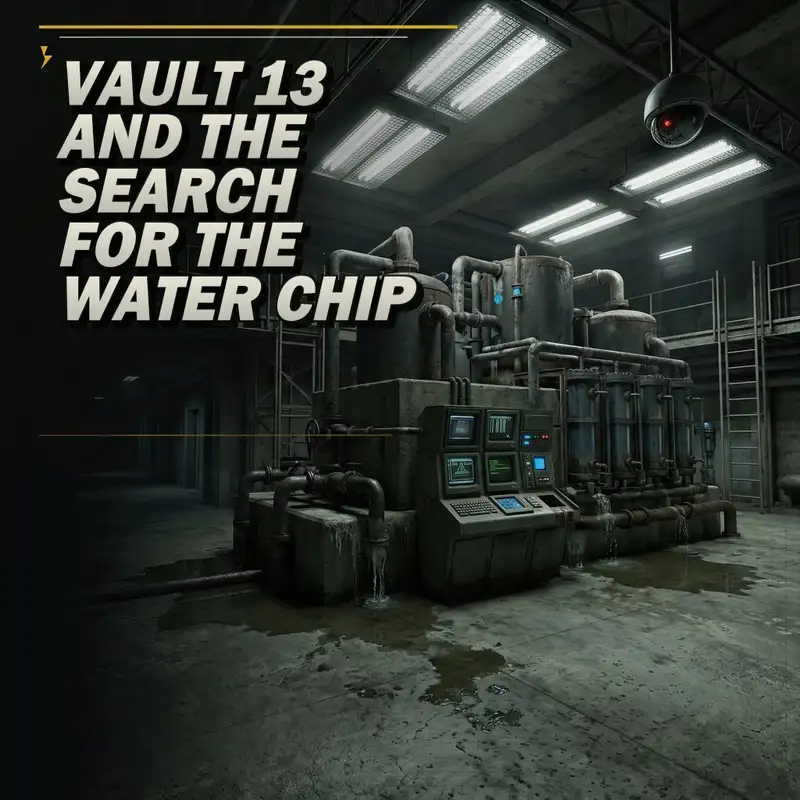
Vault 13 and the Search for the Water Chip
The failure announced itself without spectacle. No breach had opened in Vault Thirteen’s door. No army had crossed the desert. No reactor had exploded. The lights still worked. The farms still grew beneath artificial lamps. Families still lived by schedules, maintenance routines, and the authority of an Overseer. Yet the water-purification control chip had failed, and the Vault could not replace it. Behind that small technical fact stood a hard reality. A sealed population depended on a working system to turn its available water into safe water. Once that system could no longer be controlled, every reserve became a countdown. The exact deadline varies across versions of the story, and there is no reason to pretend one number governs every account. What matters is that the remaining supply was shrinking, and that the people of Vault Thirteen had only roughly months, not generations, to solve the problem.
That made the crisis more than a repair request. Water was not merely another consumable stored in a warehouse. It was the basis of drinking, sanitation, agriculture, medical care, and ordinary life underground. A community can survive damaged machinery for a while. It can ration. It can postpone comfort. It can reduce activity. But a closed settlement cannot negotiate with dehydration, contaminated water, or the collapse of its food production. The Vault’s emergency was civilian before it was military. It threatened children, technicians, administrators, farmers, guards, and everyone else who had spent their lives assuming that the door between them and the wasteland also separated them from the wasteland’s dangers.
The Overseer’s problem was therefore a revealing one. Vault Thirteen had survived the Great War and the long decades after it. It had shelter, power, food production, discipline, records, and a social order built around continuity. By the standards of the surface, it looked like an extraordinary success. But success inside a sealed environment can hide fragility. The Vault had survived because its systems continued to function. It had not necessarily learned how to replace every system when it failed. The water chip exposed the difference between preserving a machine and possessing the industrial capacity to recreate it.
Vault-Tec’s own material described Vault Thirteen in the confident language of pre-War civil defense. Construction began before the bombs and concluded years before October twenty-third, twenty seventy-seven. The design advertised geothermal power, backup energy systems, hydro-agricultural farms, water purification, residential quarters, and defensive equipment. It described a facility intended to sustain a large population in a hostile world. Like much Vault-Tec messaging, it combined useful technical information with corporate reassurance. The company sold survival as a product, and it had a strong interest in making survival appear complete, controlled, and permanent.
That does not mean every claim in the old documentation was false. Vault Thirteen plainly possessed substantial infrastructure. Its residents were alive in the year twenty-one sixty-one because generations of people had maintained an underground settlement through conditions that destroyed much of the old world. But a design specification is not a field report from eight decades later. A listed capacity does not establish the Vault’s actual population. A backup system mentioned in a manual does not prove that every backup remained functional. A statement about supplies does not tell us how much had been consumed, lost, repaired, improvised, or quietly written off over the years.
The important point is not that Vault Thirteen was poorly built. It was that no shelter can be judged only by its strongest features. The Vault had power, but power did not manufacture a specialized control component. It had farms, but farms depended on water. It had educated residents, but education does not automatically provide machine tools, rare materials, production lines, and the accumulated experience needed to reproduce an integrated pre-War device. It had maintenance personnel, but maintenance is not the same as independent industry. A society may be technically capable in the sense that it can keep inherited systems running. That does not mean it can rebuild those systems after a critical failure.
The water chip was not important because it was mysterious or dramatic. It mattered because it fit into a larger structure that depended upon it. In military planning, this would be called a single point of failure. In civil engineering, it is the kind of dependency that keeps planners awake long after the public meeting has ended. One component can govern an entire network if no substitute exists. The chip controlled part of the purification system. Without it, the Vault could not simply route around the problem, fabricate a rough equivalent, or convert its remaining equipment into a new system. The community had redundancy in some areas, but not in the one area that now mattered most.
That vulnerability also revealed the political structure of the Vault. The Overseer possessed formal authority. In an emergency, that authority carried a burden as well as power. He had to decide how to allocate the remaining time, how much risk the community could accept, and whether the Vault’s isolation could be breached without endangering the people he was trying to protect. Sending someone outside was not routine maintenance. It was an expedition beyond the limits of the institution’s normal competence. The Vault had prepared residents to live within a controlled environment. It had not maintained a standing reconnaissance service, a caravan corps, a diplomatic network, or a salvage organization capable of operating across Southern California.
So one resident was selected and authorized to leave. The Vault Dweller’s identity remains deliberately open. The record does not permit a responsible historian to assign a fixed name, gender, temperament, preferred weapon, companion group, moral code, or private motive. What is established is the role. The Vault Dweller became the point where a sealed society concentrated its hopes, fears, and practical requirements. One person carried the information needed to identify the problem, the authority to seek a solution, and the burden of returning before the shrinking water reserve became a death sentence for everyone behind the door.
That is an extraordinary arrangement. Vault Thirteen had preserved an entire community through hierarchy, routine, and enclosure. But when its system failed, the institution could not dispatch a team with a known route, secure resupply, current maps, reliable communications, and a clear inventory of available parts. It sent an individual into a region it barely understood. The mission was technical in purpose, but operational in character. It required movement through unknown terrain, judgment under uncertainty, contact with strangers, access to information, and the ability to distinguish a useful lead from a dead end. The chip itself was small. The search for it was not.
The first apparent answer was Vault Fifteen. It was a logical lead because the old world had left behind other Vaults, and another Vault might possess compatible equipment. But that logic rested on assumptions that the post-War world had spent decades dismantling. A facility can appear on an old map and still be inaccessible. It can have been damaged, buried, emptied, looted, flooded, occupied, or simply stripped of the one thing a visitor needs. The knowledge that a site once existed is not the same as control over that site.
Vault Fifteen could not provide the needed solution. Its command area was inaccessible, and the expected path to a replacement chip ended there. Later retrospective material confirms the broad result, though not every detail of every journey that might have led to it. The significance of Vault Fifteen lies less in the disappointment itself than in what it taught. Vault Thirteen’s inherited plans were obsolete. Pre-War infrastructure had become a landscape of uncertain ruins. A closed society that relied on old records could identify possibilities, but it could not know which possibilities remained real until someone went outside and tested them.
This was an intelligence failure in the broadest sense. Vault Thirteen had information, but not current intelligence. It possessed archives, but not a living picture of regional conditions. It knew enough to name another Vault. It did not know whether its systems remained accessible, inhabited, or useful. The difference matters. Governments and military organizations often confuse stored data with knowledge. A map can survive while the bridge marked on it has collapsed. A file can survive while the institution described in it has vanished. A maintenance schedule can survive while the factory that made the necessary parts is a crater, a raider camp, or a silent ruin.
Once Vault Fifteen failed, the mission could no longer be solved from inside Vault Thirteen’s inherited frame of reference. The search had to move into the social geography of the wasteland. That meant settlements. Shady Sands, Junktown, and the Hub were not merely points along a route or collections of side stories. They represented something the Vault lacked: networks of people who knew the region because they lived in it. They traded, traveled, repaired equipment, remembered dangers, exchanged rumors, and made decisions based on conditions beyond a sealed door.
The outside world was dangerous, but it was not empty. It had communities with their own interests, institutions, suspicions, and arrangements for survival. Shady Sands demonstrated that people could establish local order around agriculture, defense, and communal life. Junktown showed another kind of settlement politics, shaped by commerce, armed authority, and the constant need to manage violence without possessing the resources of a large state. The Hub mattered because trade had made it an information center as well as a market. Caravans moved goods, but they also moved reports. Merchants knew routes, shortages, hazards, customers, and opportunities. In a fragmented region, that made them part logistics network, part intelligence service, and part political force.
For the Vault Dweller, these communities offered possibilities that no Vault Thirteen briefing could provide. A resident of a settlement might know which roads were passable, which ruins had been picked over, which groups controlled local territory, or where a functioning piece of old-world equipment might still be found. A trader might recognize the value of a request that sounded meaningless to someone who had never dealt in salvage. A local guide might understand the difference between a dangerous route and a fatal one. Equipment could be repaired, supplies acquired, and rumors compared. None of this meant that the surface communities existed to serve the Vault’s needs. They did not. Each had its own priorities. But the mission succeeded because the wasteland contained relationships and practical knowledge that isolation had denied Vault Thirteen.
This is one of the central ironies of the water-chip search. The Vault had treated separation as security. In the short term, that had probably been sensible. The post-War world included raiders, radiation, disease, violent factions, and ruins full of hazards that no enclosed community would casually invite inside. Yet isolation also meant ignorance. Vault Thirteen had no established trading partners, no trusted scouts, no current survey of nearby facilities, and no practical role in the regional economy. It had protected itself from entanglement so effectively that, when emergency came, it had to enter that world as a stranger.
The Hub offered the clearest example of both the value and the cost of outside support. Its water merchants could, under some circumstances, send caravans toward Vault Thirteen. Such a service could extend the Vault’s remaining supply and relieve immediate pressure on the mission. This was not a replacement for the failed water chip. It did not restore the purification system, eliminate the need for a compatible component, or make the Vault self-sufficient. It was emergency logistics. It bought time.
Buying time, however, is rarely free. A water caravan needs a destination. It needs a route, guards, goods, payment, and enough knowledge to deliver its cargo. Once the Hub’s merchants began servicing Vault Thirteen, the Vault became less anonymous. A place that had survived partly by remaining hidden now entered the calculations of people outside its walls. Traders might know it existed. Caravan guards might know where it lay. Others might hear about a customer with a desperate need, a secure entrance, and a population possessing old-world equipment. In a dangerous region, information is a resource, but it is also exposure.
The choice between relief and secrecy was not unique to Vault Thirteen. Every isolated community eventually faces some version of it. A settlement can avoid attention by avoiding trade, but then it must bear every shortage alone. It can build outside relationships, but those relationships create obligations and reveal vulnerabilities. The Hub’s caravans demonstrate that logistics and security are often in tension. The same road that carries water can carry rumor. The same merchant who provides relief can unintentionally map a community for those who would exploit it.
Whether the caravans were used in a particular account remains dependent on player action. What is fixed is the strategic dilemma. Vault Thirteen’s water emergency could not be solved by secrecy alone. Even temporary assistance required contact with the regional economy. The Vault’s leadership was forced to confront an uncomfortable fact. It had no meaningful external support system because it had spent generations avoiding one. Its survival depended on a society it had never helped build and could not control.
The decisive lead eventually pointed toward Necropolis, a settlement built around the remains of Vault Twelve. Necropolis is often remembered through danger, decay, and the hostile forces that surround it. But to understand the water-chip mission, it must be seen first as a community facing its own infrastructure crisis. The ghouls of Necropolis were not scenery in another ruin. They were people trying to survive in the remains of an underground system whose condition had deteriorated. Their settlement had internal divisions, limited resources, and the ever-present pressure of hostile forces in the surrounding area. Like Vault Thirteen, they lived under the shadow of a water problem. Unlike Vault Thirteen, their struggle was already visible on the surface.
Vault Twelve contained the component Vault Thirteen needed. In its command center was a functioning water chip compatible with the purification system back home. For the expedition, this was the breakthrough. For Necropolis, it was more complicated. The chip was not lying unused in a warehouse, detached from human consequences. It belonged to another Vault’s water-processing apparatus. Removing it could leave that system unrepaired unless a separate problem with the water pump was addressed. The technical answer to Vault Thirteen’s emergency was embedded in another community’s emergency.
That fact gives the search its moral and political weight. Scarcity is never only about whether a resource exists. It is about who depends on it, who controls access, and whether one group’s survival can be purchased at another group’s expense. Vault Thirteen had spent generations sealed away from the conflicts of the surface. Now its life-support system depended on equipment located within a vulnerable ghoul settlement. The Vault Dweller’s mission brought two communities into contact, but not on equal terms. One possessed the authority to take a component essential to its own survival. The other possessed that component while struggling to preserve its own water supply and defend its people.
The available outcomes in Necropolis are not all the same. The water pump can be addressed under some paths, and the settlement’s future can differ sharply depending on events beyond the simple recovery of the chip. It would be false to collapse those possibilities into a single historical account. What can be said is that the game makes the connection clear. Removing the chip without restoring the damaged pumping system leaves Necropolis in greater danger. The distinction matters because it separates mission success from humanitarian success. A community can accomplish its immediate objective and still leave another community exposed to catastrophe.
Necropolis also undermines the comforting assumption that the people inside Vault Thirteen were uniquely civilized while everyone outside had fallen into chaos. The ghouls had their own social order, their own history, and their own efforts to keep a damaged settlement alive. Their circumstances were harsher, and their condition more precarious, but they were not simply obstacles between the Vault Dweller and a piece of hardware. They were civilians and political actors caught in a regional environment where old-world infrastructure still shaped life, often cruelly. Vault Twelve’s failing system was another reminder that a Vault was not a guarantee. It was an enclosed machine, and machines age.
The recovery of the water chip was therefore a tactical success. The needed component was found. It was removed from Vault Twelve and carried back to Vault Thirteen. At the narrowest level, the mission had worked. The expeditionary agent had done what the Overseer required. But tactical success is only the first layer of analysis. The chip had to survive the journey. It had to be compatible with the system in Vault Thirteen. It had to be installed and used to restore purification. And the consequences of obtaining it did not end at the moment it was placed in a pack or carried through the Vault door.
Recovering the chip restored the means to address Vault Thirteen’s immediate water crisis. It allowed the community to resume the functioning of the system on which its daily life depended. That was no minor accomplishment. A failure that threatened every resident had been met with a solution. The Overseer had identified the critical dependency, authorized an extraordinary mission, and received the necessary component. In institutional terms, it was a successful emergency response.
But the mission also showed that the Vault had not solved its deeper problem. It had acquired one irreplaceable part from another old-world installation. It had not established a manufacturing base capable of producing replacements. It had not created a standing supply chain for advanced components. It had not suddenly developed a reliable intelligence picture of Southern California. It had not removed the possibility that another life-support system might fail later. The repair restored a machine. It did not make the institution resilient.
This distinction between repair and resilience is essential in Fallout. Pre-War technology often survives as a collection of impressive artifacts. A laser rifle, a reactor, a robot, a water purifier, or a power armor suit can appear to offer decisive power. Yet its strategic value depends on an institution that can repair it, train people to use it, replace its parts, protect the facilities that support it, and distribute its benefits fairly enough to retain legitimacy. Vault Thirteen’s water chip was not a superweapon, but it illustrates the same principle better than many weapons do. Technical compatibility and maintenance knowledge can determine survival more decisively than visible firepower.
The mission also created obligations that could not be measured only in spare parts. If the chip was removed from Necropolis without resolving the local pumping problem, Vault Thirteen’s survival came at a direct cost to another endangered population. Even if assistance was provided, the episode still demonstrated a larger fact. Vault Thirteen’s fate was connected to the fate of people it had never known. The Vault had not escaped the political geography of Southern California. It had merely delayed contact with it.
When the Vault Dweller returned, the restored water system offered immediate relief. The central emergency had been answered. The Vault’s farms, sanitation, and daily routines could continue. For residents who had lived under the pressure of a shrinking reserve, that return would have confirmed the value of the institution’s emergency authority. The Overseer had acted. A mission had been sent. The problem had been solved. Yet even this success carried a destabilizing lesson. The Vault had been saved not by remaining sealed, but by breaking its own pattern of isolation.
The returning expedition brought back more than a chip. It brought knowledge that could not have been acquired from old manuals or internal records. There were settlements outside. There were trade routes, merchants, local authorities, ghouls, hostile forces, damaged Vaults, and surviving fragments of regional society. The old world’s infrastructure could still matter, but it could not be trusted merely because it bore a familiar name. Another Vault might be buried. A functioning system might be tied to another community’s survival. A merchant network might offer relief while compromising secrecy. The desert beyond the door was not an empty dead zone. It was a political environment.
That knowledge changed the relationship between Vault Thirteen and the outside world. Before the mission, the Vault could imagine that its boundaries were both physical and intellectual. The door kept danger out, and its archives explained enough of what lay beyond. After the mission, that confidence could not survive intact. A resident had crossed the boundary, made contact, gathered intelligence, and returned with proof that external conditions mattered directly to the Vault’s survival. The community was still enclosed, but it was no longer innocent of its surroundings.
The mission report also carried a warning. Encounters connected to Necropolis raised the Overseer’s concern about super mutants operating in the region. That development led the story into a broader security crisis, but it is important here mainly for what it revealed. Vault Thirteen’s danger had never been only mechanical. The failed chip was an internal vulnerability. The mutant threat was external. The two became linked because the search for one exposed the other.
A working water system could keep a population alive underground. It could not guarantee that the population would remain undiscovered, untouched, or secure from forces developing beyond the Vault’s limited horizon. In that sense, the Overseer’s original decision did more than solve a maintenance emergency. It expanded the Vault’s understanding of security. Security was not simply a sealed door, functioning farms, and stored water. It required awareness of the region, knowledge of threats, and some ability to respond to events outside the facility.
This is a difficult transition for any sheltered institution. Isolation can preserve a community during a period of extreme danger. But the longer isolation continues, the more the outside world changes without it. New powers emerge. Trade networks develop. old threats mutate into new ones. Places marked as safe on a map become inaccessible. Places dismissed as ruins become homes. A community that refuses contact may preserve its internal order, but it also forfeits the intelligence needed to understand the environment in which it actually exists.
Later retrospective material establishes the broad consequence of this transformation. After the Vault Dweller saved Vault Thirteen, the relationship between the returning survivor and the Vault’s leadership did not simply return to normal. The Vault Dweller was eventually expelled, and some residents later followed into the outside world. The exact path to that result should not be reconstructed as though every conversation, personal motive, and intervening event were fixed beyond doubt. The Vault Dweller remains player-defined, and the retrospective account is selective. But the broad political meaning is clear enough.
The person sent out as an emergency instrument came back carrying experience that the Vault could not easily absorb. That experience was necessary. Without the mission, Vault Thirteen’s water crisis could not have been solved. Yet it was also disruptive. The returning resident had seen that the outside world contained danger, certainly, but also communities, relationships, knowledge, and possibilities beyond the Vault’s administered routine. For an Overseer committed to preserving isolation, this was not merely an individual problem. It was evidence that the boundary sustaining the Vault’s social order had been breached in a deeper sense.
The Overseer’s dilemma was institutional, not simply personal. If the Vault Dweller remained, the story of the outside world remained inside the Vault. Knowledge of settlements, trade, conflict, and survival beyond the door might encourage others to question the necessity of permanent enclosure. It might alter how residents viewed the Overseer’s authority, their own future, and the old assumption that safety existed only below ground. The very success of the mission could make the old governing model harder to preserve.
Expulsion, in that light, was an attempt to restore a boundary that could no longer truly be restored. A door can close behind one person. It cannot erase what that person learned, what the institution needed from them, or what their return proved. Vault Thirteen had survived by treating the outside as a threat to be excluded. But when the water chip failed, survival required outside information, outside infrastructure, outside commerce, and contact with people the Vault had spent generations avoiding. The crisis showed that the Vault was not separate from Southern California. It was dependent on Southern California while lacking any mature way to participate in it.
This does not mean the Overseer was wrong to fear the wasteland. The dangers were real. The mission itself revealed ruins, insecurity, predation, and emerging threats that justified caution. Nor does it mean that opening a Vault automatically produces a stable, humane society. Contact brings trade, intelligence, and opportunity, but it also brings disease, conflict, exploitation, and political risk. The lesson is narrower and more severe. Isolation can be an emergency measure. It is not the same as resilience.
Vault Thirteen’s water-chip search proves that its greatest weakness was not the desert outside its door, but the institutional logic behind the door. It had preserved life by sealing itself away, yet when one component failed, survival required outside knowledge, outside trade, outside communities, and one resident transformed by contact with a world the Vault could no longer pretend did not exist.