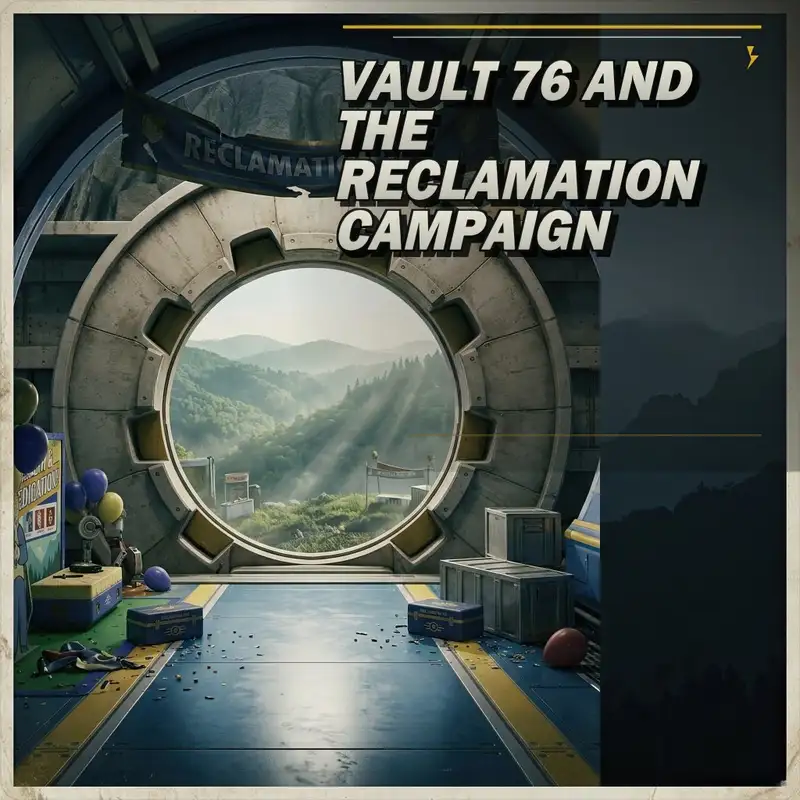
Vault 76 and the Reclamation Campaign
On October twenty-third, twenty-one oh two, the door of Vault Seventy-Six opened on schedule. Twenty-five years had passed since the Great War. The residents had been raised inside a shelter meant not merely to endure nuclear war, but to emerge afterward and help restore the country beyond it. The public language surrounding the Vault promised a carefully selected population, equipped to become a nucleus for reconstruction. It was civil-defense planning at its most optimistic. Preserve capable people, protect them through the emergency, and send them out when the danger has passed.
But Appalachia had not been waiting in orderly silence. There was no regional government prepared to receive the Vault Dwellers. No functioning civil-defense network. No recovering economy with vacant jobs, open farms, and intact supply depots. The territory outside held abandoned towns, damaged infrastructure, hostile machines, mutated wildlife, and the evidence of communities that had already tried to rebuild. Most had failed.
Reclamation Day was therefore not the beginning of a normal settlement mission. It was the opening day of an emergency campaign. Vault Seventy-Six had prepared its residents to leave a Vault. Appalachia required them to understand why every institution outside it had collapsed, and whether any of those institutions could still be made useful.
The Vault’s mission had always contained a contradiction. Recolonization assumes that there is a place to recolonize. It assumes that the basic conditions of life can be restored through trained labor, technical knowledge, and a disciplined population. But a region is more than land and buildings. It is water systems, roads, food production, medical care, communication, markets, law, trust, and institutions capable of making difficult decisions without immediately turning every disagreement into a gunfight.
Vault Seventy-Six could provide people with education, equipment, and a common starting point. It could not provide a functioning Appalachian state. It could not guarantee that the surviving infrastructure was safe. And it could not guarantee that the greatest danger in the region was visible from the Vault door.
The first sign that the plan had already changed came from the Overseer’s trail. Before Reclamation Day, the Overseer had left Vault Seventy-Six ahead of the larger population. Her records, caches, and instructions became the closest thing the emerging campaign possessed to a headquarters system. They directed Vault Dwellers through Flatwoods, Morgantown, Charleston, Free States facilities, Fort Defiance, the Whitespring bunker, and eventually toward the missile silos hidden beneath Appalachia.
This was not command in the conventional military sense. The Overseer had no documented field army, no established civil bureaucracy across the region, and no dependable communications network extending beyond the Vault. Her authority came from her office and from the mission she carried. Outside the shelter, that authority depended on whether people could act on it, whether they trusted it, and whether the resources described in old records still existed.
Her task evolved as she learned more. She had been sent to assess Appalachia, recover useful knowledge, and secure dangerous strategic assets. The nuclear missile silos were especially important. A postwar reconstruction mission that ignored functioning nuclear launch infrastructure would have been dangerously incomplete. Yet the further the Overseer traveled, the clearer it became that the silos were not the only problem. Appalachia was already suffering from a crisis that had destroyed every organized human response able to confront it.
The campaign that followed depended heavily on dead people’s records. Terminals, holotapes, emergency broadcasts, personal notes, military files, and abandoned training systems preserved fragments of the recent past. They told Vault Dwellers where communities had gathered, how they had defended themselves, what they feared, and where they had failed. They were invaluable intelligence sources, but not perfect ones. A firefighter recorded what happened in a shelter. A soldier described a battle from one position. A survivalist documented what could be seen from a bunker. None had a complete picture of Appalachia’s collapse.
That limitation matters. The Vault Dwellers did not enter the region with a finished operational map. They assembled one from incomplete evidence. In military terms, they inherited a battlefield after the commanders, civilians, and most of the communications systems had already disappeared.
Appalachia made that task difficult. Its forests, mountains, mines, rivers, industrial sites, urban ruins, and isolated government facilities created a distributed security problem. A threat could emerge from a collapsed mine, a ruined airport, a research facility, or an abandoned town. A road that looked useful on an old map might be blocked, irradiated, watched by hostile forces, or simply no longer maintained. A radio tower might still stand while the people it once connected were gone.
The region also contained unusual pre-War capacity. Appalachia had power infrastructure, factories, mines, laboratories, military installations, and automated systems. That made it strategically valuable. It also made it dangerous. A functioning machine is not the same thing as a functioning institution. Someone must know how to operate it, repair it, supply it, and decide who has the right to use it. The Great War had left Appalachia with much of the machinery of authority and very little of the human framework needed to govern it.
The early evidence was grim. Settlements had been abandoned. Emergency services had been overwhelmed. Defensive positions had fallen. Automated security systems continued to enforce orders from organizations that no longer existed. The landscape was not empty, but it had been politically hollowed out. The people of Vault Seventy-Six were not moving into untouched territory. They were walking through the remains of an earlier reconstruction attempt.
The Responders were the clearest example of what Appalachia had lost. They were not a conventional army or a government created by election and statute. They were an emergency coalition. Medical workers, firefighters, police personnel, volunteers, and other public-service figures tried to keep people alive after the bombs. Their methods were practical. They organized shelters, distributed aid, trained recruits, relayed warnings, treated the sick, and tried to restore the ordinary routines that make survival more than an armed camp.
Their centers at places such as Flatwoods, Morgantown Airport, Charleston, and the Charleston Fire Department show a society trying to turn improvised relief into something more durable. The Responders understood a basic truth that many postwar factions learned only after considerable bloodshed. Security begins with civilians who can drink clean water, receive treatment, find shelter, contact one another, and expect help to arrive when disaster strikes.
That gave the Responders a kind of legitimacy that armed conquest could not easily produce. They asked people to cooperate because cooperation kept communities alive. Their authority came from service. A medic who treated strangers, a firefighter who entered a burning structure, or a volunteer who kept a food line moving could build more trust than a uniform alone.
But service-based authority is fragile when the system has no depth. Emergency networks require supplies, safe routes, trained replacements, communication, and people who are not already exhausted. A regional crisis can consume all of those at once. The Responders faced damaged infrastructure, scattered communities, dangerous travel, limited medical resources, and a threat that attacked the social foundations of relief itself.
Their collapse was not a simple matter of cowardice or incompetence. They were trying to perform public-health work, humanitarian relief, evacuation, and local defense in a region where the old state had vanished. They had no secure rear area, no reliable industrial base, no large reserve force, and no guarantee that a town they helped today would still exist tomorrow. The Responders showed that compassion could organize people. Their fate showed that compassion also needs logistics, protection, and institutions capable of surviving sustained pressure.
That pressure came from the Scorched Plague. The Scorched were not a conventional army with a reliable order of battle, established supply lines, or a documented command structure. They were infected people and creatures drawn into a wider biological and behavioral crisis. The infection did not merely create hostile bodies. It corrupted trust. It made every encounter with the sick, the missing, or the recently displaced into a potential danger.
That is the strategic significance of a contagious threat in a broken society. Plague does not have to defeat a settlement by storming its walls. It can disrupt medical care, force evacuations, discourage travel, isolate communities, and turn rescue operations into hazards. It punishes the very networks that a recovery effort depends upon. A region that cannot safely move doctors, food, messages, and civilians cannot easily sustain collective defense.
The Responders attempted to adapt. Their Fire Breathers became a specialized formation for high-risk operations against the Scorched and the hazards surrounding them. Their training reflected the grim progression of the crisis. What began as emergency response increasingly demanded protective procedures, combat readiness, and an understanding of disease containment. The Fire Breathers were not evidence of a large professional military. They were evidence that civilian institutions had been forced to militarize parts of themselves in order to survive.
Their work included efforts to understand protective measures and inoculation. That mattered because the Scorched crisis could not be solved solely by shooting visible enemies. A fighter might clear a building, but if the infection spread through an unprotected population, the building would not remain secure. The problem was medical, tactical, logistical, and political at the same time.
The Fire Breathers achieved important local adaptations. Yet training alone could not rebuild a collapsed region. A small specialist unit can investigate a threat, escort a mission, or hold a dangerous point for a time. It cannot replace hospitals, transport systems, farms, communications networks, and a dependable reserve of trained personnel. By the time Vault Dwellers retraced the Responders’ work, the knowledge existed, but the organization capable of applying it at regional scale had largely died.
That became one of the central advantages of the Reclamation Campaign. Vault Seventy-Six did not discover every answer from nothing. Its residents recovered answers that earlier defenders had developed under pressure. The difference was timing. The Vault Dwellers arrived with fresh personnel, access to protected resources, and a mission that could connect information from several failed institutions. They inherited the lessons of people who had not survived long enough to use them fully.
Not every surviving Appalachian record came from public servants. The campaign also passed through the fractured remains of raider networks, including the material associated with Rose, the Miss Nanny robot operating from the Top of the World. Rose preserved her own version of local history, shaped by raider culture, personal attachment, and machine logic. Her testimony is useful, but it is not neutral. A robot can preserve data for decades and still misunderstand the human relationships that gave that data meaning.
The raider material revealed a different form of postwar adaptation. Local armed groups could control a road, raid a storehouse, intimidate a smaller settlement, or build temporary alliances around food, weapons, and shelter. They understood the practical economy of scarcity. They knew that a route, a cache, or a defendable elevation could be more valuable than a formal claim on a map.
But fragmented predation was not a solution to a regional plague. Raiders could survive inside the gaps left by failed institutions. They could not easily create the medical trust, shared intelligence, and coordinated containment that the Scorched threat required. Their networks were often too personal, too coercive, or too unstable to become a public system. They could exploit collapse. They were not positioned to reverse it.
The Free States represented the opposite instinct. Where raider groups often adapted through local force and opportunism, the Free States emphasized autonomy, preparation, surveillance, and bunker survival. Their members distrusted distant authority, and Appalachia’s pre-War history gave them reasons to do so. The old world had not earned confidence through restraint. It had produced corporate power, government secrecy, militarization, and catastrophe on an industrial scale.
The Free States prepared accordingly. Their bunkers, monitoring systems, and preserved records became vital sources of intelligence for later Vault Dwellers. They tried to identify the nature of the emerging danger. They kept technical knowledge alive when open settlements became increasingly vulnerable. In a region where information could vanish with the death of a radio operator or the destruction of a local office, that preservation mattered.
Yet the Free States also demonstrated the strategic limits of isolation. A bunker can protect people and records for a time. It cannot easily coordinate a broad regional response if every community retreats into its own sealed system. A contagious enemy does not respect local independence. Nor does a flying threat that can cross terrain faster than a ground patrol.
The Free States preserved fragments of understanding, but they lacked the political structure needed to combine those fragments into durable collective action. Their autonomy protected freedom at the local level. It also limited mutual reinforcement, shared command, and public confidence beyond their own circles. Preparedness without coordination can become a form of strategic solitude.
The Appalachian Brotherhood of Steel possessed more obvious military purpose. Led by Paladin Elizabeth Taggerdy, this Brotherhood chapter attempted to confront the Scorchbeast threat with discipline, technology, and a distinctly military understanding of the danger. Their headquarters at Fort Defiance became a symbol of that effort. It was a fortified position, a medical site, and a record of a chapter trying to impose order on a rapidly worsening crisis.
Taggerdy’s Brotherhood had roots in the wider Brotherhood tradition, but it was not simply a distant branch receiving regular guidance and resupply. Communications with Lost Hills failed. The chapter became increasingly isolated from the organization that had helped shape its identity. That isolation was more than an administrative inconvenience. It deprived the Appalachian Brotherhood of outside intelligence, replacement personnel, strategic direction, and the possibility of reinforcement.
The chapter faced a threat poorly suited to simple military containment. Scorchbeasts could move through the air, attack across difficult ground, and sustain a wider plague crisis. Appalachia’s mountains and forests limited visibility and complicated movement. A fortified base could become a refuge, but it could also become a target or a trap if surrounding routes collapsed.
The Brotherhood had arms, armor, training, and a culture of discipline. Those advantages mattered. They allowed the chapter to fight longer and more coherently than many improvised groups. But advanced equipment does not abolish attrition. Weapons require ammunition. Armor requires maintenance. Trained personnel require rest, medical care, replacement, and reliable command. Every loss becomes more serious when no outside system can replace it.
The chapter also faced a wider operational problem. Killing individual threats did not necessarily end the system generating them. A force can win local engagements while losing the regional contest if it cannot identify the source of the enemy’s strength, secure transportation routes, protect civilians, and maintain its own support network. The Brotherhood’s purpose was military, but the problem demanded military action connected to public health, intelligence, and regional governance.
Fort Defiance preserves the record of a force that understood the danger and still could not overcome strategic isolation. The lesson is not that military professionalism was useless. It is that professionalism alone was insufficient. A chapter can preserve doctrine and technology, but doctrine cannot create allies, food, communications, and population support out of ruins.
Vault Seventy-Six entered this history as a connector. The Responders had built civilian legitimacy. The Fire Breathers had developed hazardous-response practices. Raider remnants revealed the fractured political geography of the region. The Free States preserved intelligence. Taggerdy’s Brotherhood contributed military analysis and the evidence of what direct confrontation had cost. None had solved the crisis alone. The Vault Dwellers could assemble their surviving knowledge into a campaign that crossed institutional boundaries.
That process eventually led beneath the Whitespring, into the remnants of the Enclave’s local infrastructure and the control of MODUS. MODUS was an artificial intelligence with access to facilities, records, and strategic systems. It was also the product of a deeply compromised inheritance. The Enclave represented continuity of a kind, but not necessarily legitimate continuity. It preserved the habits of secrecy, hierarchy, and technological control that had helped make pre-War America so dangerous.
MODUS could provide capacity. It could open doors, process information, connect Vault Dwellers to advanced infrastructure, and guide access toward the missile system. But capacity is not authority. An artificial intelligence operating beneath a resort bunker is not a functioning United States government. It does not possess democratic consent, accountable civilian leadership, or a population that has agreed to be governed by it.
That distinction is essential. The Reclamation Campaign repeatedly encountered machines that still worked after people and institutions had disappeared. MODUS was the most consequential example. Automated continuity can preserve extraordinary capability. It can also strip away the oversight that once constrained that capability, however imperfectly. A computer can maintain a command network. It cannot by itself answer who should command, whose lives should be protected, or what political future the system is meant to serve.
The Whitespring’s strategic value lay in its connection to the Scorchbeast crisis and to the weapons capable of reaching its source. The campaign had moved from scattered local investigation toward a hard conclusion. Earlier defenders had fought symptoms of the catastrophe. To alter the regional situation, the Vault Dwellers would need to strike the center of the threat.
That brought them to Sites Alpha, Bravo, and Charlie. The missile silos were among the most dangerous assets in Appalachia. The Overseer had sought to secure them because allowing nuclear launch systems to fall into uncontrolled hands would be a disaster in any era, and especially in a region struggling to rebuild after nuclear war.
Securing a silo, however, is not the same thing as creating stable control over it. Access codes, automated defenses, launch procedures, and technical knowledge can make a weapon available. They do not produce a lawful chain of command or a political institution capable of using that weapon responsibly. The silos gave Vault Dwellers immense destructive potential. They did not make them a government.
The campaign’s central contradiction became unavoidable. To reclaim Appalachia, the Vault Dwellers had to take custody of the most destructive inheritance of the old world. Conventional containment had failed. Civilian emergency networks had collapsed. Survivalists had isolated themselves. The Brotherhood had been ground down. The remaining option was to use nuclear force against the source of the Scorchbeast threat.
The narrative connection between the silos and Fissure Site Prime is clear. A nuclear strike against that location enables the confrontation with the Scorchbeast Queen, the central figure in the immediate crisis. The exact details of participation can vary. There is no single named Vault Dweller who can be treated as the sole canonical victor, nor should repeatable operations be mistaken for a literal endless sequence of identical historical battles. What matters is the collective achievement represented by the operation.
On the ground, the Queen is confronted and defeated. That is a substantial military success. The immediate enemy at the point of impact is overcome by coordinated action under extreme conditions.
At the mission level, the strike and battle target the propagation center of a crisis that earlier defenders had been unable to suppress. The campaign is no longer merely reacting to scattered Scorched attacks. It reaches the source of the threat in a way that creates a real possibility of recovery.
Across the wider campaign, Appalachia is no longer facing the same uncontested Scorchbeast emergency. The region’s surviving routes, settlements, facilities, and potential communities gain breathing room. That does not mean every hazard vanishes. The wasteland remains dangerous, and a plague crisis does not become politically irrelevant because one decisive operation succeeds. But the balance changes. The territory becomes more viable for human return.
In the larger struggle, that breathing room is the campaign’s greatest achievement. It makes later settlement possible. It preserves the possibility that people can farm, trade, build, travel, and form communities without living under the immediate shadow of an expanding Scorched catastrophe. In that sense, Vault Seventy-Six succeeds where Appalachia’s earlier defenders could not. It connects intelligence, medical preparation, military action, and strategic infrastructure into one emergency effort.
But the political result is narrower. Defeating the Queen does not automatically create courts, taxation, land law, civil administration, representation, or a legitimate monopoly on force. It does not decide who controls the silos afterward. It does not determine which communities receive protection, who repairs roads, how disputes are settled, or whether powerful technical institutions will serve the public rather than rule over it.
The campaign also carries a moral burden. Appalachia is made safer through the controlled use of nuclear force. The weapon is directed against an immediate and exceptional threat, but it remains a weapon inherited from the civilization that destroyed itself through nuclear war. Reclamation, in this case, requires mastering the machinery of annihilation without allowing that machinery to become the foundation of the new society.
That is not a contradiction the Vault Dwellers fully resolve. It is one they manage well enough to survive. The difference matters. Emergency success is not the same as permanent political wisdom.
Later developments confirm the practical value of the opening created by the campaign. By the year twenty-one oh three, settlers and raiders begin returning to Appalachia in significant enough numbers to establish new centers of power and new disputes. Later Brotherhood forces also arrive with an interest in the fate of Taggerdy’s lost chapter. Those developments should not be folded backward into the lonely, archival Appalachia of twenty-one oh two. They belong to a later stage.
Still, they reveal something important. People return only where return appears possible. The arrival of new communities indicates that Appalachia is no longer simply a sealed disaster zone defined by the Scorched emergency. The Reclamation Campaign has reopened territory, preserved knowledge, and changed the strategic environment enough for others to contest its future.
Yet contest is not unity. Later settlers, raiders, Brotherhood personnel, and local survivors do not inherit a finished commonwealth. They inherit land, infrastructure, unresolved claims, dangerous technologies, damaged institutions, and competing visions of order. The Vault Dwellers have made reconstruction possible. They have not completed it.
That is why the Reclamation Campaign should not be remembered as a simple Vault-Tec success story. Vault-Tec’s plan imagined a controlled transition from shelter to recovery. Appalachia offered no such transition. Its residents emerged into the aftermath of failed emergency government, failed containment, failed isolation, and failed military defense. Their achievement came from adapting to conditions the original plan had not solved.
Vault Seventy-Six reclaimed something more important than empty buildings or salvageable equipment. Its residents recovered institutional memory. They connected the Responders’ service ethic, the Fire Breathers’ hard-earned knowledge, the Free States’ preserved intelligence, the Brotherhood’s military warnings, and the Enclave’s dangerous technical capacity. They turned fragments of failed societies into an emergency response capable of reaching the source of the crisis.
That made the campaign successful as an operation. It prevented Appalachia from being permanently lost to the Scorched threat. But it did not yet make Appalachia a stable state, because it left reopened territory and terrifying strategic infrastructure without a settled political order capable of governing either.