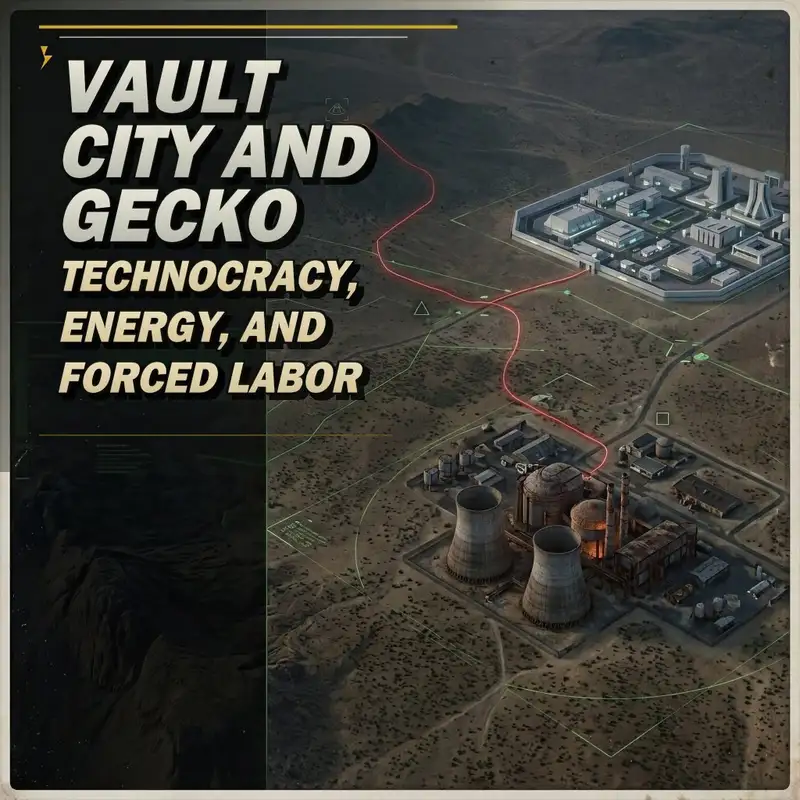
Vault City and Gecko: Technocracy, Energy, and Forced Labor
The water problem came first. People in Vault City were getting sick, and the suspected source lay beyond the city’s clean streets and guarded boundaries, at an old nuclear power plant operated by ghouls in Gecko. The plant was damaged. Its coolant system was leaking contamination into the surrounding water. That was not a fantasy invented by frightened Citizens, and it was not merely an excuse for prejudice. A failing reactor can turn technical neglect into a public-health emergency very quickly, especially in a region where clean water is not an inconvenience but the basis of every settlement’s survival.
Yet the danger did not answer the political question. Vault City could identify a threat. It could diagnose contamination. It possessed medical knowledge, records, administrators, and a government convinced of its own competence. None of that settled who had the right to control Gecko, who should bear the risk of repair, or what obligations Vault City owed to the people doing the dangerous work. Joanne Lynette, Vault City’s First Citizen, saw a radioactive settlement of outsiders whose existence endangered her city. Harold, Gecko’s leading political voice, saw a more powerful neighbor looking at a critical industrial site and asking how useful its workers might become under compulsion.
That is why the Gecko crisis matters. It was not simply a dispute between humans and ghouls, nor a straightforward tale of one settlement poisoning another. It was a contest over citizenship, ownership, technical labor, and political status. Vault City’s prosperity rested on science and order, but also on a sharp boundary between those entitled to its protections and those expected to serve it. Gecko, poorer and more exposed, possessed something Vault City could not simply manufacture for itself: an operating industrial facility, local expertise, and a workforce accustomed to maintaining machinery in conditions most human workers could not endure.
By the year twenty-two forty-one, the old world had been dead for more than a century and a half. That did not mean its infrastructure had ceased to matter. It meant that surviving infrastructure had become more valuable, more difficult to repair, and more likely to become the center of a political struggle. A functioning reactor was no longer just a machine. It was power, trade, medical security, leverage, and danger, all housed in the same damaged structure.
Vault City understood itself as one of the rare places where civilization had survived in organized form. Its people emerged from Vault Eight, one of the control Vaults that was not built around a known social experiment. The city they created inherited more than shelter and machinery. It inherited a sense of continuity. Vault City had medical facilities, security forces, administrative routines, technical records, and a population that could plausibly claim descent from people selected to survive the apocalypse in relative order.
But its order depended on controlled membership. Citizenship in Vault City was not simply a description of residence. It was a protected status. Citizens enjoyed access to the city’s security, medical services, and inner social life in ways that Outsiders did not. The distinction was political, legal, and cultural. It separated people who could claim the city as theirs from people who might trade with it, work near it, seek its help, or be tolerated at its margins without ever being accepted as equals.
This arrangement gave Vault City a powerful identity. It allowed Citizens to see themselves as guardians of knowledge and standards in a dangerous world. It also made exclusion seem like prudence. An Outsider was not necessarily an enemy, but neither were they assumed to possess the same rights, judgment, or claim on public resources. A ghoul settlement operating a damaged reactor nearby could therefore be understood not as a neighboring community with a shared problem, but as proof that the world outside Vault City’s boundaries was disordered, contaminated, and threatening.
Vault City was not politically uniform. Its council contained more than one instinct. Senior Councilor McClure represented a more practical and technical approach to the Gecko problem. He could recognize that the situation involved economic data, industrial capacity, and regional relationships that could not be solved merely by declaring the ghouls a threat. His position did not make Vault City an egalitarian society, and it did not erase the city’s hierarchy. It did show that a technocracy can contain internal disagreement about whether expertise should serve control or cooperation.
The city’s servant system makes the limits of its civic culture impossible to ignore. Vault City used the word “Servant,” a term with the clean, administrative sound of a staffing category. The reality was slavery. These workers performed assigned labor under conditions that denied them ordinary freedom and required them to defer to Citizens as social superiors. The vocabulary mattered because euphemism is one of the oldest tools of coercive institutions. It does not change the condition of the person compelled to work. It changes the language available to everyone else.
Calling enslaved people servants allowed Vault City to preserve a flattering image of itself. The city could present hierarchy as order, coercion as service, and ownership as contract or obligation. This was not simply a matter of individual cruelty. A political system can benefit from forced labor even when some members of that system dislike the practice, avoid thinking about it, or regard it as regrettable but necessary. The institution remains real because it distributes work, security, comfort, and risk in a way that serves those with power.
Vault City’s Citizens received the benefits of protection and advanced medicine. The city’s enslaved workforce bore part of the burden that made that protected life possible. That arrangement did not mean every Citizen personally wielded a whip or endorsed every abuse. It meant the city had already established a principle with dangerous consequences: some people could be classified as useful without being treated as full political persons.
For Gecko, that principle was not an abstract concern. Harold’s fear that his community might be turned into a slave camp did not emerge from nowhere. Vault City had a stronger security apparatus, better institutional continuity, and greater political confidence. It already possessed a labor system built on control and unequal status. If the city came to regard Gecko’s reactor as essential, the ghouls who operated it could be seen not as neighbors with rights, but as necessary workers attached to a strategic asset.
Gecko was not a contaminated obstacle beside Vault City’s frontier. It was a community built around a degraded but still functioning power facility. The town’s residents were mostly ghouls, people altered by radiation in ways that made them far more tolerant of radioactive environments than ordinary humans. That tolerance shaped Gecko’s survival. It allowed people to live and work near a hazardous plant that would have been even more dangerous for an unprotected human population.
But radiation tolerance did not make Gecko’s residents expendable. It did not mean they were immune to every danger. It did not reduce them to biological tools designed for reactor work. The ghouls of Gecko had political interests, commercial relationships, technical skills, social ties, and a clear understanding that their settlement could be threatened by forces other than radiation. Their ability to endure a hazardous environment became one reason outsiders might value their labor. That made their position more precarious, not less.
Harold served as Gecko’s principal political mediator, but he was not the whole town. Gecko had technicians, repair personnel, traders, mechanics, and residents with different responsibilities. Figures such as Festus, Gordon, Jeremy, Hank, and Skeeter point to a broader fact about industrial survival. A power plant is not maintained by one indispensable genius standing heroically beside a control panel. It survives through distributed competence. Someone understands the records. Someone knows the equipment’s failures. Someone can locate or adapt a replacement component. Someone keeps systems running long enough for the next repair to matter.
This was Gecko’s practical authority. Vault City could claim law, citizenship, and inherited technical prestige. Gecko possessed the knowledge gained by living with the plant every day. Its residents understood the facility’s condition because their town depended on it. They knew that a reactor was not a sealed relic from the old world, capable of running forever simply because its walls still stood and some lights remained on.
The plant required maintenance. It required cooling systems, replacement parts, functioning controls, technical documentation, and people able to interpret warning signs before damage became catastrophe. The contamination crisis demonstrated what happened when that chain weakened. A degraded industrial system does not fail in a clean or contained way. It leaks into water, soil, tools, homes, and bodies. It creates uncertainty. It turns every rumor about sickness into a political accusation.
For Gecko, the reactor was the center of local survival. For Vault City, it was first an external danger and then an increasingly valuable asset. Both views were true, but neither was sufficient on its own. The plant could poison a neighboring water supply. It could also provide power. It could support trade. It could create work that depended on ghoul expertise. It could become a source of regional influence. Its condition linked the two settlements whether either leadership wanted that connection or not.
This is the central fact that rhetoric could not erase. Vault City was not self-sufficient merely because it possessed medical technology and disciplined administration. Gecko was not powerless merely because it lacked Vault City’s polished institutions. Each community had something the other needed. Vault City needed the contamination stopped and had reason to care about dependable energy. Gecko needed stability, access to technical assistance, and the ability to operate without being treated as a hostile population occupying someone else’s property.
The reactor was infrastructure, not magic. Repairing it did not create unlimited electricity, erase the need for maintenance, or transform Gecko into an industrial superpower overnight. Nuclear facilities are demanding systems. Their value depends not only on the machinery itself, but on a chain of labor and support around it. Parts must be obtained. Equipment must be understood. Failures must be detected. Workers must be protected as much as the available technology allows. Records must be interpreted correctly. A machine can outlast the government that built it, but it cannot outlast neglect forever.
That made the technical problem inseparable from the labor problem. Vault City had access to better administration and technical resources. Gecko had workers with site knowledge and experience. Neither contribution was optional. Technical resources without skilled local operators could not guarantee safe operation. Local expertise without access to parts and broader exchange could not guarantee recovery. The reactor crisis was therefore not solved by one side rescuing the other. It required a relationship.
That relationship could take different forms. It could become cooperation between communities that recognized mutual dependence. It could become an unequal arrangement in which Vault City supplied resources but demanded political control. It could become a security operation justified by public health and expanded into occupation. Or it could collapse into destruction, with the reactor eliminated rather than repaired and the productive foundation of Gecko damaged beyond use.
The difference between those paths lay in politics, not engineering alone. A repaired reactor could reduce contamination. It could not, by itself, answer whether ghouls would be treated as equal partners. An optimized reactor could increase useful power. It could not, by itself, establish who owned that power, who made decisions about it, or who would be compelled to work when the next crisis arrived.
Joanne Lynette’s position emerged from the real pressure of protecting Vault City’s population. A leader responsible for a city’s water supply cannot ignore a leaking reactor nearby. Public health is not a trivial concern, and the people becoming ill were not imaginary victims invented to excuse policy. Any government that failed to respond to contamination affecting its residents would be neglecting a basic duty.
But Lynette’s response also carried the assumptions of Vault City’s hierarchy. Gecko was not merely a technical problem in her view. It was a ghoul settlement, an outsider community, and a source of contamination located near a city that believed its own survival depended on vigilance against the surrounding wasteland. Her hostility toward the ghouls cannot be separated from the health crisis, but neither can it be explained by the health crisis alone. The danger was real. The prejudice shaped the remedy.
This is a familiar failure of technically capable governments. They can correctly identify a physical threat while misunderstanding the people involved in resolving it. A bureaucratic system may possess medical files, engineering data, and security procedures, yet still treat a neighboring society as an object to be managed rather than a political community capable of consent. It can know that a reactor is failing and still fail to ask who has kept it operating under impossible conditions.
McClure offered a different institutional logic. His concern with economic and technical information recognized that Gecko was part of a larger regional system. The reactor, uranium, and trade relationships had consequences beyond a single argument between two nearby settlements. This did not mean that every regional connection was mapped clearly or that the surviving record provides a complete economic model. It means the available evidence points to a wider network of supply and value. Gecko’s plant was not just a local hazard. It was part of the material foundation on which trade and survival depended.
The disagreement between Lynette and McClure was therefore more than a personality clash. It reflected two competing ways to understand power. One saw security through exclusion, supervision, and control of perceived threats. The other saw security through managed interdependence and technical cooperation. Both approaches could claim to protect Vault City. Only one began from the possibility that Gecko’s residents were necessary participants in their own future.
Neither approach was politically neutral. Cooperation can still be unequal if one side controls the paperwork, resources, and recognition needed for the arrangement to function. Yet cooperation at least acknowledges a truth that coercion tries to conceal: the people who operate critical infrastructure are not interchangeable components. Their knowledge has political weight because systems fail when the workers who understand them are ignored, displaced, or terrorized into obedience.
Harold understood this danger clearly. His concern was not simply that Vault City disliked ghouls. He feared that the city’s interest in the reactor could become a means of controlling Gecko itself. Once a stronger neighbor gained leverage over the town’s power supply, it might decide that the simplest way to secure energy was to secure the workers. In a city already accustomed to treating some people as servants, that prospect was more than paranoia.
Harold’s warning deserves attention because it captures the relationship between energy dependence and coercion. A state does not need to conquer every mile of territory to dominate a neighbor. It may control access to water, medicine, trade, repair parts, or markets. It may offer assistance under conditions that turn temporary dependence into permanent subordination. It may justify intervention by pointing to a genuine emergency while quietly arranging for the emergency’s productive assets to serve its own needs.
Vault City possessed advantages in any such contest. Its defenses were stronger. Its political institutions were more cohesive. Its Citizens had access to systems of medicine and security that Gecko could not match. The city could speak in the language of law, public safety, and civic responsibility. Those claims gave it legitimacy among its own people, and perhaps among outsiders who saw the contamination problem without understanding Gecko’s internal life.
Gecko possessed a different kind of strength. It had the reactor. More importantly, it had people capable of operating it. Military superiority does not automatically produce industrial control. A government can occupy a facility, seize its gates, and issue orders. That does not mean it can keep complex machinery functioning. A reactor depends on skilled personnel who know its condition, recognize its limits, and understand which improvised repair is safe enough to attempt and which one will make a bad situation worse.
This is the limit of coercive power. Forced labor may compel bodies into dangerous spaces, but it does not reliably create trust, initiative, or technical judgment. A worker who is enslaved can be made to perform tasks. They cannot easily be made to care about the long-term survival of the institution exploiting them. Nor can specialized knowledge be extracted as easily as ore from a mine. It exists in records, habits, professional memory, informal communication, and accumulated experience. Destroy the community that holds that knowledge, and the machinery may remain while its usable capacity disappears.
Gecko’s vulnerability was still severe. Local expertise did not guarantee political independence. A smaller settlement can possess a strategic asset and remain exposed if it lacks reliable allies, secure trade, or the ability to prevent a stronger power from defining the terms of exchange. The reactor gave Gecko leverage, but leverage is not the same as sovereignty. Its value could attract partners. It could also attract occupiers.
The possible repair process demonstrates how closely the two settlements were tied together. The Chosen One could act as a mediator between Gecko and Vault City, helping move knowledge, resources, or technical assistance across a divide neither community could bridge alone. The exact route, motive, and method of that intervention remain player-defined. What matters historically is the structure of the problem. A repair required more than a lone traveler’s determination. It depended on institutions, equipment, workers, and the willingness, however reluctant, of rival communities to cooperate.
Vault City could provide access to resources and administrative channels unavailable within Gecko alone. Gecko could provide site knowledge and the labor required to make technical assistance meaningful. Automated systems could help with particular tasks, but they did not replace the people who understood why the repair mattered or what conditions at the plant required attention. This was logistics in its most basic form: the right part, the right knowledge, the right worker, and the ability to bring them together before failure became irreversible.
A successful repair could resolve or mitigate the immediate contamination crisis. It could reduce the danger to Vault City’s water supply and give Gecko a more stable basis for survival. But a machine problem is not the same as a sovereignty problem. The fact that the reactor could be repaired did not automatically settle the political relationship between the two settlements. It merely removed one excuse for avoiding that question.
In some possible outcomes, the reactor could also be optimized, increasing its useful output. This was a technical success, but it created a strategic paradox. A safer, more productive plant could improve Gecko’s position. It could give the town a stronger role in regional trade and make its labor more valuable. It could create the basis for a broader partnership with Vault City and other communities. Productive capacity can be a source of independence when a community controls its work, its contracts, and the terms on which it exchanges goods or power.
The same increase in output could make Gecko more vulnerable. A facility that is barely surviving may be dismissed as a nuisance. A facility producing greater value becomes an object of interest. Its neighbors may begin to calculate how much it is worth, who supplies the materials that keep it running, and whether its workforce can be brought under direct control. The better Gecko’s reactor performed, the more tempting it could become for Vault City to convert economic dependence into political domination.
The available record supports the importance of uranium and regional economic relationships, but it does not provide a complete ledger of tonnage, prices, or routes. There is no need to invent one. The strategic point is clear enough. Industrial systems do not exist in isolation. A reactor needs inputs. Its output matters only if it can be distributed, exchanged, or used. Trade creates opportunity, but it also creates leverage. Whoever controls a necessary supply line, purchasing arrangement, or repair channel can turn commerce into a political instrument.
That is why productive success does not automatically create freedom. A community can produce something valuable and still lose control over it. It may lack armed protection. It may depend on a stronger neighbor for parts or food. It may have no alternative buyers. It may be divided internally. Or it may confront a government that regards ownership by outsiders as temporary, suspect, or illegitimate. In that situation, an increase in production can strengthen the case for annexation as easily as it strengthens the case for partnership.
Gecko’s reactor was therefore a test of whether Vault City’s technical culture could recognize a basic political fact. The ghouls were not merely the people standing near the machinery. They were the operators, maintainers, and residents whose community gave the machinery meaning. If the city wanted energy security without recognizing Gecko’s autonomy, it was not seeking stability. It was seeking control.
The possible outcomes presented around Gecko make this argument especially sharp because they are conditional. They do not form a single, seamless history. They are different branches, shaped by player action and institutional choice. They must be kept separate.
One possible result is destruction. The reactor can be eliminated rather than restored as a working foundation for the town. This may remove a source of contamination, but it does so by destroying productive infrastructure. The immediate hazard is addressed through loss, not repair. For Gecko, the cost is not abstract. A community built around the plant loses the system on which much of its survival depended. For the region, an industrial asset disappears. Destruction can solve a narrow security problem while deepening the broader scarcity that created the crisis.
Another possible result is an uneasy truce. The contamination problem can be addressed without immediately transforming the relationship between Vault City and Gecko into open domination or full partnership. Such a truce has value. It prevents a public-health emergency from becoming a war. It creates room for trade and continued coexistence. But it does not erase distrust, prejudice, or the imbalance of power between the settlements. A truce is not the same as reconciliation. It is often an arrangement in which both sides remain alert for the next failure.
A darker branch follows reactor optimization. Increased productivity can make Gecko valuable enough that Vault City chooses to enslave its people. This is the outcome Harold feared. The town’s technical success becomes the basis of its subjugation. The ghouls’ ability to operate a difficult facility is treated not as evidence of their competence and right to self-government, but as a reason to place them under tighter control.
There is also a possible cooperative outcome. Vault City and Gecko can form an alliance in which the reactor’s value supports partnership rather than conquest. That possibility matters because it shows that technical interdependence does not inevitably produce domination. A more durable arrangement can emerge when a stronger settlement recognizes that the people maintaining a critical asset are not merely labor to be acquired. They are political partners whose security and autonomy contribute to the reliability of the system itself.
The cooperative branch should not be romanticized. Alliances require continued exchange, working institutions, and some method of resolving disputes. They depend on whether Vault City can restrain its exclusionary instincts and whether Gecko can secure recognition beyond temporary convenience. But the possibility remains important. It demonstrates that the choice was not between contamination and conquest. There was another path, though it required more political imagination than simply seizing what others had preserved.
No later released account establishes one complete Gecko ending as universal history. Harold’s eventual appearance in the Capital Wasteland confirms that he later traveled far from Gecko. It does not reveal every decision made in northern California and Nevada, and it does not prove that any particular ending-slide branch occurred in full. The outcomes remain conditional. They are not fragments to be gathered into a single official timeline.
The immediate problem is straightforward. The damaged reactor must be repaired, contained, or removed if the contamination crisis is to end. Vault City’s residents need clean water. Gecko’s residents need a facility that does not steadily poison the land around them. Technical action matters because people are sick and systems are failing.
Energy also changes the importance of place. Gecko becomes more than a nearby settlement with a hazardous problem. It becomes a node in a larger network of trade, resources, and power. That can increase its bargaining position, but only if it retains control over its productive capacity. If another state controls the plant, the parts, the labor, and the terms of exchange, Gecko’s increased output may serve someone else’s power rather than its own survival.
The political question is whether Gecko is recognized as a community or classified as a resource. Cooperation treats the ghouls as people with authority over their own town and expertise. Enslavement treats them as a workforce attached to equipment. The difference is not ceremonial. It determines who can refuse an order, who receives the benefits of production, who bears danger, and who decides whether a repair becomes a future investment or a future instrument of control.
For civilians, these distinctions are immediate. Gecko’s residents face possible autonomy, precarious coexistence, displacement, or enslavement. Vault City’s residents face illness and uncertainty if the contamination continues. Outsiders and servants within Vault City reveal that the city’s inequalities are not hypothetical. They are already built into everyday life. The way a state treats its least protected people is often the clearest warning of how it may treat a dependent neighbor.
Vault City was not simply an advanced civilization standing against radioactive chaos. It was a capable polity with real medical, technical, and administrative strengths. Its people had reasons to fear contaminated water and failing infrastructure. Its leaders had genuine responsibilities to protect public health. But capability did not make its hierarchy just, and technical sophistication did not make it self-sufficient.
Gecko, meanwhile, was not a primitive dependency waiting for Vault City to rescue it. It was a damaged but functioning community whose residents held knowledge that Vault City could not safely replace. The ghouls maintained a difficult industrial system, understood the risks of the plant, and had every reason to fear that their usefulness would become an argument for their subordination. Their technical competence did not guarantee freedom. It made the question of freedom more urgent.
The reactor crisis exposed the central problem of reconstruction after the Great War. Infrastructure can connect communities, reduce suffering, and create the basis for trade. It can also become a justification for hierarchy when the people who own or operate it are treated as dangerous, inferior, or conveniently expendable. A government may call that arrangement security. A corporation may call it efficiency. A bureaucracy may call it service. The people compelled to sustain it know the difference.
Repairing the reactor could clean water and restore power. Only political recognition could prevent energy security from becoming another name for forced labor.