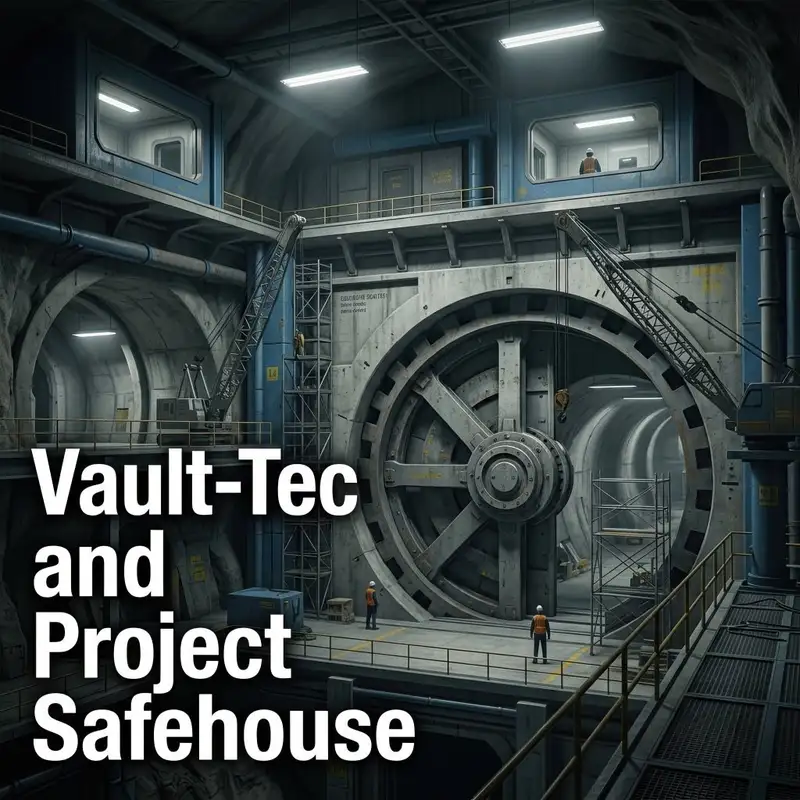
Vault-Tec and Project Safehouse
The families entering Vault One Eleven believed they had reached the last secure line before nuclear fire. They had been processed, assigned, reassured, and moved underground under the authority of a company that sold preparedness as a public service. The blast doors did what blast doors were meant to do. They sealed out the immediate violence of October twenty-third, twenty seventy-seven. But once the door closed, the meaning of safety changed. The residents were separated from ordinary life, placed into cryogenic chambers, and used as unwitting subjects in a medical experiment. The shelter protected their bodies from the bomb. It did not protect their rights, their consent, or their future.
That contradiction is the proper place to begin with Project Safehouse. A Vault cannot be judged by its steel door, its reactor, or the cheerful image painted on its entrance. It must be judged by who controlled admission, who understood the rules, who had authority after the door shut, and whether the people inside were treated as citizens under protection or as material under management. Vault One Eleven was particularly cruel, but it was not merely an isolated story about one rogue laboratory. It exposes the question behind the entire program. Was Project Safehouse a national civil-defense system that powerful people later corrupted, or was selective survival built into its design from the beginning?
The answer is neither a simple acquittal nor a simple conspiracy tale. The Vaults were real shelters. Some protected people from immediate blast, fallout, disease, weather, and the collapse of the world above. Some preserved communities for decades. Some released trained populations who could help reclaim devastated regions. Yet the same system also gave corporations, government partners, military planners, scientists, and local administrators extraordinary power over isolated civilian populations. Its public promise was survival. Its internal logic often involved selection, surveillance, experimentation, and elite continuity.
Project Safehouse matters beyond its familiar yellow-and-blue branding because it was never simply a collection of bunkers. It was not simply a collection of bunkers. It was an attempt to decide who would survive the end of the United States, under what conditions, and with what authority over the world that followed. The project preserved fragments of humanity. It also preserved old habits of hierarchy, secrecy, and institutional arrogance. In many cases, the people who reached safety discovered that the danger had merely changed shape.
Pre-War America had legitimate reasons to fear catastrophe. The country faced severe resource strain, international confrontation, domestic repression, public-health crises, and an increasingly militarized political culture. The Sino-American War had made energy, industrial capacity, and strategic geography matters of national survival. The New Plague had intensified fear of biological threats and public disorder. Nuclear war was not treated as an abstract possibility reserved for military planners. It entered schools, advertisements, workplace procedures, government messaging, and household anxiety.
Under those conditions, civil defense was not irrational. A government facing the prospect of nuclear attack had to consider how it would preserve skilled workers, medical personnel, engineers, records, communications equipment, leadership, and whatever social order might survive the first days after an exchange. Underground shelters could protect people from some effects of nuclear war. They could store supplies, sustain water systems, provide medical care, and preserve technical knowledge. A functioning shelter network might allow a society to recover more quickly than one forced to begin from ruins without tools, expertise, or organized communities.
The problem was that no shelter program could protect everyone. Even before considering corruption or experimentation, civil defense required choices about land, construction, funding, maintenance, staffing, and admission. A government could call survival a national obligation, but every limited shelter system still had to decide who received a place, who made the list, who remained outside, and who possessed the authority to call those exclusions necessary.
Project Safehouse emerged in that environment as both an engineering undertaking and a political instrument. Vault-Tec became its most visible corporate face. The company marketed security to the public, built and operated facilities, trained personnel, designed systems, selected or processed residents, and managed a vast bureaucratic image of national preparedness. It was not merely a company that poured concrete around a few private shelters. It stood at the intersection of government contracting, military planning, consumer marketing, scientific research, and emergency administration.
Building a Vault required more than excavation. A long-term underground facility needed land, labor, structural engineering, ventilation, power, water treatment, food storage or production, medical equipment, communications, sanitation, security, education, and maintenance. It needed trained technicians who could repair systems after years of isolation. It needed administrators who could ration supplies, settle disputes, respond to illness, and decide when contact with the outside world was possible. It needed a population capable of living together under rules that could become more binding than any law above ground.
The technical challenge created opportunities for secrecy. No elected public body could easily inspect every sealed research space, proprietary system, personnel file, or classified contract. A program spread across corporate offices, construction sites, government agencies, military facilities, universities, and underground installations naturally became compartmentalized. One employee might understand water recycling. Another might manage admissions. A third might train overseers. None needed to see the full design. Bureaucracy has always been good at dividing responsibility until no individual office feels responsible for the result.
Admission was therefore one of Project Safehouse’s most consequential technologies. It determined which people would be protected from immediate nuclear destruction and which would be exposed to bombardment, radiation, displacement, hunger, disease, and the collapse of civil order. The records that survive suggest that selection could involve technical skill, military usefulness, corporate connections, social status, genetic interest, political value, or simple access to money and influence. The precise standards varied, and the full national process remains incomplete. But the broad pattern is clear. Access to safety was not distributed as a universal right.
That did not mean every person admitted to a Vault was powerful or privileged. Many residents were ordinary civilians who trusted the program because they had few alternatives. Some may have been selected because a functioning shelter needed teachers, mechanics, nurses, cooks, children, elders, security personnel, and people capable of sustaining a community. A Vault population could not consist entirely of executives and scientists. Yet even when residents were not individually elite, they were still part of a chosen population. Their survival depended on decisions made elsewhere, often without meaningful public accountability.
The people outside the doors were not a minor detail. They were the majority of the catastrophe’s human burden, though the exact scale cannot be reliably calculated from surviving evidence. They included families who never received admission, workers who built shelters but had no place in them, communities too distant from a Vault, people trapped in evacuation traffic, and civilians who discovered that the reassuring promises of civil defense had more exclusions than protections. Nuclear war made those exclusions lethal. The door that saved some people also marked the boundary beyond which many others were abandoned.
The United States government bears responsibility for creating the political environment in which such a system operated. Federal sponsorship gave the shelter program authority, funding, access to military requirements, and the appearance of national legitimacy. But it would be careless to treat every federal institution as identical to Vault-Tec, or to claim that every office understood every experiment. Pre-War government was not a single mind. It contained military commands, civilian agencies, intelligence networks, elected institutions, corporate allies, security services, and hidden centers of influence. The surviving record does not provide a neat chart showing exactly who knew what.
Still, incomplete knowledge is not the same as innocence. A government that delegates survival to private corporations, permits secrecy around admission, and accepts insulated authority inside sealed facilities creates the conditions in which abuse can flourish. Project Safehouse was not simply a private venture that happened to operate during a national emergency. It was a public-private system in which national survival became inseparable from contracting, classification, and unequal access.
Selection did more than decide who lived through the initial strike. It created enclosed populations that could be observed, managed, manipulated, and experimented upon. Once a Vault door closed, the residents inside became unusually vulnerable to authority. They could not easily leave. They could not appeal to outside institutions. Their food, water, medicine, information, work assignments, reproduction, security, and contact with the surface could all be controlled by a small administrative structure. In a properly governed shelter, such authority might be necessary for survival. In an unethical one, it became a mechanism of domination.
This was the research logic behind many of the Vaults that later became known to the wasteland. Isolated populations could be studied under stress. Administrators could observe leadership, obedience, conflict, illness, reproduction, technological dependence, scarcity, hierarchy, and social cohesion. A Vault could become a laboratory for conditions no ethical society should impose through involuntary human confinement: deliberate deception, arbitrary authority, social division, isolation, controlled fear, and the removal of meaningful choice.
The known experiments were not all identical, and they should not be forced into one universal theory. Some appear tied to biological research. Some explored social pressure or psychological manipulation. Some centered on technology, virtual reality, environmental control, or long-term isolation. Some may have served military, corporate, or political interests. Others reflected the obsessions of specific officials, scientists, or overseers. A system can be centrally corrupt without every local experiment having the same purpose.
What unites these cases is not a single scientific hypothesis. It is the transformation of shelter residents into controlled populations. The basic ethical failure was not merely that an experiment produced suffering. It was that people entered facilities believing they were receiving protection, while crucial information about their treatment was withheld. Informed consent was impossible when the people controlling the facility also controlled the records, the exits, the medical systems, and the story residents were allowed to hear.
The experiments also failed on their own stated terms. Information gathered through cruelty, secrecy, technical breakdown, and institutional collapse was often of limited practical use. Data is only useful when it can be preserved, interpreted, transmitted, and applied by institutions capable of acting on it. The Great War destroyed much of the system meant to collect and exploit Vault research. Staff died. communications failed. archives were lost or damaged. individual Vaults became isolated worlds. The program inflicted immense harm in pursuit of knowledge that often could not be reliably recovered or used.
Four Vaults illustrate how widely Project Safehouse could vary, and why variation does not excuse its governing structure. Vault Seventy-Six shows the project at its most defensible. Its residents were meant to emerge after twenty-five years and begin reclaiming Appalachia. In that sense, the Vault was not designed as a permanent tomb. It was a recovery instrument, intended to preserve a population long enough for the worst immediate effects of the Great War to pass.
The existence of Vault Seventy-Six matters because it prevents an easy but inaccurate conclusion that every Vault was built only to torment its residents. At least some facilities were intended to support reemergence, reconstruction, and regional recovery. Their residents could carry technical knowledge, institutional memory, and social organization into a damaged landscape. The reclamation model recognized an essential truth of civil defense. Shelters are not useful simply because people survive underground. They must eventually reconnect people to land, water, food, trade, and political life above ground.
Yet Vault Seventy-Six also reveals the limits of even a comparatively successful design. Releasing people into a devastated region did not guarantee stable reconstruction. Appalachia was already shaped by disease, factional conflict, failed emergency systems, damaged infrastructure, and competing claims to resources. A Vault could preserve a starting population. It could not by itself create a durable government, rebuild every road, restore public trust, or resolve the political conflicts left by the old world. Survival was an opening condition, not a completed recovery plan.
Vault Eighty-One provides a different example. It became a comparatively functional long-term community. Its residents maintained social life, education, medical knowledge, and the routines required to keep an underground settlement alive. That outcome demonstrates that the basic technologies of shelter could work. Water systems, power, food production, medical facilities, and collective rules were not inherently fraudulent. A Vault did not have to become a death trap simply because it was underground.
But Vault Eighty-One was not evidence that the larger program deserved trust. Its relative stability existed beside evidence of concealed experimentation and restricted authority. The Vault’s more humane outcome depended partly on people inside it limiting or resisting the most destructive implications of the original design. That distinction matters. Institutions are not redeemed merely because some residents, staff, or local leaders act decently within them. Sometimes survival depends on people refusing to carry out the full logic of the institution that placed them there.
Vault One Eleven represents the biomedical side of Project Safehouse. Residents entered expecting refuge and were subjected to cryogenic preservation without meaningful consent. The experiment turned a family shelter into a controlled environment for testing how people might endure long-term freezing. The facility’s later history also demonstrates the fragility of technological systems cut off from normal oversight. Cryogenic equipment, staffing arrangements, security procedures, and emergency plans all depended on people and systems continuing to function under extreme isolation. Advanced machinery could delay death. It could not guarantee competent leadership or institutional responsibility.
The cruelty of Vault One Eleven was not only medical. It was administrative. The residents were processed through a chain of authority that treated them as a problem to be handled rather than citizens to be protected. Someone wrote the procedures. Someone trained the staff. Someone classified the experiment. Someone decided that the people entering those chambers did not need to know the truth. The harm was distributed across offices, forms, uniforms, and technical language. That is how large institutions often make atrocity appear procedural.
Vault One Twelve shows another path from shelter to captivity. There, residents survived through virtual reality technology under the control of Stanislaus Braun. Their bodies remained alive, but their autonomy was subjected to an artificial world designed around one administrator’s power. It was a shelter in the narrowest physical sense. The population was protected from the dead landscape outside. But the Vault became a total-control environment where survival served the desires of the person holding the system’s controls.
Vault One Twelve is important because it exposes a weakness in the language of continuity. Preserving a body is not the same as preserving a person. A government, corporation, or scientist can claim success because a population remains alive. But if that population has no meaningful freedom, no honest information, no power over the conditions of its own existence, and no route to appeal beyond its captor, then the system has preserved biological life while destroying the civic basis of human society.
Vault Fifteen offers a different kind of consequence. Its population was structured around deliberate social pressures, and its later history helped shape political communities in Southern California. The Vault’s importance lies not in proving that every facility was part of one master plan for the future wasteland. The evidence does not support that sweeping claim. Its importance lies in showing that Vault experiments did not end at the door. The people who emerged carried memories, skills, rivalries, beliefs, and grievances into the post-War world. A controlled population could become the seed of later settlements, conflicts, and institutions.
That is one of Project Safehouse’s deepest legacies. Vaults were indirect engines of state formation. They released communities into a shattered continent, often with technical knowledge or strong internal identities, but also with the scars of secrecy and coercion. Some survivors helped found settlements. Some entered trade networks. Some became political leaders, researchers, soldiers, or isolated local authorities. Others carried trauma into societies that had no idea what had been done behind the doors. Vault-Tec did not create every later community, and it did not control every outcome. But its systems altered the human material from which the post-War world was built.
The people inside Vault-Tec also need to be distinguished from one another. Corporate leadership, engineers, sales staff, researchers, security personnel, maintenance workers, overseers, and residents did not hold equal knowledge or power. The company was large enough that many employees may have seen only their portion of the work. A technician servicing a filtration system did not necessarily know the purpose of a restricted laboratory. A salesperson promising safety to anxious families may not have known the full conditions waiting inside. A maintenance worker might have understood that a system was failing without possessing authority to change policy.
Overseers occupied an especially complex position. They were local authorities with substantial control over information, discipline, admission, emergency decisions, and sometimes the experiments themselves. In some Vaults, the overseer was clearly an active administrator of abuse. In others, the office could become a trap, with the person holding it bound by secret instructions, isolated from outside support, and pressured to carry out a design they did not create. The title gave enormous power, but it did not always provide freedom.
This is the quieter danger of Project Safehouse. Its worst acts did not require every employee to be a sadist or every official to understand the full plan. They required a system in which each person could be told that someone else had approved the policy. The engineer could say that the equipment was sound. The administrator could say that the orders were classified. The overseer could say that the protocol came from above. The executive could say that the research served national survival. Meanwhile, the residents had no meaningful ability to refuse.
Vault-Tec did not operate alone. The United States government supplied legitimacy, contracts, strategic requirements, and access to a national emergency structure. Other corporations provided research, technology, investment, industrial capacity, or specialized systems. RobCo, West Tek, REPCONN, Big Mountain, Poseidon Energy, and similar firms belonged to a broader political economy in which private industry and national security increasingly overlapped. But they should not be compressed into a single corporate mind. Each had its own leadership, interests, technologies, and relationship to state power.
The same caution applies to the Enclave. Before the Great War, the Enclave functioned as a hidden political and military network connected to high levels of government, industry, and continuity planning. Its later appearance makes clear that some pre-War elites were preparing not merely to survive catastrophe, but to preserve authority beyond the formal collapse of the United States. Yet the surviving canon does not provide a complete command chart for Project Safehouse. It does not establish that the Enclave directly ordered every Vault experiment, controlled every overseer, or possessed a single flawless plan for the aftermath.
That uncertainty should not weaken the analysis. It should sharpen it. The danger was not one omnipotent conspiracy capable of moving every piece on the board. The danger was a dense system of overlapping interests. Government officials sought continuity. military planners sought survivable command structures. corporations sought contracts, research access, and influence. senior elites sought protection from the consequences of decisions imposed on everyone else. When these interests converged, ordinary people became objects of planning.
The Prime Video series provides the clearest direct view of how senior corporate figures could imagine this arrangement. In the pre-War meeting involving Barb Howard, Bud Askins, and representatives of major corporations, Vaults are not treated simply as public shelters. They are discussed as assignable assets, experimental platforms, and opportunities for different institutions to preserve their influence through catastrophe. The language is managerial. The human beings who will live inside these facilities are considered in terms of utility, controlled environments, and long-term outcomes.
That meeting does not prove that every Vault in the country was designed under one shared corporate formula. The management project associated with Vaults Thirty-One, Thirty-Two, and Thirty-Three was a specific model. It focused on preserving selected managerial personnel, shaping leadership, and extending a particular kind of corporate authority into the future. It should not be treated as a blueprint for every Vault seen in the games. But it does reveal the thinking available at the highest levels of Vault-Tec. Nuclear survival could be turned into a market, a laboratory, and a succession plan.
Barb Howard’s proposal that Vault-Tec might initiate nuclear war if peace threatened the company’s long-term plan is especially important. It establishes that at least one senior executive was willing to contemplate deliberate nuclear escalation as a business and political strategy. In that room, apocalypse was not only a feared disaster. It was a condition under which the company’s monopoly on safety, its experiments, and its elite-continuity programs could become indispensable.
That is not proof that Vault-Tec launched the first nuclear weapon. The Great War’s initiating chain remains unresolved. A proposal is not the same as an executed operation. The existence of a motive does not establish responsibility for the first strike. Treating the matter as settled would replace one form of propaganda with another, offering a neat culprit where the surviving evidence remains deliberately incomplete.
The later revelations involving Barb Howard, Robert House, cold fusion, and Automated Man technology complicate the picture further. They show a pre-War world in which advanced energy systems, automation, corporate ambition, and secret strategic programs were entangled at the highest levels. The Enclave emerges more clearly as a hidden power operating within or against the visible corporate players. Its presence confirms that the boardroom was not the only place where the future was being planned.
But the broader lesson is not that one hidden faction can be blamed for every decision. The deeper problem was structural. Powerful institutions had built systems meant to function after mass civilian death. They had invested in shelters, secret technologies, continuity plans, classified research, and protected enclaves. They anticipated catastrophe well enough to prepare for it, yet did not create a public order capable of preventing it. Some may have feared nuclear war. Some may have expected it. Some were willing to exploit it. That distinction matters morally, but all three positions helped create a society in which ordinary people were less protected than the institutions claiming to save them.
The uncertainty over who fired first therefore should not become an excuse to ignore what Project Safehouse actually did after the bombs fell. The project can be evaluated by its results. In the first hours, some Vaults succeeded. They protected residents from the immediate blast, from early fallout, and from the exposed chaos of the surface. In the first hours and days of nuclear war, a sealed, supplied shelter could mean the difference between survival and death.
Over months and years, the record was more uneven. A Vault had to sustain a population over time. That required functioning power, water, sanitation, food, medicine, maintenance, security, and leadership. It required people who could repair equipment and resolve conflict without turning every disagreement into a crisis of command. Some facilities endured. Others were crippled by system failure, poor planning, abusive experiments, leadership breakdown, or simple isolation. A bunker is not self-sustaining merely because it survives the initial attack.
As a continuity system, Project Safehouse failed to provide a unified, reliable continuity government capable of restoring the United States. It preserved scattered populations and fragments of expertise. It did not preserve a broadly legitimate national political order. The country that emerged after the Great War was not governed by a coordinated network of Vault administrators reopening according to a national plan. It became a patchwork of settlements, military remnants, trading communities, raider territories, scientific enclaves, regional states, and isolated survivors.
The program’s intelligence value was equally limited. The experiments may have generated observations about human behavior, technology, disease, authority, and social stress. But knowledge trapped in sealed facilities, buried archives, dead laboratories, and isolated computer systems does not automatically become usable power. The post-War world inherited fragments of data without the institutions needed to assess it ethically, share it reliably, or apply it to reconstruction. The project acquired information at immense cost and then lost much of the capacity to make that information matter.
Politically, however, Project Safehouse had a longer afterlife. Management Vaults, cryogenic personnel, overseer structures, preserved records, and elite continuity networks carried elements of pre-War authority across the nuclear divide. Vault-Tec itself did not emerge as one intact post-War government ruling the continent. Its facilities were too isolated, too damaged, too varied, and too dependent on local conditions. But its methods survived. The idea that a select group could claim authority because it had been chosen, preserved, educated, or technically prepared for the future remained powerful.
For civilians, the legacy was harsher still. Some residents found genuine shelter and community. Others found deception, confinement, experimentation, or psychological abuse. People excluded from the Vault system faced the catastrophe without its protection. The word safe described protection from certain physical threats. It did not guarantee freedom, dignity, informed consent, or a fair share in the future.
Vault Fifteen and the many other communities shaped by Vault survivors show that the project’s effects extended far beyond underground corridors. Survivors brought knowledge, labor, institutions, and social memories into the wasteland. They helped form settlements and later political orders. But they also brought the legacies of selection and control. A society founded by survivors may inherit useful skills without inheriting justice. It may preserve technical competence while repeating the old world’s divisions between those who command and those who are managed.
Project Safehouse did save lives. That fact should not be dismissed, because physical survival matters. A family protected from fallout, a community sustained through the first years of collapse, or a population released with the capacity to rebuild represents a genuine achievement of shelter engineering and collective preparation. The tragedy is that the project was never built as a genuinely universal public refuge. Its core design joined civil defense to selective admission, insulated authority, experimentation, and elite continuity.
The sealed door of Vault One Eleven captures the final judgment. It closed against nuclear fire, but it also closed around a population denied the truth about its own fate. Project Safehouse was not merely a benevolent program corrupted by a few monstrous individuals. Nor was every Vault designed only for cruelty. It was a real shelter system built within a political order that treated public survival as something to be rationed, managed, and exploited by institutions above public accountability.
Vault-Tec’s deepest failure was therefore institutional rather than technical. It preserved bodies, expertise, and hierarchies more reliably than it preserved rights, accountability, or a shared public future. Its legacy remains visible wherever authority claims that security requires secrecy, exclusion, and control over the people it says it is saving.