West Tek and FEV: The Search for a Posthuman Soldier
Huntersville, West Virginia, was supposed to be a town with a future. West Tek brought money, work, and the promise that a struggling community might survive an age of shortages. Then soldiers closed the perimeter. Residents began changing. Some grew violent. Some suffered grotesque physical transformations. Some died. The people inside the fence had not volunteered for a medical trial, an agricultural experiment, or a military program. They had become all three at once. Their water supply had been turned into a delivery system for a substance that West Tek and its government sponsors believed might remake human biology.
That decision reveals the central problem behind the Forced Evolutionary Virus. F E V did not begin as a simple plan to create super mutants. It emerged from pre-War fears of disease, biological warfare, famine, and national decline. It passed through projects framed as public health and food security. It became entangled with military ambitions for stronger and more resilient personnel. But every step toward a posthuman soldier required an institution willing to control information, isolate subjects, secure laboratories, and decide that some human beings could be treated as material rather than citizens.
The final product was never a reliable army in the modern military sense. F E V could create physically formidable individuals. It could produce creatures capable of surviving wounds, hardship, and radiation that would incapacitate ordinary people. Yet it also created unpredictable transformations, deaths, sterility, psychological damage, social fragmentation, and a permanent dependence on functioning facilities and new human subjects. The technology promised to free military power from human limitations. Instead, it made military power dependent on a more brutal form of human exploitation.
To understand that outcome, it helps to begin with what West Tek was trying to do before its work became synonymous with green-skinned giants and ruined laboratories. The company was a major defense contractor in a United States already shaped by scarcity, militarization, corporate influence, and war with China. It worked in a world where the government feared enemy weapons, epidemics, food shortages, sabotage, and the possibility that ordinary citizens might not endure the demands of a prolonged national emergency.
The Pan-Immunity Virion project belonged to that world. Its name carried the language of protection. The ambition was to develop a treatment capable of defending the human body against disease, including the kinds of biological threats a government at war could imagine or exaggerate. That objective was not inherently the same as building a super-soldier force. Disease prevention, battlefield medicine, and public health can be legitimate pursuits. The danger came from what the project implied about control over the body.
If a virus or treatment could make a person immune to illness, perhaps it could also make that person stronger. If biology could be made more resilient, perhaps it could be made more productive. If physical limits could be altered, perhaps military and industrial planners could create people suited to particular environments, jobs, or wars. The movement from healing to enhancement did not require one dramatic meeting in which someone announced a plan to replace humanity. It could emerge through procurement demands, classified research, professional ambition, emergency authorities, and the familiar bureaucratic temptation to treat every technical capability as a future requirement.
Pre-War America had obvious reasons to find biological enhancement attractive. Resource pressure, military competition, disease fears, and the demands of a long war made a more resilient human body look like a strategic advantage. West Tek’s work also depended on a wider institutional system of contracts, government protection, military access, laboratories, security personnel, and scientific labor. Different participants could understand different portions of the project while still contributing to the same outcome.
On paper, the military attraction was straightforward. A soldier who resisted illness, environmental hazards, and physical trauma could remain effective longer and place less strain on medical and replacement systems. But armies are not created by strengthening individual bodies. They require predictable training, command, supply, discipline, communications, maintenance, and the ability to replace losses. A transformed person who is powerful but unstable, sterile, uncontrollable, or impossible to support may create a new burden rather than solve an old one.
F E V introduced problems at every level. The transformation process was dangerous and inconsistent, and even a successful subject depended on an extensive support system. Secure laboratories, containment, technical personnel, transport, guards, records, and a continuing supply of subjects all had to be maintained. The search for a self-sufficient super-soldier instead produced a weapon system with an unusually heavy institutional tail.
That weakness was visible in Appalachia before the Great War ever destroyed the old world. In August of twenty seventy-five, West Tek established the Appalachian West Tek Research Center as part of work connected to the Greenhouse Initiative. The stated purpose was tied to food production during an era of severe shortage. Controlled mutation, in that context, could be presented as agricultural science. A government facing hunger might seek hardier crops. A corporation might describe such work as practical innovation. The language was reassuring. The methods were not.
Huntersville became a test site. West Tek and government support helped revive the local economy, giving the company influence over a town whose residents had reason to welcome investment. This was not merely a matter of a laboratory appearing near an isolated settlement. Economic dependence became part of the experiment’s security structure. When a company helps determine whether a town has jobs, contracts, and prospects, its presence can seem like rescue. That makes later coercion easier to conceal and harder to resist.
The contamination of Huntersville’s water was deliberate. The town was not struck by an accidental spill, nor did an experiment simply escape a laboratory through negligence. West Tek used the water system to expose residents without their consent. The population became a long-term source of observations about F E V’s effects on ordinary human beings living their ordinary lives, at least until ordinary life became impossible. It was a human experiment conducted on a community that had no meaningful warning and no meaningful opportunity to refuse.
The records of the program show not a clean scientific breakthrough, but progressive failure and escalating harm. People changed in unstable ways. Some transformations proved fatal. Some subjects suffered severe tissue damage. Fear spread through the town. Violence, despair, and psychological collapse followed. The exact biological mechanisms are not fully established, and Fallout’s different F E V strains do not behave according to one consistent scientific model. What is clear is the operational reality. West Tek could alter bodies. It could not reliably control the result.
That distinction should be kept in view whenever F E V is discussed as a source of military strength. The company did not discover a switch that turned citizens into obedient, durable soldiers. It created a volatile process that could destroy the people exposed to it, destabilize the communities around them, and generate security threats that then justified even more control. The experiment’s failures did not automatically halt the program. In a classified system, failure can be reclassified as data, and suffering can be reclassified as an unavoidable side effect.
Huntersville’s quarantine makes that logic visible. Soldiers and security forces sealed off the town. Officially, containment could be described as necessary to protect the wider population from a dangerous outbreak. That was not entirely false. People altered by the experiment could pose real risks, and the facility had created a crisis that required some form of response. But quarantine also protected West Tek’s secrets. It prevented residents from leaving with evidence. It limited outside scrutiny. It turned a corporate and military crime into a security zone where the same institutions responsible for the danger controlled the flow of information.
This is a central lesson in the history of F E V. Public health and political secrecy can overlap, but they are not the same thing. A legitimate quarantine informs the people affected, limits harm, provides care, and subjects its authority to oversight. Huntersville had been denied the conditions that would make containment legitimate. The residents had not been treated as citizens facing a shared emergency. They had been treated as compromised assets inside a failed program.
Sergeant Jake Bianchi’s attempt to expose the truth shows how the system defended itself. Bianchi learned enough to recognize that the town’s condition was not an unfortunate natural disaster. He attempted to bring the program into the open. His reward was not an investigation that empowered the people trapped in Huntersville. He was court-martialed. The precise details of every official decision are less important than the institutional message. Disclosure was treated as a threat to command and security.
Bianchi’s case does not mean every soldier guarding Huntersville knew the full truth, or that every West Tek employee possessed the same information. A technician may have seen only data. A guard may have been told only that a hazardous outbreak required strict containment. An officer may have believed classified necessity outweighed local suffering. But systems of abuse do not need universal malice. They need a chain of command that rewards obedience, restricts knowledge, and defines moral alarm as insubordination.
The intelligence problem was especially severe for the civilians inside the fence. West Tek possessed the research, the tests, the facility, and the authority to classify its work. The military possessed weapons, discipline, and control over movement. Huntersville’s residents possessed rumors, symptoms, fear, and increasingly altered neighbors. They were expected to endure the consequences without access to the information required to understand their own condition. In military terms, they were denied situational awareness by the very authorities claiming to manage the emergency.
West Tek eventually pursued a neutralizing agent. That effort matters because it shows that at least some people within the program understood the danger and sought a means to contain it. But developing a countermeasure did not erase the original crime, and the Great War interrupted any possibility of a clean resolution. The bombs shattered command structures, destroyed infrastructure, and converted controlled facilities into ruins, sealed sites, or abandoned hazards. Survivors later neutralized the Appalachian vats and left the facility behind, but the damage to Huntersville could not be undone through a technical procedure.
The town’s fate was not an isolated betrayal of an otherwise humane research effort. It exposed the underlying logic of a program that had begun to see human communities as test environments. Once that logic existed, the distance between agricultural experimentation, immunity research, and soldier enhancement was shorter than it appeared. A food-security project could become a human trial. A medical program could become a weapon project. A quarantine could become a method for suppressing witnesses.
California reveals a related path. West Tek maintained important research infrastructure there, including the facility later known as the Glow. Before the Great War, that complex was associated with F E V research. After the war, it became a radioactive ruin, its underground levels preserving fragments of a scientific effort whose original administrators, security systems, and political sponsors had largely vanished. The Glow is not simply a haunted laboratory. It is evidence that the old world had built dangerous biological research into the same industrial landscape it believed would carry it through war.
The facility was destroyed by a direct nuclear strike during the Great War. Its destruction eliminated much of the organization that had supported its research, but it did not eliminate the knowledge or the ambition behind F E V. By then, experimentation had reached Mariposa Military Base. The exact transfer dates and administrative sequence are not fully secure in released material, and later supplementary accounts should not be treated as a complete official timetable. The broad sequence, however, is clear. Military-supervised experimentation at Mariposa took F E V further into the realm of human transformation and mutant production.
The change from West Tek laboratory to military installation was more than a change of address. A corporate research center still depends on contracts, private administration, and the appearance of civilian expertise. A military base brings different resources. It has guards, command authority, secure perimeters, prisoners or subjects under control, logistics systems, classified channels, and a culture accustomed to treating secrecy as operational necessity. Those resources could make experimentation easier to protect. They could also make it harder to challenge.
At Mariposa, the issue was no longer merely whether biology could be altered. It was whether the state could do so under military supervision and retain the resulting people as instruments of power. The answer, as later history repeatedly demonstrated, was no. F E V could create strength, but it did not produce predictable obedience. It could generate a transformed population, but it could not solve the political question of what that population was owed, how it would live, or whether it would continue to accept the authority of those who made it.
Roger Maxson’s revolt began with that moral and institutional rupture. Maxson and the personnel under his command discovered the abuses at Mariposa, including human experimentation. Their response was not a routine disagreement about procurement, scientific procedure, or battlefield doctrine. It was a revolt against an immediate chain of command that had become implicated in a system of atrocity. The men at the base had been assigned to protect a military installation. They discovered that protection meant guarding experiments conducted on human beings.
Maxson’s decision is often remembered through the later history of the Brotherhood of Steel. That later history matters, but it should not obscure the immediate event. The revolt was not proof that the entire United States military rejected F E V research. The program had existed precisely because powerful elements of the government and military apparatus supported it. Nor was it proof that every future Brotherhood policy would follow directly from the ethics of Mariposa. Institutions inherit origin stories, then reinterpret them to suit later needs.
What Maxson’s revolt does show is that secrecy can fracture the coercive apparatus built to protect it. A government can order soldiers to guard a classified program. It cannot guarantee that those soldiers will continue obeying once they understand what they are guarding. The more an institution relies on compartmentalization, the more dangerous revelation becomes. At Huntersville, disclosure was suppressed through court-martial. At Mariposa, the discovery of abuse triggered mutiny. Different outcomes, but the same underlying problem. Biological experimentation had become so morally indefensible that its own security structure could no longer be assumed reliable.
The abandonment of Mariposa did not end F E V’s history. It left behind a facility, technical knowledge, and a process that later actors could reinterpret for purposes the original researchers had never intended. Richard Grey’s exposure eventually produced the being known as the Master, whose Unity turned a failed military technology into a political project of forced transformation.
Unity promised to end human division by replacing humanity with a stronger population. In practice, it was conquest through biological coercion. Captives became raw material for conversion, and the system depended on control of the vats, secure facilities, guards, technical knowledge, and a continuing supply of people. Sterility among many super mutants made that dependence more severe. Even physically formidable soldiers could not make the political system self-sustaining if the population had to be replenished through forced conversion.
That is why F E V never became a clean military revolution. Its products could be dangerous and sometimes exceptionally capable, but the production system remained vulnerable to sabotage, revolt, technical failure, and loss of facilities. A faction that depended heavily on F E V had to defend the infrastructure that created its strength, and that infrastructure could become the point at which its entire strategy failed.
The results also varied too much to support a universal doctrine. Not all F E V strains produced the same outcomes. Not all transformed people had the same intelligence, memory, temperament, or physical condition. The Master’s mutants should not be confused with the mutants of Vault Eighty-Seven, the Commonwealth, Appalachia, or any other region. Some super mutants formed organized societies. Some served charismatic leaders. Some became raiders, isolated survivors, traders, protectors, or thinkers. The history of F E V is not the history of one species with one political character.
Fallout’s later factions repeatedly rediscovered this technology and repeatedly attempted to impose their own political purpose upon it. The Enclave provides one of the clearest examples. Where West Tek had moved from immunity research toward enhancement, and the Master had moved from enhancement toward coerced unity, the Enclave imagined F E V as a tool of biological extermination. Its leadership planned to use a modified strain against people it regarded as genetically contaminated by radiation and life in the wasteland.
The Enclave’s plan was not a return to pre-War public health. It was a doctrine of purification. The target was no longer an enemy army or a controlled test population. It was nearly everyone outside the Enclave’s own definition of legitimate humanity. The technical claims surrounding the proposed virus belong to the Enclave’s plans and assumptions. Strategically, the political design matters more than the technical claim. F E V had become a means of deciding who counted as human enough to survive.
That plan revealed the same arrogance that had marked Huntersville and Mariposa. The Enclave possessed advanced facilities, military assets, and scientific expertise, but none of those things solved the problem of legitimacy. A government that defines an entire population as biological waste may possess weapons. It does not possess consent. Its program of survival becomes a program of mass death, and its claim to preserve civilization becomes inseparable from the destruction of the people civilization is supposed to serve.
Later programs repeated the same pattern in different institutional settings. Vault Eighty-Seven became an F E V experimentation site whose victims were transformed under confinement, and later mutants continued the cycle by using captured humans as subjects. In the Commonwealth, the Institute maintained its own F E V laboratory and used abducted surface dwellers in a separate program. Those histories should not be merged into one production line simply because the results are grouped under the same broad label of super mutants.
The Institute’s program is especially revealing because it appears to have continued for years despite doubtful practical results. A classified project can survive failure when it already has staff, facilities, secrecy, and administrators invested in its continuation. Negative results become more data, sunk costs become arguments for another attempt, and the people supplying the subjects remain separated from the people who suffer the consequences. Doctor Brian Virgil’s later rejection of the program shows how long that logic could persist before an insider finally refused it.
Virgil belongs in a longer line with Sergeant Jake Bianchi and Roger Maxson. Their situations were different, and none should be turned into the same moral story. But each encountered an institution that had converted human suffering into protected research activity. Bianchi tried to expose what was happening in Huntersville. Maxson revolted after discovering human experimentation at Mariposa. Virgil sabotaged the Institute’s F E V work after concluding that it had become indefensible.
The recurring lesson is not that one whistleblower can repair an abusive system. By the time these individuals acted, much of the damage had already occurred. The stronger lesson is that secrecy allowed programs to continue after their stated purposes had become detached from their real effects. F E V survived the old world because facilities, records, and samples outlasted the political institutions that had once claimed authority over them.
The Great War did not solve this problem. It destroyed many of the institutions that had financed and directed F E V research, but it also scattered their facilities, records, samples, and survivors across a ruined continent. In some ways, the bombs made the technology more dangerous. Before the war, a national government and corporate system could at least attempt to impose centralized control, however abusive that control had become. After the war, fragmented factions inherited pieces of the program without inheriting a stable society capable of regulating it.
That fragmentation helps explain why F E V became so politically versatile. A mutant army could serve a visionary conqueror. A biological agent could serve an isolationist elite. A vault experiment could serve an automated research system. A hidden laboratory could serve an underground technocracy. The same broad category of technology could be attached to radically different ideologies because its real power lay in a simple, terrible capability: it allowed those with facilities and subjects to alter other human beings without their consent.
But that capability did not solve the old problems that had driven the research. It did not create secure food systems. It did not create trustworthy government. It did not produce a stable and self-reproducing military population. It did not eliminate the need for diplomacy, maintenance, recruitment, or public support. It did not remove the danger of dissent. It did not make society more durable. Instead, it often made every one of those problems worse by turning people into resources to be captured, processed, and controlled.
The posthuman soldier was supposed to escape ordinary human frailty. In practice, the project remained vulnerable to every human and institutional weakness. Researchers concealed failures. Commanders protected secrecy. political leaders pursued advantage. Facilities depended on finite equipment and skilled labor. Transformed people retained personalities, ambitions, fears, and the capacity to resist the purposes assigned to them. Some became soldiers. Some became victims. Some became leaders. Some became monsters in the eyes of frightened communities. None were simply equipment.
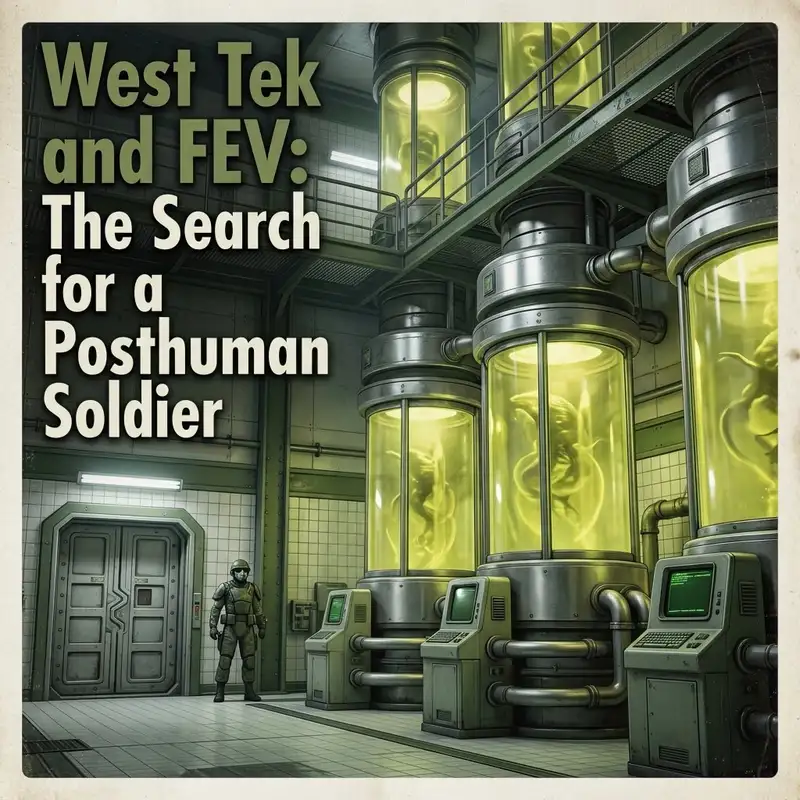
The recurring image of F E V vats matters because it makes the institutional chain visible. A vat is not merely a piece of machinery. It is the point where a political decision becomes biological fact. Someone must decide who enters it. Someone must supply the facility, record the result, guard the perimeter, and manage the consequences. Someone must decide whether a transformed person is a patient, a soldier, a prisoner, a citizen, or disposable evidence. The technology does not make those choices for them. It only gives them more destructive ways to enforce them.
Huntersville remains the clearest beginning point because it strips away later myths about mutant armies and apocalyptic power. Before the ruins, before the Brotherhood, before the Master, before the Enclave and the Institute, there was a town selected for improvement. Its people were promised economic recovery in a time of scarcity. Then their bodies were used to test an idea that powerful institutions believed they could control. The quarantine that followed was not a sign of mastery. It was evidence that the experiment had already escaped the moral boundaries its sponsors were unwilling to acknowledge.
West Tek’s central failure was not merely scientific unpredictability. The research failed because its military logic required secrecy, captive subjects, specialized facilities, and the denial of consent. It treated transformed and untransformed people alike as expendable inputs. F E V could alter bodies, sometimes dramatically, but it could not solve command, reproduction, supply, legitimacy, or human resistance. The search for a posthuman soldier produced no durable escape from human politics. It produced a lasting record of what happens when a state tries to secure its future by redesigning the meaning of who counts as human.