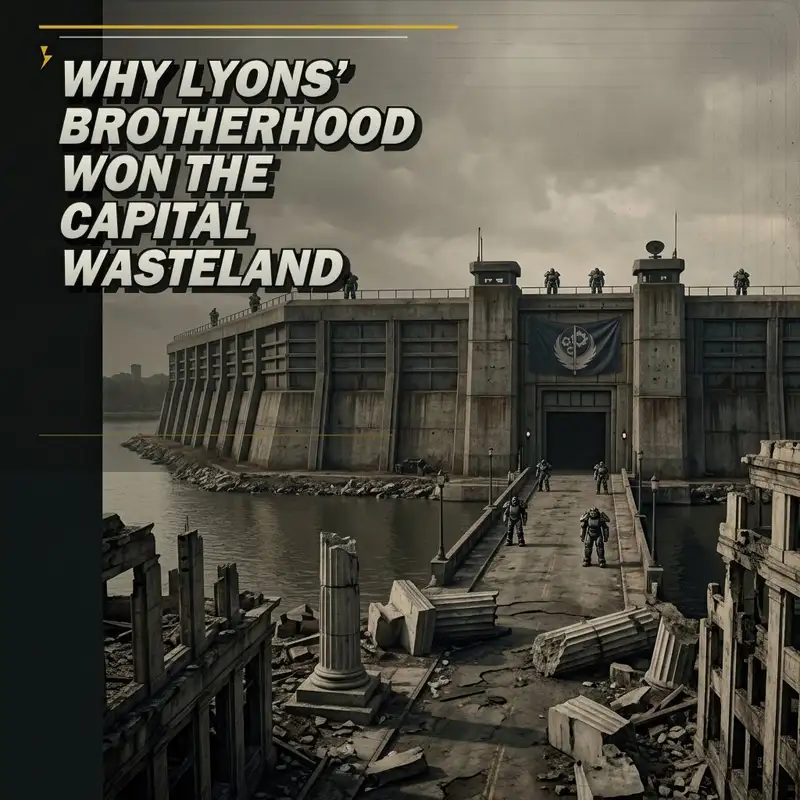
Why Lyons’ Brotherhood Won the Capital Wasteland
The Jefferson Memorial was not merely a ruin on the Potomac when the Enclave seized Project Purity. It became the most important piece of infrastructure in the Capital Wasteland. Whoever controlled the purifier could influence where clean water went, which settlements received it first, which caravans could travel safely, and which armed organization could present itself as the guardian of the region’s future. In a land where contaminated water, disease, raiding, and super mutant attacks had made ordinary survival precarious, the purifier was more valuable than another fortified ruin or weapons cache. It offered the possibility of turning technical capacity into political influence.
That was the moment Elder Owyn Lyons’ Brotherhood of Steel faced its defining test. The chapter had arrived more than two decades earlier as an expedition sent east to recover advanced technology from the remains of old American cities and military sites. It was not originally a government. It was not a humanitarian agency. It was not sent to administer the Capital Wasteland or solve its water crisis. Yet by the year twenty-two seventy-seven, it was the organization capable of contesting the Enclave for the purifier, deploying the region’s most formidable military asset, and emerging as the dominant armed power around Washington.
That is what it means to say Lyons’ Brotherhood won the Capital Wasteland. It did not conquer every settlement, eliminate every threat, or establish a civilian state. Its control was uneven, strongest around the Citadel, Project Purity, important routes, and major military objectives. But it defeated or outlasted the region’s principal organized enemies, secured its most consequential infrastructure, and became the power other communities had to account for. The question is why. Lyons commanded a small expedition far from the Brotherhood’s western heartland. His chapter lost experienced personnel in a painful internal schism. It depended on local allies, civilian scientists, and one exceptional independent actor. Yet it won because Lyons recognized a hard truth about the Capital Wasteland. Technology was not useful in isolation. It mattered only if people, institutions, supply lines, and settlements survived long enough to use it.
The Brotherhood expedition reached the Capital Wasteland in the year twenty-two fifty-five. It took possession of the Pentagon and converted the old military complex into the Citadel. That decision gave the chapter a defensible headquarters, access to old military infrastructure, room for workshops and archives, and a symbolic link to the armed power of pre-War America. But symbols do not feed troops or repair armor. The expedition had arrived in a ruined urban theater, far from the West Coast Brotherhood’s main authority, with limited personnel and no guarantee that the resources it found could be turned into a lasting presence.
Its original mission was technology recovery. Scribe Reginald Rothchild describes the expedition’s orders in terms familiar to the Brotherhood’s older tradition. The chapter was to search East Coast cities and military installations for advanced weapons, scientific assets, and dangerous technologies that should not simply be left in the hands of whoever found them first. This was a coherent mission. In the aftermath of nuclear war, a group with technical knowledge and military discipline had good reason to fear what ambitious warlords, raiders, corporations, or surviving military systems might do with old-world weapons.
But technology recovery was not the same thing as regional rule. A chapter sent to retrieve artifacts could avoid taking responsibility for every settlement outside its walls. It could preserve scarce personnel for high-value operations. It could argue that humanitarian aid, policing, and local politics would consume resources without advancing the Brotherhood’s core purpose. That was, in essence, the position later taken by the Brotherhood Outcasts. It had institutional logic. The Brotherhood was not large enough to be everything to everyone, and every paladin killed defending strangers was a paladin who could not guard a laboratory, escort a recovery team, or maintain a rare suit of power armor.
The discovery of Liberty Prime altered the expedition’s calculations. Beneath the remains of the old capital, the Brotherhood found an unfinished pre-War combat robot built for a much larger war. Liberty Prime was a strategic artifact of extraordinary potential, but it was also an unfinished machine requiring technical knowledge, parts, power, protection, and time. The chapter’s decision to remain in the region was encouraged by the possibility that it could restore this machine. Even then, the Brotherhood did not possess a simple path to victory. It had acquired a major project, not a completed weapon. The Citadel became permanent because the expedition found too much valuable technology to abandon, and because the region surrounding that technology made departure increasingly difficult.
The Capital Wasteland’s decisive problem was the super mutant threat. Lyons did not redirect the chapter merely because he found the suffering around him morally offensive, though there is every reason to believe that he did. He redirected it because super mutants made nearly every other Brotherhood mission harder. They threatened patrols, attacked settlements, captured human beings, disrupted travel, and turned the urban ruins around Washington into hostile ground. An expedition cannot preserve technology if its recovery teams are hunted on the roads. It cannot recruit skilled technicians from a population being destroyed. It cannot maintain trade, cooperate with scientists, or establish secure supply routes when the surrounding human environment is under constant pressure.
Over time, the Brotherhood learned enough to understand that the mutant problem had an identifiable source. The Capital Wasteland’s super mutants were connected to Vault Eighty-Seven, where forced exposure to the Forced Evolutionary Virus had created a continuing cycle of abduction and transformation. The mutants were not simply scattered monsters wandering the ruins. They were part of a system that consumed the region’s population. Every captive taken from a settlement was not only a human loss. It could become another enemy combatant, another reason for caravans to avoid a route, another blow to the fragile recovery of the Wasteland.
This was Lyons’ most important strategic insight. The Brotherhood’s traditional mission treated dangerous technology as the central threat. Lyons saw that dangerous technology existed inside a wider security environment. A laser rifle, a reactor, a military archive, or an unfinished combat robot had little civilizational value if the communities capable of supporting their use were disappearing. He did not abandon technology. He redefined why it mattered. The Brotherhood would preserve the means of rebuilding, but it would also protect the people and institutions without which rebuilding was impossible.
That adaptation came at a severe internal cost. By the year twenty-two seventy-six, the disagreement had become a schism. Paladin Henry Casdin and those who became known as the Outcasts broke with Lyons’ command. Their complaint was not merely personal resentment, even if resentment surely played its part. They believed Lyons had abandoned the Brotherhood’s mandate. In their view, he was spending irreplaceable soldiers, armor, and equipment on tasks that belonged to local militias, settlements, or no one at all. They wanted the chapter to return to the disciplined recovery and control of advanced technology.
The Outcasts were not cowards, and they were not irrational villains. They identified real risks. Lyons’ forces were small. Their equipment required maintenance. Their losses could not be easily replaced by a distant western organization that already disapproved of the elder’s policies. A military order that tries to protect an entire region may find itself fighting endless small wars, draining its best personnel, and slowly becoming responsible for civilians it has no capacity to govern. The Outcasts also understood that the Capital Wasteland was full of advanced weapons and military systems. If the Brotherhood failed to secure those systems, another faction might use them with catastrophic results.
Scribe Bowditch’s account makes the scale of the split clear. The chapter lost more allies through the schism than through any single battle. That is an extraordinary statement for an organization living amid super mutants, raiders, and later an Enclave invasion. It means the chapter’s greatest loss was institutional rather than battlefield. Experienced members left. Equipment left with them. Shared doctrine and trust fractured. Lyons retained command of the Citadel, but formal authority is not the same as unquestioned legitimacy. His authority increasingly depended on those who accepted his broader interpretation of Brotherhood duty and on the personal loyalty he inspired in the people who remained.
In one respect, the schism weakened Lyons. It reduced the manpower available for patrols, technical recovery, facility defense, and future campaigns. It also exposed a dangerous weakness in his command structure. Lyons had adapted the Brotherhood through personal authority. That gave him flexibility, but it tied the chapter’s direction to one elder’s judgment. In another respect, the split clarified the chapter’s identity. The Brotherhood that remained at the Citadel was no longer pretending that it could remain detached from the people around it. It had chosen to become a regional force, even if it had not yet developed the institutions required for regional governance.
Reduced manpower forced Lyons to seek strength from sources that a more insular Brotherhood expedition might have discounted. The chapter recruited locally. It formed working relationships with settlements and scientists. It made itself visible not as an occupying army, but as a protector with limited reach and significant capabilities. This did not make the Brotherhood democratic. It did not place the Citadel under civilian authority. It did not create elections, a legislature, or a public treasury. But it created a political relationship between the chapter and the Wasteland. The Brotherhood could gain information, recruits, supplies, goodwill, and practical cooperation because local people had reasons to prefer its presence to the alternatives.
Rivet City was central to that relationship. The aircraft carrier settlement possessed something the Brotherhood needed and could not manufacture by military discipline alone: a concentration of civilian technical knowledge, social networks, and surviving expertise. Project Purity depended on scientists, research, specialized equipment, and years of work. The Brotherhood assisted James and the Rivet City scientists, but it did not independently build the purifier or master every part of its operation. Its support became strained after the project stalled and personnel were lost. That limitation matters. The Brotherhood could defend a scientific project, transport equipment, and contribute technical resources, but power armor was not a substitute for hydrology, engineering, medical knowledge, and civilian labor.
The chapter’s relationship with Galaxy News Radio also mattered, though it should not be mistaken for neutral journalism. Three Dog was an advocate. His broadcasts promoted the Brotherhood’s battle against super mutants and the Enclave because he believed the chapter represented the best available defense of the Capital Wasteland. His reports were political messaging, not detached military analysis. Still, political messaging has real consequences. In a fragmented region where reliable information is scarce, a radio station can make military action visible. It can tell settlements that a force exists, identify threats, spread warnings, and shape the reputation of an organization that many people may never meet directly.
The Brotherhood’s public role helped convert military activity into legitimacy. A patrol that protects a road is useful. A patrol known to protect a road can encourage trade, migration, recruitment, and cooperation. A settlement that believes the Brotherhood will fight super mutants may share information or accept its presence. A young recruit who has seen Brotherhood soldiers defend civilians may see the Citadel as a source of purpose, training, and protection rather than merely another armed compound demanding obedience. This is not sentimentality. It is military infrastructure in a society where formal government is weak. Trust, reputation, and access to local knowledge can matter as much as a fortified wall.
Lyons’ Brotherhood gained legitimacy through service, protection, and association with projects that offered a public good. It did not gain legitimacy through taxation or comprehensive administration. That distinction would shape both its success and its limitations. The chapter could influence the Capital Wasteland by protecting specific sites, supporting allied communities, recruiting local people, and fighting visible threats. It could not reliably police every road, settle every dispute, regulate every market, or guarantee that its promises would reach every isolated settlement. Its power was real, but it was concentrated in nodes: the Citadel, its patrol routes, Rivet City relationships, technical facilities, and eventually the purifier.
Those relationships mattered because Brotherhood technology was never self-sustaining. The familiar image of a knight in power armor can obscure the institutional machinery behind the armor. A suit requires trained users, maintenance, repairs, replacement components, power, ammunition, weapons support, workshops, and secure storage. Energy weapons require technical knowledge and functioning supply chains. Sensors and communications equipment need people who can operate and repair them. A force can recover a cache of pre-War equipment, but recovery is not the same thing as sustained use. The old world left behind a vast graveyard of machines. Most of them could not be brought back into service by optimism and a screwdriver.
The Citadel gave Lyons’ chapter a place to build that support system. It was a command center, a secure depot, a technical archive, a repair site, and a defensible base from which patrols could operate. The scribes were as important to this arrangement as the paladins. Scribe Rothchild and the technical staff did not merely catalogue artifacts. They turned recovered knowledge into military capability. They worked on Liberty Prime, evaluated old technology, maintained equipment, and provided the specialist expertise that allowed the Brotherhood to use systems too complex for a militia to sustain.
The chapter’s technical advantage was therefore genuine but narrow. The Brotherhood possessed better equipment than most local forces, a defensible base, trained personnel, and access to specialized knowledge. It also had scarce manpower, constant maintenance demands, and a broad mission that stretched its resources. Lyons’ achievement was not that he solved those constraints. It was that he used the resources he had to build an operating position stronger than the individual pieces suggested. He connected soldiers to scribes, a military base to civilian allies, technical recovery to regional security, and public protection to recruitment.
That operating position was tested by the Enclave. The Enclave was a far more sophisticated opponent than the super mutant bands that had dominated much of the Wasteland’s daily danger. It had advanced armor, trained soldiers, vertibirds, a major headquarters at Raven Rock, and a claim to represent the legitimate continuation of the United States government. Its forces could move by air, deploy advanced weapons, and use the authority of old-world symbols more aggressively than Lyons’ chapter ever could. Against a conventional militia, the Enclave might have imposed itself quickly.
But the Enclave was not a unified machine. Its political authority rested in President John Henry Eden, an artificial intelligence claiming the presidency from Raven Rock. Its military power rested substantially with Colonel Augustus Autumn and the officers under his command. Eden and Autumn did not share one stable strategy. Eden pursued a catastrophic plan involving the purifier and a modified water supply. Autumn opposed that plan and sought to use Project Purity differently, as a source of political leverage and control. This division did not make the Enclave harmless. It made its command structure brittle at the moment it most needed cohesion.
Project Purity was essential to the Enclave precisely because the organization’s old claim to national authority had little practical meaning in the Capital Wasteland. A uniform, a vertibird, and a presidential broadcast could establish presence. They could not establish consent. The Enclave had not spent years protecting settlements from super mutants. It had not developed the local relationships that linked Lyons’ chapter to Rivet City and other communities. It entered the region as an armed claimant with superior technology but little civilian trust. Control of clean water offered a way to change that equation. Distribution could create dependency. Access could become a bargaining tool. A military occupation of the Jefferson Memorial could be converted into regional influence.
The Enclave’s weakness was not incompetence. Its personnel were dangerous, its equipment formidable, and its objectives strategically sound in the narrow sense that water distribution could indeed shape the Wasteland’s future. The weakness was political and institutional. It relied on coercion in a region where it had no social foundation. Its leadership was divided. Its military structure was elite and limited rather than rooted in a broad local population. It could seize the purifier, but it had not yet demonstrated that it could operate a water network, protect it, distribute its output, and persuade the region to accept Enclave authority.
The conflict was not resolved through one symmetrical clash between two armies. It turned on the convergence of Enclave fragmentation, Brotherhood preparation, civilian scientific work, and the intervention of the Lone Wanderer. The Lone Wanderer was an exceptional independent actor whose exact personality, moral decisions, companions, and route through the Wasteland remain undefined. But several contributions are fixed in the history of the campaign. The Wanderer exposed the connection between Vault Eighty-Seven and the super mutant crisis, recovered the Garden of Eden Creation Kit needed for Project Purity, became involved in the struggle around Raven Rock, and fought alongside the Brotherhood in the contest with the Enclave.
These actions mattered because they connected problems the Brotherhood could not easily solve through ordinary force. The Garden of Eden Creation Kit was not simply another artifact. It was essential to completing the purifier. Vault Eighty-Seven was not a normal military target. It was a heavily dangerous site tied to the mutant threat, and access to its interior depended on circumstances beyond the Brotherhood’s conventional reach. Raven Rock was an Enclave headquarters protected by an enemy that possessed stronger air mobility and significant technological advantages. The Lone Wanderer moved through spaces, gained information, and reached decision points that an organized military force could not necessarily approach without prohibitive cost.
That does not mean the Lone Wanderer replaced the Brotherhood. A single exceptional actor can influence a mission, expose a weakness, retrieve an irreplaceable device, or force a decision. But strategic results require an institution able to exploit those events. The Brotherhood supplied the Citadel, the technical staff, the command framework, the armed personnel, and the ability to turn intelligence into a campaign. The scientists of Project Purity supplied expertise the Brotherhood lacked. Rivet City and other local relationships provided practical support and legitimacy. The Lone Wanderer was a force multiplier, not a substitute for the military and civilian systems that made the final victory meaningful.
The loss of Raven Rock was one of the campaign’s crucial blows. It struck at the Enclave’s headquarters and disrupted the political structure that had claimed authority over the operation. Exactly how every decision inside Raven Rock unfolded depends in part on the path taken by the Lone Wanderer, and the record does not allow a simple account of one universal sequence. What is clear is that the Enclave emerged from the loss of its headquarters in disarray. Its command cohesion suffered. Its claim to be an organized national restoration force became harder to sustain when its own political center had fractured.
The Battle of Project Purity then turned that disruption into a military defeat. Liberty Prime marched with Brotherhood forces toward the Jefferson Memorial, breaking through Enclave resistance and allowing the Brotherhood to assault the purifier. In the immediate fight, Prime gave Lyons’ forces an extraordinary advantage. It could absorb punishment, destroy fortified positions, and provide a breakthrough capability the Brotherhood otherwise lacked. Against an enemy using advanced armor and prepared defenses, that mattered. The Brotherhood’s conventional assault was no longer simply an attempt to fight its way through a stronger technological opponent. It had a weapon specifically capable of rupturing the Enclave’s defensive line.
Across the wider campaign, the battle denied the Enclave control of the Capital Wasteland’s key infrastructure. This was more important than the destruction of enemy soldiers at any one location. The Enclave had attempted to seize Project Purity because the purifier could connect military power to regional influence. Once the Brotherhood regained the facility, it did not merely remove an Enclave garrison. It acquired the means to distribute a public good that ordinary settlements could not produce for themselves. The victory protected Rivet City’s scientific work, preserved the project’s purpose, and gave Lyons’ chapter a role at the center of postwar recovery.
Nor did the battle produce complete territorial control. The Brotherhood did not suddenly occupy every ruin, settlement, and road in the Capital Wasteland. It did not eliminate all Enclave forces in one action. Raven Rock’s loss and the defeat at the purifier damaged the Enclave’s ability to act as a unified challenger, but remnants remained. The Wasteland also remained dangerous for the old reasons. Raiders, hostile creatures, contaminated terrain, insecure routes, and the ordinary fragility of postwar life did not disappear because the flag at the Jefferson Memorial changed.
Broken Steel makes the next stage of Lyons’ victory clear. Capturing Project Purity created a logistics problem. The Brotherhood could not simply hold the facility and declare the water crisis solved. Purified water had to be moved. Caravans required guards, routes required security, equipment required maintenance, and distribution required cooperation with communities beyond the Brotherhood’s immediate reach. The chapter continued its campaign against Enclave positions while also operating the purifier and sending out Aqua Pura. These were not separate missions. They were two sides of the same strategic challenge. The Brotherhood had to defend the infrastructure that gave it political relevance while preventing Enclave remnants from recovering enough strength to threaten it again.
Rivet City security assisted with water caravans. That detail is important because it reveals the limits of Brotherhood power. The chapter was dominant, but it could not secure every route alone. It needed local cooperation. The water network was vulnerable to ambush and disruption. A purifier at the Jefferson Memorial could create clean water, but it could not personally escort every shipment across a hazardous region. Possession of the plant did not equal control of the entire distribution system. The difference is the difference between winning a battle and sustaining an order.
The distribution of Aqua Pura was humanitarian relief, but it was also political power. Communities that received clean water had a material reason to see the Brotherhood as useful. Caravans extended the chapter’s presence beyond the Citadel and the Memorial. They created opportunities for cooperation, trade, information exchange, and recruitment. They also imposed costs. Every caravan required transport, personnel, supplies, route knowledge, and security. Free distribution could build legitimacy, but it could not be free to the institution providing it. Someone had to maintain the purifier. Someone had to protect the water. Someone had to decide where it went when demand exceeded the ability to deliver it safely.
That was not necessarily a failure of intention. Lyons had inherited an expeditionary military order, not a functioning republic. Building a state requires more than courage, weapons, and a water plant. It requires administrators, laws, revenue, dispute resolution, food systems, transport networks, records, local consent, and a way to replace losses without exhausting the same small cadre of trained people. The Brotherhood had technical expertise and military discipline, but those assets could not automatically create political institutions. Its legitimacy was based on protection and service. That gave it influence, but it also meant that its authority depended on continuing performance.
Lyons’ personal leadership intensified the problem. His willingness to adapt had saved the chapter from becoming irrelevant in the Capital Wasteland’s actual threat environment. He saw the need to protect civilians, cooperate with scientists, and treat water infrastructure as strategically decisive. But a system shaped heavily by one elder’s judgment can struggle when that elder is gone. The Outcast split had already shown that the chapter lacked full doctrinal unity. The manpower shortage showed that its mission had exceeded the inherited model of a small technology-recovery expedition. Its postwar responsibilities only increased those pressures.
Later history, as recorded by the Brotherhood aboard the Prydwen, confirms both the durability and incompleteness of Lyons’ legacy. Before the year twenty-two eighty-seven, Arthur Maxson reunited the Capital Wasteland Brotherhood with the Outcasts. The reunified organization restored a stronger emphasis on technology recovery and Brotherhood tradition. That development can be read as a correction to Lyons’ experiment. The chapter needed more manpower, greater internal cohesion, and a clearer institutional relationship to the Brotherhood’s older mission. A force that intends to operate beyond one fortified headquarters cannot remain permanently divided over why it exists.
But later criticism of Lyons should not be accepted as an objective verdict. When later Brotherhood figures describe his policies as misguided or foolish, they are expressing an institutional memory shaped by their own priorities. Maxson’s Brotherhood did not simply erase Lyons’ legacy. It retained local recruitment, a practice that had helped Lyons replace losses and connect the chapter to the region it defended. It also retained the distribution of purified water without charge, preserving the idea that Brotherhood power could be justified through public service as well as control of technology. The later organization changed the balance between those principles. It did not prove that Lyons had been wrong to establish them.
Lyons’ Brotherhood won because it understood that the Capital Wasteland’s center of gravity was not a pile of recovered machines. It was the human environment around those machines. Super mutants threatened the population base on which every settlement, route, scientific project, and recruitment effort depended. Project Purity offered a way to turn technical capacity into civilian survival and political legitimacy. The Enclave possessed superior equipment and mobility, but it lacked deep local support and suffered from divided command. Liberty Prime gave the Brotherhood a decisive breakthrough asset, but only after years of technical work, institutional adaptation, and cooperation with people outside the Brotherhood’s walls.
The victory was substantial. Lyons’ chapter reduced the super mutant threat, defeated the Enclave’s attempt to control the purifier, continued operations against Enclave remnants, and became the Capital Wasteland’s dominant military power. Yet it remained a dominant protector rather than a durable government. Its water caravans still required escorts. Its routes remained vulnerable. Its manpower was limited. Its authority depended heavily on personal leadership, local cooperation, and the continuing performance of a few critical institutions. The later reunion with the Outcasts showed that battlefield success had not solved the chapter’s deeper organizational problem.
Lyons’ lasting achievement was not that he made the Brotherhood abandon its mission. It was that he made the mission answer to reality. He recognized that preserving civilization’s technology meant protecting the people, knowledge, infrastructure, and fragile trust that allowed civilization to exist at all.