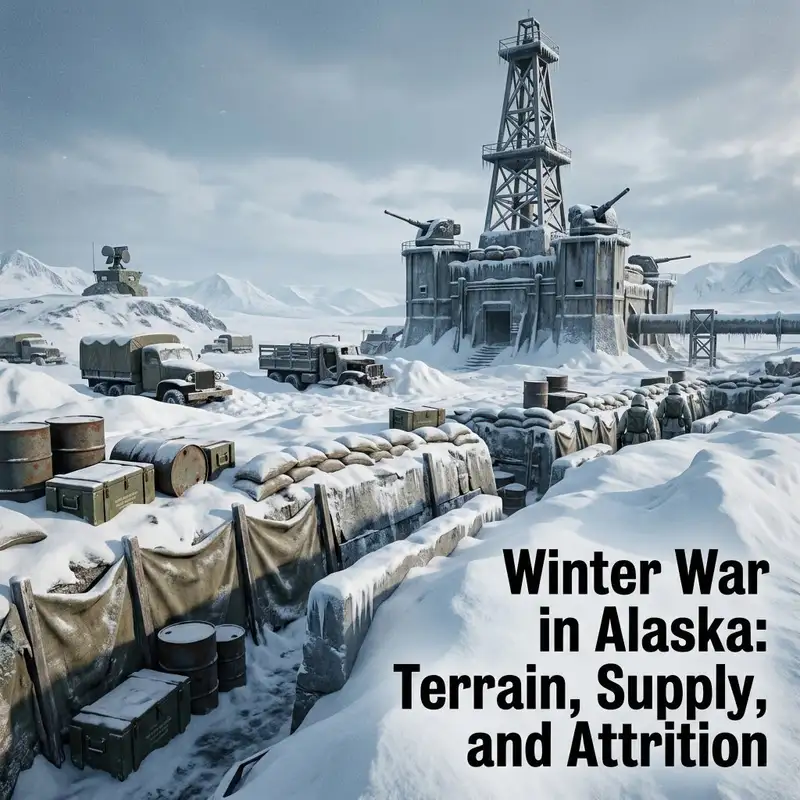
Winter War in Alaska: Terrain, Supply, and Attrition
By January of twenty seventy-seven, American forces could claim that Anchorage had been reclaimed. The city, or at least the ground the United States defined as the decisive urban objective, was back in American hands. General Jingwei, the Chinese commander associated with the campaign, was dead. The photographs, newsreels, and military stories could now present a victory with clean lines. Alaska had been invaded. America had endured. America had struck back.
But the fighting did not simply end when the city was declared recovered. Cleanup operations continued until January twenty-eighth, when an all-clear was reportedly issued and American alert status was reduced. That gap matters. It is the difference between entering a city and securing its approaches, between breaking an enemy position and clearing the scattered forces, damaged infrastructure, hidden weapons, and uncertain intelligence left behind. A battlefield can be won before it becomes safe. A theater can be secured before the larger war is decided.
That distinction is the key to Alaska. The Anchorage campaign is often remembered through a story of armored soldiers advancing through snow, artillery hammering Chinese defenses, and a final American breakthrough. There is truth in that image. Yet it also comes to us through a military simulation shaped for training, commemoration, and institutional pride. The surviving account gives us a useful outline of the campaign. It is much less reliable as a literal map, a complete order of battle, or a record of every decision made in the snow.
The real question is not whether the United States won at Anchorage. It did. The question is how a campaign in North America became an eleven-year struggle of cold, fortifications, failing machinery, exhausted people, and shrinking supply lines. The answer begins with oil, but it does not end there. Alaska became a battlefield because resources mattered. It became a winter war because neither side could escape the physical burden of reaching, feeding, repairing, and reinforcing an army at the far edge of a continent.
Alaska mattered to the pre-War United States because it was tied to energy infrastructure at a moment when energy had become a strategic obsession. Its oil reserves and the Trans-Alaska Pipeline made the region more than a distant frontier. They made it part of the national system that supported industry, transport, military power, and the political promise that American society could continue consuming at wartime scale.
In a less desperate age, the pipeline might have been treated as an economic asset. During the Resource Wars, it became something closer to strategic terrain. Whoever controlled the infrastructure around it could influence the movement of energy. Whoever threatened it could impose costs far beyond Alaska. A pipeline did not need to be destroyed to become militarily useful. It only needed to be vulnerable enough that an opponent had to defend it.
That is one reason the Anchorage front mattered. It guarded access to energy resources and protected approaches into the North American system. It also exposed the limits of that system. Infrastructure is not power by itself. A pipeline needs repair crews, security, pumping systems, transport links, spare components, and political authority capable of coordinating all of them. A port, a road, a depot, or an airfield becomes strategically valuable only when someone can sustain its operation under attack.
China’s interest in Alaska was therefore not mysterious. An invasion could threaten American energy resources, establish a forward position near the continent, and force the United States to spend men, equipment, and political attention in an expensive northern theater. The Chinese objective was not necessarily to occupy every mile of Alaska. No surviving account allows that kind of precision. It was enough to seize or threaten the infrastructure that made Alaska strategically important and to hold ground costly for the United States to recover.
The Chinese invasion began in the winter of twenty sixty-six, under General Jingwei. The broad outline is established. Chinese forces entered Alaska, American defenders were initially overwhelmed, and the Anchorage region became the center of a long occupation and counteroffensive. The details are much less certain. The record does not securely establish exact landing sites, troop strength, supply routes, or the full extent of Chinese control over Alaskan oil facilities.
That uncertainty should not be mistaken for insignificance. Large wars often leave incomplete records, especially when governments classify operations, cities are damaged, archives are destroyed, and later propaganda replaces practical reporting. In Fallout’s pre-War world, those problems were intensified by censorship, militarization, corporate secrecy, and the approach of nuclear catastrophe. What survives tells us enough to understand the military problem. It does not tell us enough to draw neat arrows across a map and pretend that every unit movement is known.
China invaded a theater that punished movement. Alaska’s winter conditions turned ordinary military needs into operational hazards. Cold affected people before they reached the battlefield. It threatened exposed troops, complicated sleep, slowed work, damaged equipment, stiffened materials, and increased the demand for shelter and heating. Snow reduced mobility and obscured terrain. Mountains and narrow corridors restricted movement. Long distances made every delay more expensive. Roads, bridges, depots, and transport routes became more important because there were fewer alternatives when one failed.
A defending force could use those conditions well. Prepared positions in snow and broken terrain were difficult to assault. Concealment became easier. Observation became unreliable. An attacker might see only the next ridge, the next trench line, or the next fortified point, while the larger pattern of defenses remained hidden. A force that knew where to place weapons, mines, scouts, and supply caches could make a small piece of ground cost far more than its size suggested.
But difficult terrain does not create security by itself. It only changes the price of maintaining security. China could use Alaska’s cold and geography to slow an American counterattack. It could fortify positions and force the United States into costly advances. Yet a forward army still required food, ammunition, medical support, communications equipment, replacement personnel, and the means to repair weapons and vehicles. A position can survive an assault and still fail because it cannot be resupplied.
The American response became known as the Alaskan Reclamation Operation, associated in surviving accounts with General Constantine Chase. Chase occupies a prominent place in the remembered campaign, particularly because he later influenced the simulation that preserved much of its popular image. He was clearly important to the American story of Anchorage. What remains unclear is the exact inter-service command structure, the full distribution of authority, and how closely his personal role matched the heroic picture later attached to him.
What is clearer is that the reclamation was not a rapid counterstroke. It became a prolonged campaign of bombardment, trench warfare, winter hardship, limited advances, and pressure on Chinese positions. The American objective was not merely to win encounters. It was to reverse an occupation and make the Chinese presence in Alaska impossible to sustain. That required more than tactical bravery. It required an organization capable of concentrating resources in one of the least forgiving environments on the continent.
This kind of warfare is often described with the word attrition, which can make it sound passive, as if armies simply waited for one another to weaken. In practice, attrition is active. It means attacking the systems that allow a force to remain in the field. It means forcing the enemy to consume ammunition faster than it can replace it, to move supplies through contested routes, to repair machinery under fire, to care for wounded troops in worsening conditions, and to commit reserves before it wants to.
The American campaign appears to have applied that pressure over years. Bombardment could damage fortified positions and infrastructure. Ground assaults could force Chinese units to spend their supplies, reveal their positions, and retreat from terrain prepared at considerable cost. Pressure on supply lines could turn every isolated strongpoint into a liability. The goal was not always immediate destruction. Sometimes it was enough to make a position more expensive to hold than the ground was worth.
For American troops, endurance required a continental support system. They needed food that could reach the front in winter. They needed cold-weather clothing, shelters, medical facilities, transport, ammunition, weapons maintenance, communications gear, and replacement parts. They needed mechanics, medics, engineers, drivers, quartermasters, and laborers, not only infantry and armored troops. A war in Alaska could not be fought by combat formations alone. It depended on people who kept engines turning, radios working, wounds treated, and supplies moving.
The cold made failures cumulative. A damaged vehicle or weapon was not simply an inconvenience. It could become a stranded asset in hostile terrain. A delayed resupply convoy could become a shortage at the front. A shortage of heating fuel or protective clothing could reduce unit effectiveness before an enemy attack began. Medical evacuation took longer, and the distance between a casualty and meaningful care could be as dangerous as the original wound. In these conditions, maintenance was part of combat power.
The United States also depended on access through Canada. That logistical reality had political consequences. Moving personnel, supplies, and military equipment toward Alaska required North American routes that did not stop politely at the border when Washington’s strategic needs intensified. Canada’s territory became increasingly important to American war planning. The erosion of Canadian sovereignty, and eventually annexation, cannot be understood without recognizing this pressure.
That does not mean Alaska alone caused the annexation of Canada. The broader war, resource crisis, and American political culture all mattered. But the Alaskan theater made the issue concrete. A government committed to retaking Alaska saw Canadian territory not only as another country’s land, but as a corridor between American industry and an endangered front. That is the logic of total mobilization. Geography becomes an administrative problem. Allies become routes. Sovereignty becomes an obstacle to be managed.
The Chinese army faced a different version of the same problem. Its forces could establish defensive positions, exploit concealment, and use the terrain against American assaults. Chinese stealth technology, where it appeared, added to the difficulty of locating and engaging defenders. Yet an army operating across the Pacific or dependent on distant connections faced a hard limit. It had to maintain access to external supplies and reinforcements despite weather, bombardment, American operations, and the strain of the wider Sino-American War.
We do not know the precise routes, shipping schedules, tonnage, or naval arrangements that supported Chinese forces in Alaska. The historical record does not justify that level of confidence. But the broader operational conclusion is sound. China’s Alaskan army became vulnerable as its ability to replace losses, move supplies, and preserve infrastructure declined. A force can fight effectively from prepared ground for a long time. It cannot do so indefinitely if its material base is being steadily reduced.
This was the actual battlefield of Alaska. Not one ridge. Not one bunker. Not one dramatic assault. The battlefield was the chain linking factory, depot, transport route, repair shop, field kitchen, aid station, radio relay, artillery position, and front-line trench. It was the ability to move a winter coat to the soldier who needed it, a component to the technician who could install it, and an order to the unit that still had the strength to execute it.
Power armor entered this environment as an adaptation to a defined military problem. The United States had been developing powered armor before and during the Alaskan campaign, and the war became closely associated with its operational use. Early T forty-five power armor represented an effort to give troops protection and mobility in a conflict increasingly shaped by fortified positions and dangerous conditions. Later, winterized T fifty-one B units became closely associated with the final offensive around Anchorage.
The appeal is obvious. A power-armored soldier could bring protected mobility and heavy assault capability to ground that had punished ordinary infantry. Against fortified positions, that mattered. Armor could help troops survive fire that might stop a conventional advance. It could allow them to carry heavier weapons, breach difficult defenses, and keep moving in conditions where exposure was a constant threat. In the final stages of the campaign, this advantage appears to have been real.
But armor was not a substitute for an army. A power armor unit required trained operators, technicians, weapons, ammunition, replacement components, transport, repair facilities, and some form of reliable power support. Winterization reduced specific environmental burdens. It did not abolish cold, exhaustion, mechanical failure, or the difficulty of moving damaged equipment through snow. A suit that could operate effectively in Alaska still had to be supplied by an institution capable of keeping it in service.
This is why the idea that one model of armor won Alaska is too simple. The T fifty-one B mattered because it was part of a larger system that had endured long enough to use it. The United States still possessed industrial capacity, technical expertise, and transport networks sufficient to bring specialized equipment into the theater. It could organize trained formations around that equipment. It could support operations that combined armor, infantry, artillery, engineering, and logistics.
The value of power armor was therefore institutional as much as technical. A nation that can build advanced equipment but cannot repair or replace it has created a handful of impressive artifacts. A nation that can train operators, manufacture components, transport supplies, and coordinate combined operations has created military capability. Alaska demonstrated both sides of American power. It showed technological adaptation. It also showed how much coercive organization and industrial sacrifice were required to make that adaptation useful.
The campaign’s final phase came after years of pressure had weakened the Chinese position. Later accounts describe Chinese supply lines collapsing under the combined effects of weather, bombardment, American operations, damaged infrastructure, and the broader strains of the war. That description should not be treated as a single event. It was a process. An isolated position lost value as resupply became less reliable. A damaged route became more serious when there were fewer reserves. Equipment losses became harder to absorb when replacements arrived slowly or not at all.
Chinese forces retained important advantages for much of the campaign. They had prepared defenses, familiarity with the ground they held, concealment, and the ability to force American troops into costly assaults. They did not need to defeat the United States outright in every encounter. They only needed to make reclamation expensive enough, slow enough, and politically painful enough that Washington might accept an unfavorable situation in Alaska.
The United States eventually made that strategy fail. It did not do so by discovering that winter no longer mattered. It did so by imposing more demands on the Chinese position than China could meet. Bombardment and ground operations reduced the security of fixed defenses. Logistics pressure limited recovery. The larger war placed demands on Chinese resources elsewhere. The Alaskan army’s ability to absorb losses narrowed until holding Anchorage became a burden rather than a strategic advantage.
The exact sequence remains incomplete. We cannot responsibly identify the one convoy destroyed, the one pass captured, or the one fortification whose fall decided the theater. The evidence does not give us that kind of clean causation. What it gives us is a broader pattern. China’s Alaskan forces became progressively isolated. American forces improved their ability to exploit that isolation. By the final offensive, the issue was no longer simply whether American troops could enter Anchorage. It was whether Chinese troops could still sustain organized resistance around it.
Anchorage was reclaimed by January tenth, twenty seventy-seven. The final American drive is strongly associated with winterized T fifty-one B power armor and the destruction or collapse of Chinese defensive capacity in the area. General Jingwei died during this final phase. Those broad points belong to the surviving history of the campaign. The more vivid details often attached to them require caution.
The best-known depiction comes from the Anchorage Reclamation simulation, created by Virtual Strategic Solutions for the United States Army. In that simulation, the campaign becomes a sequence of recognizable military tasks. A participant moves through snowbound ground, attacks fortified positions, receives equipment at convenient points, confronts visible enemy formations, and reaches a climactic confrontation with Jingwei. It is an effective military story. It is also almost certainly not a literal record.
A simulation can preserve genuine institutional memory while still simplifying the war it depicts. The terrain in the program may evoke Alaska without reproducing its geography. The density of enemy troops may serve training and drama rather than historical force structure. Equipment dispensers and mission loadouts reflect the needs of the exercise, not necessarily the daily reality of wartime supply. The apparent final confrontation with Jingwei cannot establish the exact circumstances of his death.
The simulation does support several broad conclusions. American forces fought across fortified, snowy terrain. Artillery and assault operations mattered. Chinese positions were pressured and progressively isolated. American power armor played a meaningful role in the remembered final offensive. But it cannot tell us, with documentary precision, which unit stood on which ridge, how many soldiers died in a particular assault, or whether any commander personally led the action exactly as portrayed.
That limitation matters because the simulation was shaped by General Chase himself. Records connected to its development indicate that Chase objected when the reconstruction did not feel right to him, and that he exercised influence over its tactical data, environment, and presentation. That does not mean he invented the campaign. It means the version preserved in the program was filtered through a commander’s memory, preferences, and understanding of what the victory ought to mean.
Military organizations do this routinely. They turn confused operations into coherent lessons. They reduce delay, fear, repair work, miscommunication, and exhaustion into a sequence that can be taught. There is practical value in that process. A training simulation needs objectives. It needs identifiable threats. It needs a usable story of cause and effect. The problem begins when the training story becomes the public memory of the war.
The Anchorage simulation privileges individual action. It emphasizes decisive breakthroughs, visible enemies, advanced weapons, and the moment when a determined American force breaks through Chinese resistance. What it obscures is the long labor that made such a breakthrough possible. It does not dwell on warehouse inventories, frozen vehicles, delayed replacements, exhausted medical staff, damaged radios, frightened civilians, or the political decisions required to keep an army supplied for more than a decade.
That is not an accidental omission. A clean victory is useful to a state at war. It reassures the public that sacrifice produced results. It tells soldiers that superior training and equipment can overcome hardship. It reinforces confidence in commanders and institutions. It gives a troubled government a story in which national endurance is rewarded. The bureaucratic machinery behind the story may be enormous, but bureaucracy rarely gets a statue.
The actual victory was still real. Anchorage was reclaimed. Chinese operational capacity in Alaska was broken. Cleanup continued, then an all-clear was issued. Those were substantial military achievements. The United States had recovered ground that had seemed endangered for years, restored a measure of control over strategic infrastructure, and demonstrated that China could be pushed from a major North American theater.
On the ground, American forces had defeated or displaced Chinese defenders around Anchorage. Across the campaign, they had made the Alaskan position untenable. These are not minor accomplishments. A long reclamation campaign had succeeded in its immediate mission. The United States could now show that it had not merely endured invasion. It had reversed it.
Strategically, however, the result was far more limited. The Sino-American War continued. Peace efforts did not produce a durable settlement. The wider resource crisis remained unresolved. Domestic unrest, food shortages, political repression, and public fear did not disappear because Anchorage had been liberated. The campaign removed one urgent threat. It did not solve the system of pressures that had created the threat.
This is the difference between a military victory and peace. A military victory changes the situation on the ground. Peace requires that the political causes of conflict, or at least the ability of the parties to continue fighting, be altered enough to create a stable settlement. Anchorage changed the military balance in Alaska. It did not end the rivalry, scarcity, suspicion, and militarization that drove the larger war.
For the American government, the liberation was politically valuable precisely because the larger situation was so unstable. It provided proof that sacrifice, industrial mobilization, and military technology could still produce visible success. In a society under strain, the image of armored troops reclaiming frozen territory had immense propaganda value. It suggested that the United States remained capable, united, and technologically superior.
The era also had a deep faith in spectacular technological answers. Liberty Prime, the enormous military robot associated with the conflict, represented that tendency. It was an expression of American ambition, not a complete explanation of the Alaskan victory. The record supports its importance as a wartime project and symbol more clearly than it supports any claim that it decided the campaign. Alaska was won through sustained operations, not by a single machine appearing at the decisive moment.
The costs of that success did not remain in Alaska. Sustaining a northern war required industrial priorities that reached into civilian life. Reports of shortages and military stockpiling suggest an economy under extreme pressure. Civilian infrastructure could be redirected toward war needs. Production decisions that might once have served homes, transport, or ordinary commerce were increasingly shaped by military demand. In a total war economy, the front line is connected to every factory floor and ration queue.
The long campaign also strengthened institutions designed for coercion. Troops trained for external war did not vanish once a front stabilized. Veterans and military units associated with Alaska later became involved in domestic crowd control. That fact reveals something troubling about the pre-War United States. A state that had mobilized to defend resources abroad and at its borders increasingly turned the tools of war inward when confronting unrest at home.
The historical record is thin when it comes to ordinary civilian life in wartime Alaska. We cannot honestly provide casualty totals, detailed evacuation plans, or a complete account of Chinese occupation policy. We do not know enough to reconstruct every community’s experience. Yet it is reasonable to say that residents, workers, and local institutions were subordinated to military priorities. The campaign centered on strategic infrastructure, contested territory, and the needs of large armies. Civilian life would have been shaped by those demands whether or not it appears in the polished military memory of the battle.
That is another thing the simulation leaves at the edge of the screen. It shows enemy positions and American objectives. It does not show the full human landscape around them. It does not show families displaced by fighting, laborers maintaining essential systems, local communities trying to survive shortages, or the people whose homes became routes, fortifications, depots, and targets. Military history can become dangerously clean when civilians appear only as absent background.
Alaska’s campaign therefore carried a contradiction. The United States recovered territory and protected strategic resources, but it did so by expanding the very systems of militarization, extraction, and political control that were destabilizing the country. Reclaiming a pipeline route could restore access to energy. It could not repair a society already organized around permanent emergency. Winning an external campaign did not reduce the temptation to use force internally.
By the time the all-clear was issued in late January, the United States had achieved something real. It had made China’s forward position in Alaska unsustainable. Terrain had favored the defender, but terrain could not supply an isolated army forever. Winter had slowed the American advance, but it had also magnified the consequences of Chinese shortages, damaged infrastructure, and declining reinforcement. The campaign had become a contest of institutions, not merely soldiers.
Alaska lasted so long because the environment amplified every weakness in maintenance, intelligence, evacuation, and supply. Cold, mountains, snow, distance, and limited transport corridors amplified every weakness in maintenance, intelligence, evacuation, and supply. Neither side could simply move at the pace it wanted. Every assault depended on preparations that took time. Every loss created a demand for replacement. Every damaged route made the next operation harder. The war was not decided because one army found courage and the other lost it. It was decided because one side gradually lost the capacity to continue paying the material cost of holding the theater.
American power armor was important within that process. It gave the United States an adapted assault capability at a crucial stage of the campaign. But armor alone did not deliver Anchorage. The decisive advantage came from the system behind it: industry, training, transport, repair, bombardment, supply networks, and enough political will to sustain them. Power armor was an instrument of victory, not the entire explanation for it.
The Anchorage Reclamation simulation preserves that victory in a form its creators could use. It gives us snowy defenses, advancing armor, American determination, and a clear end point. Those things are not meaningless. They are part of the campaign’s history. But the simulation transforms an eleven-year struggle of supply, maintenance, isolation, and institutional endurance into a cleaner legend of battlefield triumph.
The United States proved that it could reclaim Alaska. It did not prove that it could convert that military success into peace, political stability, or escape from the crisis that would destroy the world nine months later.