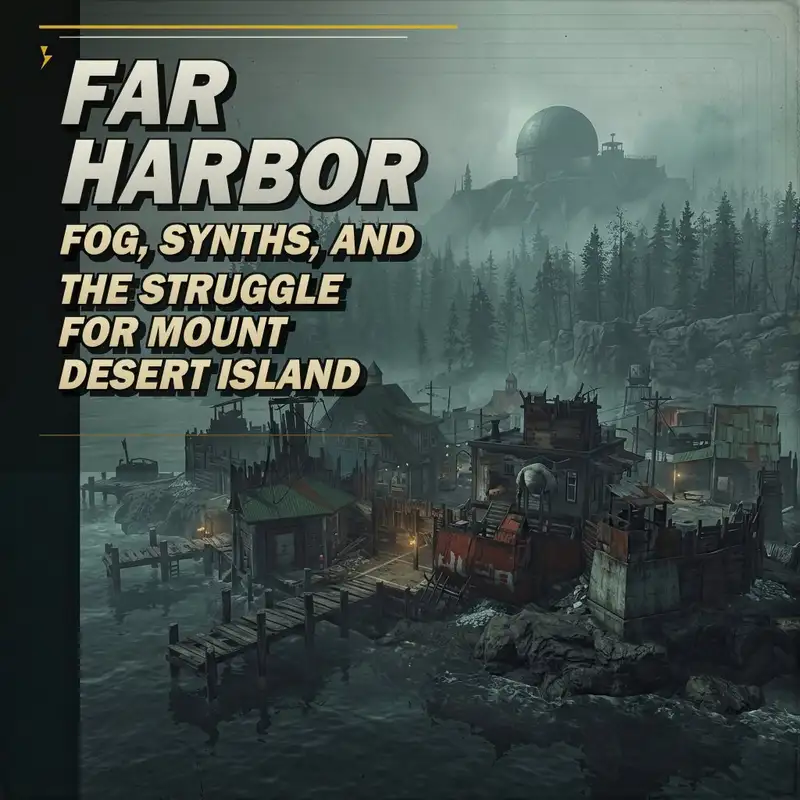
Far Harbor: Fog, Synths, and the Struggle for Mount Desert Island
Above Far Harbor, the wind farm does not look like a fortress. It has no curtain wall, no artillery battery, and no parade ground. Yet its turbines and control systems perform the most important defensive mission on Mount Desert Island. They provide power to the Fog condensers that keep a portion of the radioactive mist away from the town below. If that system fails, Far Harbor does not merely lose electricity. It loses the thin boundary between inhabited ground and an environment that can poison, isolate, and kill. Homes become exposed positions. Fishing grounds become harder to reach. Roads become uncertain. Families face the prospect of retreating, scattering, or dying where they live.
That makes the wind farm a strategic target in the oldest sense of the term. A hidden shutoff code can turn weather, radiation, mutated wildlife, and geography into weapons against an entire settlement. Elsewhere on the island, beneath the Nucleus, another concealed key is connected to a far more immediate instrument of destruction, a nuclear weapon aboard a surviving pre-War submarine. Between those two contingencies lies the history of Far Harbor. One community can be annihilated in a flash. Another can be abandoned to the Fog. Both options were preserved by DiMA, the synth who presents himself as the island’s mediator.
Mount Desert Island is therefore not simply a remote corner of the Commonwealth with stranger creatures and worse weather. Far Harbor needs technical protection it cannot easily replace. Acadia needs a human neighbor that will tolerate its existence. The Children of Atom need space, security, and the sacred landscape that gives their faith meaning. Each community sees the Fog differently. Each believes its own survival is threatened by the others. And each possesses some means of making that threat real.
The Fog is never given a complete and reliable scientific explanation. It is radioactive, thick, dangerous, and associated with the island’s altered ecology. It rolls across roads, shorelines, woods, and abandoned structures, shrinking the useful map of the island. To Far Harbor’s people, it is an advancing siege. To many of the Children of Atom, it is sacred, a manifestation of Atom’s power and a promise of transformation. To Acadia, it is a technical and logistical problem, something that can be managed in limited areas through condensers, maintenance, power, and expertise. Those are not merely different beliefs about weather.
Far Harbor’s condensers do not eliminate the Fog from Mount Desert Island. They create a defended pocket within it. The town’s survival depends on a system that must be powered, repaired, and protected. A settlement with one reliable well can endure a drought longer than its neighbors, but it also becomes vulnerable to anyone who controls the pump. Far Harbor occupies the same position. The condensers give the town a margin of safety, but they also make its security dependent on technology beyond the community’s full control. The equipment came through Acadia’s technical knowledge. Its continued operation requires parts, energy, labor, and the continued absence of sabotage.
That dependence is uncomfortable because Far Harbor is not a place built on comfort. It is a small maritime community whose people endure by fishing, hunting, trading, repairing what can be repaired, and defending their homes. Its harbor connects it to the mainland and to whatever commerce can still cross the water. Its people have local knowledge that outsiders lack. They know the shoreline, the weather, the dangers of the Fog, and the cost of losing a boat, a trap line, or a working pair of hands. Far Harbor exists because people have lived, worked, buried relatives, and kept one another alive there.
Its political order is correspondingly personal. Captain Avery serves as a recognizable civic leader, not the head of a deep bureaucracy with reserve agencies, redundant systems, and a reliable chain of succession. The town has defenders, hunters, workers, and people accustomed to making hard decisions under pressure. But it has little room for administrative failure. A larger state can survive a bad season by moving supplies across a wide territory. Far Harbor has fewer alternatives. A damaged condenser, an interrupted trade route, a concentrated attack, or a wave of fear can become a community-wide crisis.
Captain Avery represents the side of Far Harbor that believes survival requires restraint. She favors cooperation with Acadia, even if that cooperation is uneasy and incomplete. Allen Lee represents a different current in the town, one shaped by suspicion, anger, and the belief that danger is best removed before it can strike. Neither outlook emerges from nowhere. Far Harbor has endured attacks, loss, and the constant pressure of an environment that punishes hesitation. But the difference between Avery and Allen is politically important. One sees coexistence as a difficult necessity. The other sees it as an invitation to betrayal.
For the people living inside the condenser line, this argument is not abstract. The Fog threatens food, shelter, movement, and family security. A settlement can talk about honor, vengeance, independence, or tolerance, but it must still keep children dry, boats seaworthy, ammunition available, and paths open between homes. A leader who promises protection against outsiders will be heard. A leader who asks a frightened population to trust synths living in the hills must offer more than moral language. They must show that cooperation materially improves life.
Acadia offers precisely that kind of difficult bargain. It is a refuge for synths who have escaped the Institute or seek a life beyond its control. It is not a state, despite the importance of its role on the island. It has no broad tax base, no large army, no secure industrial system, and no recognized authority over the human settlements below. Its residents are vulnerable because their identity is treated by many outsiders as a security threat. To some people in Far Harbor, a synth is not simply a person with an uncertain past. A synth is a possible Institute infiltrator, an unknown machine carrying unknown instructions, or a reminder that someone can be replaced without warning.
DiMA leads Acadia less through formal office than through experience, influence, and the confidence others place in his judgment. He is an unusually old prototype synth, shaped by his own history with the Institute and by a long desire to preserve a place where synths can exist freely. Faraday provides technical knowledge and scientific capability. Chase, once an Institute courser, brings a different kind of expertise, informed by the work of locating and recovering escaped synths. Together, they give Acadia skills Far Harbor lacks. Knowing how to repair a condenser does not automatically grant the right to decide which town receives protection.
Acadia’s position is strategically weak despite its expertise. It is a small sanctuary in an old observatory, dependent on limited supplies, delicate equipment, and relationships with people who may distrust it. It cannot simply conquer Far Harbor and expect to govern a hostile population. It cannot destroy the Nucleus without inviting consequences it may not be able to manage. It also cannot fully isolate itself. Its people need information, parts, contact with the mainland, and some measure of regional stability. Acadia’s ideal is self-determination, but self-determination is difficult when one’s safety depends on neighbors who can regard one’s existence as an intolerable risk.
The Institute is not an occupying power on Mount Desert Island, but its legacy is present in every conversation about synths. Acadia’s residents are connected to an institution that created them, controlled many of them, and treated replacement, surveillance, and memory manipulation as instruments of policy. That history explains why synths flee. It also explains why human communities fear them. The island’s problem is not that every synth is secretly loyal to the Institute. The problem is that the Institute made identity itself into a weapon. It created a world in which people can reasonably fear that memory, appearance, and personal recognition may be manipulated.
The third major community takes the island’s most feared condition and turns it into a source of authority. The Children of Atom did not begin as a single, unchanging force on Mount Desert Island. In the mid to late twenty-two seventies, a group arrived from the Capital Wasteland under the leadership of Confessor Martin. Tektus was among them. Their early relationship with the people of Far Harbor was tense but not immediately irreconcilable. The Harbormen tolerated their presence for a time. Yet the underlying conflict was obvious. Far Harbor regarded the Fog as a menace that had to be held back. The Children saw it as holy.
The disagreement became a struggle over more than theology. A community that treats the Fog as sacred will not naturally accept a town’s campaign to drive it away. A town that sees the Fog as an existential threat will not easily accept neighbors who welcome it. The Children were eventually expelled from Far Harbor. That expulsion gave their movement a grievance, but it also pushed them toward a more defensible and symbolically potent home. They were guided to the old naval facility, where DiMA allowed them to settle. There, the Children established the Nucleus.
The Nucleus gave them shelter, isolation, and a powerful sacred geography. It was built around the remains of the U.S.S. Democracy, a pre-War submarine associated with the island’s surviving naval installation. The Children possess access to something terrible. Still, the mere existence of the weapon alters the island’s political balance.
A strategic weapon does not have to be launched to exercise influence. It can shape fear, deter attack, inspire loyalty, and give a community the feeling that it is protected by more than rifles and walls. At the Nucleus, the submarine becomes both material asset and religious symbol. The Children transform that inheritance into evidence of Atom’s presence. Such beliefs can provide cohesion. They can help people endure hardship, accept sacrifice, and find purpose in a landscape that others regard as poisoned and abandoned.
That cohesion should not be mistaken for uniformity. The Children of Atom are not all interchangeable militants. Martin is remembered as a leader more open to coexistence, while Tektus represents a harder and more expansionist direction. The details surrounding Martin’s disappearance and Tektus’s rise emerge through incomplete in-universe evidence, not through a perfect outside record. What is clear is that Tektus becomes the dominant voice at the Nucleus, and that his vision is less accommodating. He seeks an island in which the Fog is not contained but allowed to spread, and in which Far Harbor’s resistance to Atom’s will is removed.
In this setting, no faction has enough conventional strength to rule the entire island by force for long. Far Harbor has local roots, a harbor, experienced defenders, and a civilian community worth defending. But it depends on the condenser network. Acadia has information, technical skill, and an ability to understand systems others cannot. But it has limited numbers and almost no broad public legitimacy among humans. The Nucleus has internal cohesion, sacred purpose, defensive isolation, and access to a catastrophic weapon. But its ideology narrows its diplomatic options, and its material position does not automatically translate into an ability to administer a hostile population.
This is not a balance of equal strength. Far Harbor can threaten Acadia if fear turns into organized violence. Acadia can affect Far Harbor’s survival through the infrastructure that protects it. The Nucleus can threaten both communities, directly or indirectly, while remaining vulnerable to attack and internal division. None of these factions can seize the island and then easily feed, govern, repair, and reconcile it. A destroyed rival is not a governed territory. And an intimidated population may obey long enough to survive a crisis while still waiting for a chance to resist.
Into this deadlock comes a more intimate crisis. Kasumi Nakano leaves her family in the Commonwealth and travels to Acadia because she believes she may be a synth. Kasumi is trying to understand whether she belongs to the family that raised her or to the synth refuge that seems to recognize her uncertainty. Her fear is personal. On Mount Desert Island, identity can determine whether someone receives shelter, suspicion, protection, or violence.
Kasumi’s status is not conclusively proven in the way that known Institute replacements are exposed. The available evidence strongly points toward her being human. But the uncertainty is meaningful. Her story asks whether personhood depends on origin, memory, body, self-understanding, or recognition by others. Acadia offers her a language for doubt and belonging. Her family offers a history of care and relationship. Neither answer is simple because the Institute’s existence has made ordinary trust more difficult. When people know that memories can be altered and appearances copied, certainty becomes something they desperately seek and rarely possess.
The Sole Survivor arrives as an external investigator with unusual freedom to move among all three communities. That intervention can become decisive, but it should not be treated as a normal political process. Mount Desert Island does not possess an impartial court, a representative assembly, or an established mediation system capable of resolving its deepest disputes. Its future can be altered by the choices of a single capable outsider because its institutions are so thin.
The investigation eventually exposes DiMA’s hidden system of governance. DiMA possesses advantages that other leaders on the island do not. He has stored memories, access to old technology, long experience, and information about the vulnerabilities of every major faction. He understands that Far Harbor fears the Children and distrusts synths. He understands that Acadia cannot survive an open war. He understands the Nucleus’s ideological direction and the dangers concealed within its naval facility. In a crisis, this knowledge makes him valuable.
There is an important distinction between intelligence and authority. A scout may identify an ambush. A technician may know which system will fail. An intelligence officer may uncover a plot. None of these facts automatically authorize that person to replace leaders, conceal murders, or decide which civilian population may be sacrificed. DiMA crosses that line. He begins as a mediator trying to preserve a refuge. He becomes a covert ruler who believes stability justifies manipulation. The tragedy is not that he recognizes the island’s dangers. Most of those dangers are real. The tragedy is that he treats knowledge of danger as a license to govern without consent.
DiMA’s methods echo the Institute he claims to have escaped. The Institute’s power rests partly on its ability to make identity uncertain. DiMA rejects the Institute’s domination of synths, but he adopts a similar political logic. He believes that a person’s identity can be copied, redirected, or substituted if the result prevents conflict. The target changes. The purpose changes. The scale changes. The underlying presumption remains: that someone with sufficient information may decide who another community needs its leaders to be.
His first great secret concerns Captain Avery. Recovered memories reveal that the original Avery was killed by DiMA and replaced by a synth carrying her memories and personality. DiMA’s stated reasoning is brutally practical. A more moderate leader in Far Harbor could prevent a wider conflict with Acadia. The replacement could preserve the town’s stability while protecting synth refugees from attack. Far Harbor has a captain who favors cooperation. Acadia remains standing. The island does not immediately collapse into open war.
But the political cost is profound. This is not diplomacy. The people of Far Harbor believe they are being led by Captain Avery. They do not know that their leader was murdered and replaced. They have not consented to the arrangement. They have not been asked whether peace purchased through such a crime is acceptable. Even if the replacement speaks with Avery’s memories, retains Avery’s habits, and sincerely seeks the town’s welfare, the original political relationship has been broken. The community’s trust rests on a falsehood imposed by an outside actor.
The replacement also turns the language of coexistence inside out. Far Harbor appears to have a conciliatory leader, but the town has not freely chosen that direction under the conditions it understands. Its political moderation has been engineered. This does not mean every resident who supports cooperation is manipulated or insincere. A society cannot build legitimate peace on a process that denies its people the right to know who governs them.
DiMA’s decision to erase his own memory of the murder makes the matter still more revealing. He stores the evidence in a protected system at the Nucleus, separating himself from knowledge of his own act. Whatever the motive, it demonstrates that DiMA understood the act could not survive open scrutiny. He did not simply make a hard public decision in wartime. He built a secret architecture around the decision, then removed the evidence from his own conscious mind.
That is not merely an ethical failure. Secrets can preserve short-term stability when institutions are weak. They can prevent panic, delay retaliation, or keep adversaries from exploiting a vulnerability. But when the secret concerns the murder and replacement of a civic leader, it hollows out the legitimacy that stability requires. If the truth emerges, Far Harbor is not simply asked to forgive an old crime. The danger is not only anger. It is the collapse of trust in every bargain built on Avery’s authority.
DiMA’s hidden memories reveal more than one crime. They also reveal contingency plans for eliminating the island’s rival communities. One plan is connected to the Nucleus and the submarine’s nuclear weapon. Another is a kill-switch code for the wind farm that powers Far Harbor’s condensers. The first is an instrument of immediate catastrophic destruction. The second is environmental siege warfare. It does not need to launch a missile or storm a wall. It merely withdraws protection and allows the Fog to become the weapon.
The nuclear option is politically terrifying because it offers the prospect of removing the Nucleus and its strategic threat in one act. Yet its appeal is inseparable from its moral cost. The Nucleus is not only Tektus. Destroying it may eliminate a hostile leadership and a dangerous weapon, but it does not distinguish cleanly between commander and civilian, zealot and reluctant member, threat and bystander.
The condenser kill switch is quieter but no less revealing. Far Harbor’s people do not need to be attacked directly if their means of surviving the island can be removed. The Fog will do the work. So will contaminated paths, hostile wildlife, lost harvests, interrupted fishing, and the slow erosion of confidence that makes a settlement viable. Such a plan is a form of engineered abandonment. It treats the town’s civilian population as expendable because its existence is inconvenient to Acadia’s security. The indirect character of the killing does not make it less intentional.
Together, the two contingencies expose the limits of DiMA’s claimed neutrality. A mediator preserves relationships by building channels of communication, establishing terms, reducing misunderstandings, and accepting that no side will receive everything it wants. DiMA instead prepares private instruments for removing whole communities when they become too dangerous. He does not simply seek peace. He seeks control over the conditions under which peace can exist. The island’s balance is not held together by shared consent.
One possible outcome is the destruction of the Nucleus through the weapon within it. In immediate military terms, this can remove Tektus’s community as an organized threat. It can end the danger posed by the submarine’s arsenal and eliminate a faction whose leadership has become increasingly hostile to Far Harbor. For frightened residents, that may look like decisive security. The enemy fortress is gone. The nuclear threat is gone. The ideological movement that welcomed the Fog has been struck at its center.
Yet this is the difference between tactical success and political settlement. Destroying the Nucleus removes a threat, but it does not create reconciliation, representative authority, or a shared island economy. It eliminates any possibility that less militant members of the Children might influence their own community’s direction. It leaves survivors, if there are any, with reason to remember not negotiation but annihilation. It may make Far Harbor safer in the short term, but it does so through mass civilian death and the deliberate destruction of a rival society. No durable order emerges automatically from the ruins.
Another possible outcome is the deactivation of Far Harbor’s condensers. This choice removes the human settlement’s protected space and permits the Fog to reclaim it. Acadia may gain relief from a hostile neighbor. The Children may see Atom’s will fulfilled. But the civilian consequences are unmistakable. Far Harbor’s people are not an army deployed in the field. They are a community whose homes, food systems, work, and family life depend on the condenser line. Destroying that protection is not a clean strategic maneuver.
That outcome also fails to solve Acadia’s deeper problem. A sanctuary that survives by arranging the destruction of Far Harbor confirms the fears that its neighbors hold about synth power. It demonstrates that technical control can become political domination. It may remove a source of immediate danger, but it leaves Acadia dependent on secrecy, isolation, and the hope that no future force arrives to demand accountability. A refuge can defend itself. But when it covertly chooses another community’s extinction, it begins to resemble the kind of power from which it once fled.
There are also separate paths in which outside Commonwealth factions discover Acadia and attack it. Those outcomes depend on circumstances beyond the island’s internal struggle, including relationships and choices connected to the wider Commonwealth. They should not be treated as an inevitable conclusion to Far Harbor’s story. Their significance lies elsewhere. They remind us that Acadia’s security is never entirely local. A settlement can negotiate with its immediate neighbors and still remain vulnerable to larger powers, old prejudices, or organizations that view synth autonomy as intolerable.
The alternative often described as peace is the Reformation route. It preserves Far Harbor, Acadia, and the Nucleus by removing Tektus and replacing him with a synth duplicate carrying his identity. The new Tektus can publicly moderate the Children’s policies, restrain open hostility, and allow the three communities to coexist. The condenser network remains active. Far Harbor avoids destruction. Acadia survives. The Nucleus does not become the target of a nuclear strike. In the short term, this is the least visibly destructive outcome available.
It is also the route that most clearly reveals DiMA’s governing philosophy. The replacement of Tektus is not an open reform movement within the Children of Atom. It is not a negotiated settlement between competing leaders. Tektus is removed because he is dangerous. A duplicate is installed because the duplicate can produce the policy outcome DiMA prefers. The same method used against Far Harbor’s captain is used against the Nucleus’s confessor.
The target is different, and the immediate danger is real. Tektus’s leadership threatens Far Harbor and Acadia. Replacing him may spare lives that would otherwise be lost in war, reprisal, or mass destruction. For that reason, the choice has force. It is not difficult because Tektus is harmless.
But necessity is not the same as legitimacy. The Reformation route creates coexistence by falsifying political identity. It asks the island to accept a peaceful Tektus without knowing that the real Tektus has been replaced. The Children are denied the chance to confront their leader’s direction. Far Harbor is denied the chance to know what bargain actually secured its safety. Acadia is asked to preserve itself through another secret whose exposure could destroy the trust it needs most. The arrangement produces quiet, but quiet is not always consent.
Its institutional weaknesses are severe. The settlement depends on secrecy, on the continued performance of a synthetic leader, and on the survival of DiMA’s hidden architecture. It creates no transparent mechanism for resolving future disputes. It does not establish a shared authority over the condensers. It does not provide a public process for dealing with the submarine’s weapons. It does not answer how Far Harbor, Acadia, and the Nucleus will manage repairs, trade, migration, crime, religious conflict, or leadership succession when the next crisis arrives.
The Reformation route also transforms DiMA from mediator into a kind of invisible sovereign. He does not wear a crown, command an army, or collect taxes. Yet he determines who leads two of the island’s three major communities. He chooses which identities are authentic enough to preserve and which can be replaced for the greater good. This is power at its most intimate. It does not merely control territory or weapons. It controls recognition.
That helps explain why Far Harbor is not simply a story about whether humans, synths, and the Children of Atom can coexist. They can, under certain possible outcomes, avoid immediate war. A peace achieved through transparent bargaining, mutual restraint, and shared dependence is difficult but potentially durable. A peace achieved through secret murder, replacement, and hidden leverage may be calmer in the moment, yet it carries the same poison as the conflict it suppresses.
Each faction recognizes a real problem. Far Harbor knows that survival requires protection from the Fog and from neighbors who may destroy what it has built. Acadia knows that synths need security, dignity, and a place beyond Institute control. The Children of Atom know that people facing a transformed and hostile world seek meaning, community, and a way to interpret suffering. But they explain why the island’s conflict cannot be solved by dismissing one side as merely irrational or evil.
None of the three communities can rule Mount Desert Island outright through ordinary military power. Far Harbor cannot occupy the Nucleus and Acadia while maintaining its own food, harbor, and defenses. Acadia cannot govern human and religious populations that never consented to its authority. The Nucleus cannot let the Fog consume every rival and still inherit a prosperous, functioning island. All of them depend on labor, repair, trade, information, and some degree of civilian cooperation. Their real security lies not in destroying the others, but in creating terms under which no single failure can become a death sentence for an entire community.
That would require more than the absence of gunfire. It would require open arrangements for maintaining the condensers, repairing the wind farm, and sharing the knowledge that keeps Far Harbor habitable. It would require restraint around the Nucleus’s nuclear inheritance and a recognition that symbolic power cannot safely substitute for accountable command. It would require channels through which grievances can be heard before they become raids, expulsions, or assassination plots.
DiMA’s tragedy is not that he wanted peace. On Mount Desert Island, peace is a rational and necessary ambition. His tragedy is that he believed the island’s people were pieces on a board, and that their identities could be altered, hidden, or replaced whenever stability seemed to demand it. The silence produced by that method may resemble order, but without consent, accountability, and the courage to face the truth, it is only controlled instability.