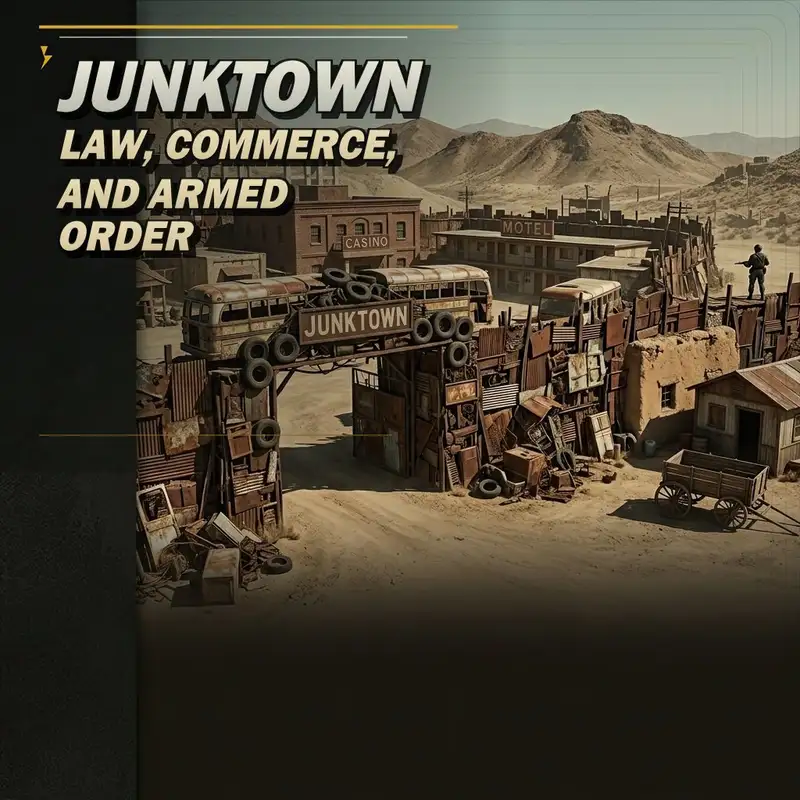
Junktown: Law, Commerce, and Armed Order
After dark, Junktown closes its gate. A guard controls the entrance. Weapons are not to be drawn except in self-defense. A jail stands ready for those who ignore that rule. These are modest arrangements, almost ordinary by the standards of a functioning town, but in the year twenty-one sixty-one they represent a serious political achievement. Beyond the walls, travelers face open desert, raiders, hostile creatures, bad information, and the possibility that the next settlement may offer a bed or a shallow grave. Inside Junktown, somebody has decided that violence will not be left entirely to whoever carries the largest weapon.
That visible order conceals a quieter struggle. While guards watch the gate and patrol the streets, a wealthy casino owner is trying to remove the mayor through deniable murder. Junktown’s crisis is not a simple contest between law and commerce. The town needs both. It needs merchants, visitors, drink, lodging, medicine, gossip, and money moving through its streets. It also needs rules that make people willing to enter those streets without expecting to be robbed, extorted, or shot. The question is whether those rules can survive when a major source of wealth decides that public authority is merely another asset to acquire.
Junktown is not a modern city, and it should not be mistaken for one. The surviving record does not establish its population, its trade volume, its food supply, or the exact size of its guard force. Its compact appearance in the original game is not a literal survey of its streets or boundaries. What the evidence does show is a settlement with specialized roles. There is a mayor, a guard commander, a gate guard, a jailer, a general store, a doctor, a bar, lodging, a casino, and criminal groups operating at the edge of public life. That is more than a fortified campsite. It is a community attempting to divide labor, regulate conduct, and turn a dangerous location into a place where strangers can do business.
The gate is the clearest expression of that effort. A gate does not merely keep threats out. It creates a distinction between the uncertain world beyond the settlement and a space in which known rules apply. Closing it at night limits movement, inconveniences late travelers, and may leave somebody outside when they would rather be inside. Yet it also reduces the number of ways danger can enter while most residents are asleep. It gives the guards a manageable perimeter. It creates time to identify visitors, observe weapons, and decide whether a disturbance is an emergency or merely another piece of desert noise.
This is frontier policing rather than national defense. Junktown has no indication of a conventional army, no evidence of large reserves, and no reason to believe it can project power far beyond its immediate surroundings. Its guards are responsible for the more immediate task of keeping murderers, thieves, and wandering threats from turning the town into a hunting ground. That mission is narrow, but narrow missions can be decisive. A settlement that cannot protect its market, its sleeping residents, and its entrances will struggle to hold skilled workers or attract travelers. It will become a place people pass around rather than pass through.
The weapon rule matters for the same reason. In a post-War environment, many people travel armed because travel is dangerous. Junktown does not appear able to demand that every visitor surrender the means of self-defense. Instead, it tries to regulate the moment when private force becomes public danger. Drawing a weapon without cause is treated as a violation because an argument with a gun in hand is no longer a private disagreement. It can become a panic, a feud, a revenge killing, or a challenge to the authority that claims to keep the town safe.
That is not evidence of a liberal legal order in the modern sense. The guards have broad discretion, and their methods are rough. But it is evidence of restraint as a public service. Junktown’s leaders are trying to establish that violence must have a reason, that certain people can investigate it, and that confinement is preferable to instant retaliation when confinement is possible. The jail, overseen by Andrew, is an especially important detail. A jail is not just a building for criminals. It is an admission that the settlement intends to hold people rather than kill them immediately, and that accusations may require time to examine.
Commerce gives these rules their practical purpose. Junktown cannot live by security alone. Guarding an empty settlement is simply guarding a liability. The town’s businesses suggest a place sustained by recurring exchange. Darkwaters provides general goods. The Skum Pitt offers food, drink, and a social space where residents and travelers can meet. Gizmo’s casino attracts gambling, entertainment, and money. There are places for visitors to stay and for the sick or injured to seek treatment. Each service depends on customers who have something to exchange, whether that means goods, labor, information, favors, or whatever local means of payment people accept.
None of this means Junktown is self-sufficient. A general store does not manufacture every object it sells. A doctor needs supplies, equipment, and knowledge that must be maintained. A bar needs food, water, fuel, containers, and people able to work there. A casino needs visitors with enough spare wealth, or enough hope, to sit at a table and risk losing what they carry. The town’s economy therefore rests on connections beyond its walls. Goods and people must arrive through a region where travel remains uncertain, and the settlement must offer something valuable enough to justify that risk.
Security and trade reinforce one another. Safer streets can encourage merchants to stop, travelers to sleep, and residents to invest labor in something more durable than immediate survival. In turn, commercial activity supplies information, creates work, and gives the town reasons to maintain its defenses. A guard force needs food and equipment. A jail needs staff. Gates require maintenance. A settlement where nobody trades and nobody stays will not sustain much administration for long. Junktown’s order is not separate from its economy. It is part of the economy’s infrastructure.
But commerce also creates concentrations of influence. A successful storekeeper may become indispensable. A bar owner may hear more than a guard commander. A casino operator may command money, favors, entertainment, hired muscle, and the attention of outsiders. In a larger and more developed state, these interests might be balanced by courts, elected institutions, independent offices, established law, or competing centers of authority. Junktown has little evidence of such depth. Its institutions are real, but they are small. Their survival depends heavily on a handful of people.
Mayor Killian Darkwater embodies that mixture of personal standing and public office. He is identified as the grandson of Junktown’s founder, and he runs Darkwaters, the town’s general store. He is also the mayor and the political superior of the town guards. In practical terms, Killian’s authority rests on several foundations at once. Family history gives him local legitimacy. Business ownership gives him an economic role. His position as mayor gives him a claim to direct civic affairs. The guards provide the means to enforce at least some of those decisions.
That combination can be useful in a young settlement. A leader who knows local trade, understands the people passing through, and has a family connection to the town may be able to make decisions quickly. In an environment of scarce resources and limited communication, personal reputation often does work that formal bureaucracy cannot. People may trust Killian because they have dealt with him, bought goods from him, or seen him maintain order when nobody else could. A distant constitution cannot feed a traveler or settle a street dispute. A known shopkeeper sometimes can.
Still, the arrangement carries risks. Killian is not merely a neutral official standing above Junktown’s economy. He is a merchant with his own business interests. He directs guards whose loyalty is tied to his office. He benefits when the town is stable, but he may also benefit when competitors are weakened. There is no need to invent corrupt motives to recognize the structural problem. In a small settlement, public authority and private livelihood can become difficult to separate. The same figure may decide policy, sell supplies, define threats, and command the people authorized to use force.
This does not make Killian equivalent to Gizmo. Their methods and objectives matter. Killian’s authority is associated with public rules, guard patrols, detention, and a claim to protect Junktown as a whole. Gizmo’s project is different. Yet a town built around one strong civic personality remains vulnerable. If its institutions cannot operate without that person’s judgment, reputation, and command, then political stability can become a question of whether that individual survives the next plot, illness, feud, or accident.
Lars, the head of the guards, provides a glimpse of Junktown’s practical security capacity. He is not portrayed as a refined civil servant or the commander of a professional military formation. His responsibilities are closer to those of a frontier constable leading a small armed watch. The guards patrol, respond to crimes, control access, and deal with threats entering from the desert. They are expected to confront murderers and thieves. They also enforce the rules that make daily life predictable enough for ordinary people to live close together.
Their weakness is that armed policing cannot solve every political problem by force. The guards cannot simply arrest or shoot every person they dislike, particularly when the suspect is wealthy, connected, and capable of claiming persecution. Nor can they know everything that occurs behind closed doors. Criminal violence often works through intermediaries, threats, private conversations, and people who do not want to testify. A guard force may see the consequences of intimidation without being able to prove who ordered it.
That distinction becomes crucial in Junktown. Lars and the guards can act against obvious violence. They can enforce rules at the gate. They can respond to a crime in progress. But a politically powerful suspect requires more than suspicion. If the mayor’s guards move against a major businessman without evidence, the operation may look less like justice than a personal purge. That perception matters. Public order rests partly on fear of punishment, but it also rests on the belief that punishment has recognizable limits. A town where the mayor can destroy any rival by accusation is not protected from arbitrary power. It is merely captured by a different kind of it.
Gizmo represents Junktown’s alternative model of power. He owns the casino, and he presents that business as central to the town’s economic life. There is some truth in the claim. A casino can bring visitors. It can create activity, attract money, and provide employment or opportunity for people willing to take part in its trade. In a settlement struggling to become a destination rather than a stopover, entertainment has value. People do not travel only for water and ammunition. They travel for markets, company, news, diversion, and the chance to improve their circumstances.
But Gizmo’s influence extends beyond ordinary entrepreneurship. He has private guards and operational agents, including Izo and Kenji. He seeks to use deniable violence against Killian rather than defeat him openly through accepted political means. That choice reveals the limits of Gizmo’s legitimacy. If he truly controlled Junktown, he would not need a concealed murder plot. If he could openly replace the mayor without consequence, he would not need to hide the sponsor of the attack. His power is substantial, but it is incomplete. He needs the benefits of public order while attempting to bend that order toward private control.
Gizmo’s method also imposes costs on the wider town. An assassination attempt against the mayor is not merely an attack on one man. It warns every merchant, worker, traveler, and resident that important disputes may be decided through private violence. If a powerful man can arrange a killing and remain untouched, then the town’s weapon rules become theater. The gate still closes. The guards still patrol. The jail still has a door. But everyone understands that some people operate above the rules imposed on everyone else.
Junktown’s struggle should not be reduced to a personal feud between two merchants. Killian and Gizmo both occupy commercial roles, but they represent competing answers to a political problem: either business remains subject to public authority, however imperfectly, or public authority becomes another asset to be bought, threatened, and managed. The difference determines whether an ordinary resident can expect equal protection or whether safety depends on being useful to the wealthiest man in town.
The Skum Pitt shows another side of Junktown’s political life. Neal’s establishment is a bar, but it is also social infrastructure. Food and drink are only part of what people obtain there. Travelers meet locals. Workers hear about opportunities. Rumors circulate. People judge who is angry, who is frightened, who has money, and who is looking for help. In a settlement without a large formal intelligence service, this kind of place can become a clearinghouse for information. It is not an official archive, but neither is it mere background scenery.
Information in Junktown is personal. It moves through conversation, observation, reputation, and introductions. A guard may know that a man has a bad reputation without knowing what crime he can prove. A shopkeeper may hear that a gang is recruiting, but fear becoming a target if he repeats it. A traveler may arrive with useful knowledge but no reason to trust local authorities. A former criminal may know exactly how a gang operates but may be reluctant to speak unless someone can offer protection. The town’s ability to act depends on turning scattered knowledge into evidence that others can rely upon.
The Crash House and the Skulz expose the darker side of those relationships. The Skulz are a local gang associated with criminal activity. They are not a conventional military force, not an insurgent army, and not a disciplined state within the town. Their strength comes from something more familiar and more difficult to eliminate: local intimidation, shared identity, access to violence, and the ability to operate in the spaces where witnesses are afraid or uncertain. A gang does not need to control every street to make a settlement feel less safe. It only needs enough people to believe that crossing it carries consequences.
The guards suspect the Skulz, and the town’s residents have reason to fear them. Yet suspicion is not the same as a case. If Junktown’s authorities simply attack the gang because they are known troublemakers, they may remove some violent people, but they also establish a precedent for punishment without proof. That may be tempting in an environment where evidence is fragile and danger is immediate. It may even produce short-term results. But it also makes every future accusation more political. Once force is detached from evidence, any unpopular group can be described as a threat.
The Skulz story demonstrates the importance of insider knowledge. Former members, witnesses, and people willing to provide testimony can reveal what uniformed guards cannot see. Infiltration and cooperation matter because criminal organizations protect themselves through silence. They exploit the distance between what everyone suspects and what anyone can demonstrate. A resident may know who is responsible for a beating, but not know who gave the order. Another may know where the gang gathers, but not what is planned there. The settlement’s challenge is to collect enough credible information to act without turning policing into indiscriminate retaliation.
The exact relationship between the Skulz and Gizmo should not be overstated. The evidence strongly suggests a wider environment of criminal influence around the casino owner and his effort to undermine Killian. But Junktown does not provide a complete organizational chart proving that every gang action was ordered from Gizmo’s office. That uncertainty is important. Criminal power often benefits from ambiguity. A wealthy sponsor does not need to issue written instructions to profit from a climate of fear. He only needs people to understand which interests are dangerous to challenge.
For civilians, this ambiguity is exhausting. People do not experience corruption only as a grand political scandal. They experience it as the decision not to report a threat, not to walk home alone, not to refuse a demand, not to speak freely in a crowded room. A settlement may still have trade, entertainment, and visible guards, yet lose the confidence that makes civic life possible. The gang does not need to overthrow the town. It only needs to make lawful protection seem unreliable.
The attempted assassination of Killian brings all of these problems into one event. The violence itself is obvious. The harder problem is attribution: identifying who planned the attack, who paid for it, who passed instructions, and what evidence will persuade the guards, the town, and anyone with reason to doubt Killian’s motives. In intelligence work, identifying the immediate attacker is often easier than proving sponsorship. Junktown faces precisely that problem.
Gizmo’s use of agents gives him a measure of distance from the crime. Izo and Kenji can carry out or facilitate coercion without requiring Gizmo to stand in public and announce his intentions. This is not sophisticated espionage by the standards of a pre-War intelligence service. It is a small-town version of deniable action. The method is crude because the town is small. It is still politically significant because it allows Gizmo to benefit from violence while preserving the public image of a businessman whose hands remain clean.
Killian’s response is revealing. He does not simply order Lars to storm the casino and settle the matter by force. Instead, he seeks evidence connecting Gizmo to the attempt on his life. The available methods can include a hidden recording device or an operation to plant a bug. These are intrusive measures, and they deserve to be understood as such. Surveillance is not morally weightless simply because its target is unsympathetic. A town that uses hidden recording devices without limits can create its own abuses.
The recording operation also reveals the limits of Junktown’s institutions. A larger state might have investigators, prosecutors, courts, records, and a more established process for handling political crime. Junktown appears to have none of that institutional depth. It has guards, a jail, relationships, and whatever evidence its residents can gather under pressure. Its procedures are improvised because the settlement itself is still improvised. The fact that it attempts procedure at all is notable. The fact that the procedure may depend on a capable outsider is a warning.
The outsider in this crisis is the Vault Dweller, but the Vault Dweller should not be mistaken for Junktown’s founder, permanent guardian, or confirmed savior. The available paths are deliberately variable. An outsider can help protect Killian, gather evidence, expose criminal activity, support Gizmo, kill either leader, intervene against the Skulz, or leave without decisively resolving the town’s political struggle. Those possibilities cannot be blended into one historical account. The game allows branches because Junktown’s future is contingent.
One possible outcome is that Killian survives, Gizmo is removed, and Junktown becomes more firmly ordered under the mayor’s authority. In the ending material associated with this branch, the town is described as embracing a tougher form of frontier justice. This is a conditional future, not an unquestionable later canon. Still, it deserves analysis because it shows what victory for recognized civic authority might look like in a place with limited safeguards.
Removing Gizmo disrupts the immediate challenge. The assassination plot loses its sponsor. Private muscle loses protection from a powerful patron. The guards no longer need to operate under the shadow of a rival economic center willing to use deniable violence. Residents may feel safer. Traders may have greater confidence that disputes will be handled by the town rather than by the casino’s enforcers. These are real gains. A government that cannot defend its officials from murder is not likely to defend ordinary people for long.
But stronger enforcement can create a new danger. Frontier justice is not the same thing as mature justice. It may deliver quick decisions, but it often places broad discretion in the hands of a small number of armed officials. Killian already combines commercial standing, inherited legitimacy, and political authority. If his victory produces a more forceful security regime without stronger independent restraints, Junktown may become safer while also becoming more dependent on one man’s judgment. Critics, competitors, and unpopular residents may have fewer protections when the same office defines the threat, directs the guards, and determines the remedy.
The civilian effect would therefore be mixed. Many residents might prefer predictability to the fear created by gangs and attempted assassination. A shopkeeper wants customers who can walk the street safely. A traveler wants to sleep without being robbed. A family wants disputes handled before they become shootings. These needs can justify firm policing. But a settlement also needs room for independent business, disagreement, and people who lack personal ties to its ruling household. If order becomes too closely identified with obedience to Killian, then the town may defeat criminal capture only to concentrate authority in another vulnerable form.
The strength of the Killian branch is that it binds force, at least initially, to an investigation and a public claim of safety. Its weakness is that the resulting system may still lack the institutions required to restrain the people enforcing that claim. Tactical success removes an opponent. It does not automatically create regular courts, stable succession, transparent authority, or protections that outlast the current mayor and guard commander. It gives Junktown breathing room. What it does with that breathing room remains the larger question.
Another possible outcome places Gizmo in the stronger position. In this branch, Junktown can become commercially prosperous, with increased activity and wealth flowing through the casino-centered order. That result should not be dismissed merely because Gizmo is the more openly corrupt figure. Commerce can produce visible benefits. More visitors can mean more customers. More spending can mean more work. Entertainment can make a settlement attractive. A place with money moving through it may offer opportunities that a tightly controlled and suspicious town does not.
But prosperity and legitimacy are not the same thing. Gizmo’s political model rests on private patronage, intimidation, and self-interest. Under such a system, access to protection is likely to become selective. People close to the ruling network may prosper. Those willing to provide services, carry messages, ignore abuses, or participate in the casino’s economy may find doors open to them. Others may discover that rules are enforced unevenly. The gate still exists. The guards may still exist. Yet their purpose can shift from protecting the town to protecting the interests of the men who control its wealth.
This is the classic weakness of captured institutions. Public offices retain their names and perhaps their routines, but the practical question becomes whom they serve. A jail can hold thieves while leaving extortionists untouched. A guard can restrain ordinary violence while ignoring violence committed on behalf of the powerful. A merchant can speak of prosperity while using debt, fear, and private muscle to decide who shares in it. The town may look active and successful from the outside because money is moving. That does not mean its residents enjoy equal protection or predictable justice.
Gizmo’s system also carries a succession problem. Personal patronage is effective while the patron has money, loyal agents, and enough fear working in his favor. It is less reliable when revenue falls, a rival appears, or the leader dies. A government built around institutions can survive the loss of an official, at least in principle. A system built around one casino owner’s relationships and private coercion may fracture the moment those relationships change. Partners become rivals. Enforcers become independent predators. People who accepted the system while it paid may abandon it when it no longer does.
For civilians, that instability may be hidden beneath temporary prosperity. Some people will gain work. Some will enjoy entertainment. Some may welcome a leader who seems able to make money where others only impose restrictions. But the price is political dependence. Security becomes a favor rather than a right. Opportunity becomes tied to proximity to power. Fear becomes part of the town’s economy. The same commercial energy that could have strengthened Junktown as a trading center is redirected toward enriching and protecting the faction that captured it.
The Gizmo branch therefore exposes a truth that the Killian branch can obscure. Commerce is not automatically liberating simply because it is less visibly coercive than a guard patrol. Markets need trust. Contracts, informal or formal, require some expectation that fraud, theft, and violence will have consequences. A business owner who can purchase impunity undermines the conditions that make wider commerce possible. He may enrich the town in the short term, but he does so by replacing public rules with personal access.
Its weakness is that the entire arrangement remains personal. Killian’s authority depends heavily on his standing. Lars’s effectiveness depends on a small guard force and limited intelligence. Neal’s bar depends on relationships that can be disrupted by fear. The jail depends on the town being able to hold prisoners safely. The casino can become either a useful business or a rival center of coercion. The Skulz exploit the gaps between suspicion and proof. A single assassination plot can force the whole settlement to reveal whether its rules are real or merely decorative.
Later accounts provide only limited perspective on what Junktown ultimately became. A reference from the Vault Dweller’s memoirs looks back on the place with moral unease, but such retrospective testimony does not establish every decision taken there or settle every possible ending. It does, however, fit the evidence of the original crisis. Junktown was morally troubling because its problems were not clean. The town could seek safety and still risk authoritarian enforcement. It could welcome commerce and still risk corruption. It could punish criminals and still struggle to distinguish justice from factional advantage.
That is why Junktown matters in the history of the early West Coast wasteland. It belonged to a regional landscape where settlements were beginning to develop connections, markets, identities, and political ambitions. But it should not be treated as a finished state or as a simple predecessor to later governments. Its later institutional fate is not fully documented. What is clear is that Junktown faced a problem common to every rebuilding society: how to make power useful without allowing it to become unaccountable.
Armed order and commercial life were not opposing choices in Junktown. Each made the other possible. The deeper danger was that weak institutions could be captured either by a mayor whose enforcement outgrew its restraints or by a casino owner whose wealth and deniable violence outgrew public control. Junktown’s future depended not on eliminating power, but on binding power to evidence, public safety, and rules strong enough to outlast the people who first enforced them.