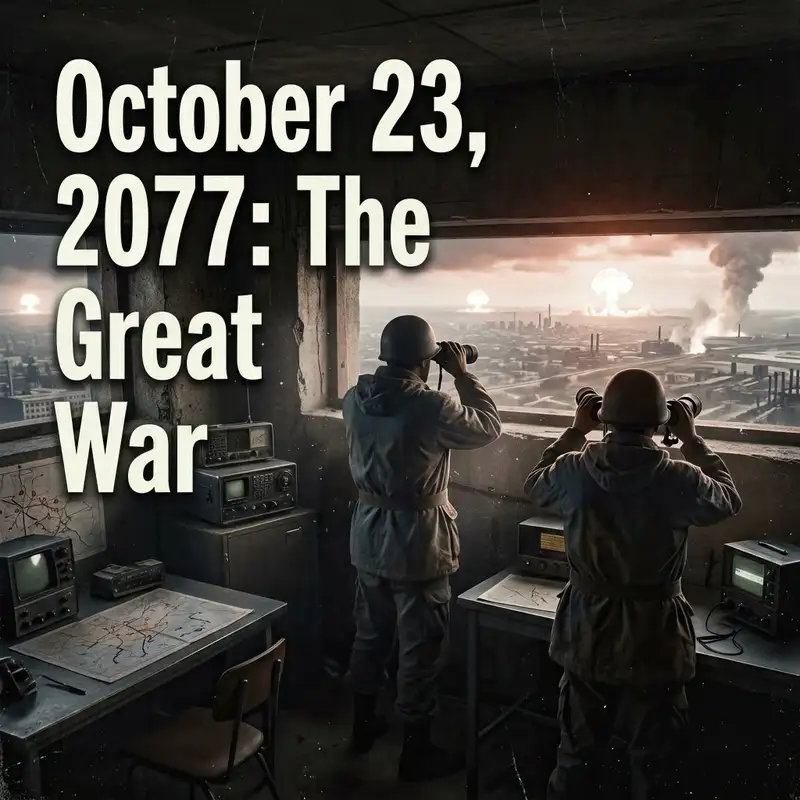
October 23, 2077: The Great War
On the morning of October twenty-third, twenty seventy-seven, the American strategic warning system began receiving evidence that something was coming. At the Switchboard, a military communications facility beneath the ruins of what would later be called the Commonwealth, status reports recorded missile detection, rising alert levels, confirmation through the North American Aerospace Defense Command, and the authentication of a retaliatory scenario designated M X C N ninety-one. Within the logic of the system, this was the moment when warning became action. The network had been built to recognize an attack, pass information upward, and preserve enough command authority to answer before the nation was destroyed.
But the machines could not answer the question that mattered most. They could not explain who had fired first. They could not establish whether every detected launch was part of a full attack, a limited strike, an accident, a deception, or the beginning of a sequence that no human government could still control. They could report movement, trajectories, and alert conditions. They could not provide trust. And they could not give the people of North America enough time to understand what was happening.
Above ground, civilians were already learning how little protection sophisticated systems provided. In the Boston area, a family received a hurried warning, ran toward Vault One Eleven, and watched a nuclear detonation rise over the horizon before the doors sealed. Elsewhere, countless people never reached a shelter, never received a clear warning, or found that the place reserved for them did not exist. The Great War began and ended on October twenty-third, twenty seventy-seven. The exchange lasted roughly two hours. In that brief span, billions died, governments broke apart, and the material foundations of modern civilization were smashed beyond any ordinary recovery plan.
The Great War was not simply a conventional conflict that suddenly became nuclear. It was the final failure of a world that had spent decades making catastrophe administratively manageable, economically profitable, and militarily imaginable. Resource scarcity had made international cooperation seem fragile. Conventional war had made compromise look dangerous. Nuclear deterrence had made uncertainty intolerable. Civil defense had become a means of selecting who might live rather than protecting society as a whole. And hidden continuity plans prepared parts of the governing class to survive the disaster without preventing it.
That does not mean responsibility disappears into the machinery. Institutions are built by people. Policies are approved by people. Wars are continued by people. The surviving record may not identify the first attacker with confidence, but it makes one fact painfully clear. Long before the first warning reached an American command center, the great powers, corporations, military planners, and continuity officials of the old world had created a system in which a few minutes of fear could condemn billions of people.
Scarcity by itself does not cause war. A shortage can produce conservation, cooperation, technological adaptation, rationing, or political reform. It can also produce hoarding, coercion, annexation, militarization, and the conviction that another society’s survival must come at one’s own expense. The old world chose the second path often enough that it became normal. Governments increasingly treated resources not as goods to be managed for public welfare, but as strategic assets to be secured before rivals could seize them.
That change affected every level of society. Energy shortages did not remain a problem for economists, industrial planners, or diplomats. They shaped transportation, food production, manufacturing, military readiness, and domestic politics. When a country believed it might lose access to fuel or raw materials, it also feared unemployment, unrest, military weakness, and national humiliation. Every crisis therefore acquired a security dimension. Every trade dispute could become a strategic warning. Every foreign dependency became a potential threat.
The United States entered this world with enormous industrial resources, advanced technology, and a political culture increasingly committed to military solutions. Its public imagery remained cheerful and patriotic. Television advertisements promised safety, comfort, and technological progress. Civil-defense messaging assured citizens that preparation could defeat disaster. Yet beneath that optimism lay rationing, surveillance, labor pressure, corporate influence, political repression, and a government preparing for a conflict that would demand more control over its own population.
China faced its own strategic pressures. It was not simply an irrational adversary inserted into the story so that American militarism could appear defensive. The available evidence points to a rival great power confronting resource scarcity, strategic encirclement, and the growing military advantage of the United States. Its leaders may have seen access to energy as essential to national survival. Its military decisions were still decisions, carrying responsibility for invasion and escalation, but desperation and aggression are not opposites. States often become most dangerous when they believe defeat will mean national collapse.
By the middle of the century, resource competition had become open war between the United States and China. The most important early battlefield was Alaska. In the winter of twenty sixty-six, Chinese forces invaded the state, seeking access to its oil reserves. This was not a fight over a remote patch of snow. Alaska mattered because oil still mattered. It was a source of energy, a strategic position on the northern approaches to the continent, and a symbol of whether the United States could defend resources it considered vital.
The invasion transformed the crisis into the Sino-American War. Once Chinese forces had established themselves in Alaska, the United States confronted a military problem with political consequences far beyond the battlefield. It had to move forces across a vast continent, sustain them in severe conditions, protect lines of communication, and convince its own public that the government could still defend national territory. The war demanded fuel, weapons, replacement parts, trained personnel, transport capacity, medical support, and industrial production on a scale that placed further strain on a society already shaped by scarcity.
Canada became essential to that effort. Its territory formed a route to Alaska, and American military requirements increasingly overrode Canadian sovereignty. The occupation and eventual annexation of Canada were not neutral logistical details on a map. They were acts of coercive wartime policy. The United States secured access, movement, and infrastructure by subordinating an allied country to its own military needs. That decision may have made operational sense to American planners facing a northern war. It also revealed the political character of the conflict. Under pressure, the United States did not merely defend a way of life. It treated law, alliance, and foreign autonomy as expendable when they obstructed strategic access.
The conflict also accelerated technological militarization. The United States invested in power armor, advanced weapons, communications systems, robotics, hardened installations, and a vast military-industrial apparatus capable of sustaining war across hostile terrain. These systems gave American forces important advantages, but they did not remove the old problems of war. Power armor still required trained operators, repair, energy, spare parts, and transport. Advanced weapons still depended on factories, supply lines, and maintenance. A sophisticated army could seize ground, but it could not make scarcity disappear.
In January of twenty seventy-seven, American forces reclaimed Anchorage. The recovery of the city was a major conventional victory. It demonstrated that the United States could reverse the Chinese invasion of Alaska and regain a strategically vital resource region. In the language of ordinary military history, Anchorage should have been the kind of event that opened a path toward negotiation. An invader had been driven back. A homeland objective had been secured. A government could claim success without pursuing unlimited war.
That is not what happened. The available record indicates that the wider conflict continued, including American pressure and operations against mainland China. The exact boundaries, force levels, and achievements of those campaigns are not fully documented in released sources. It would be easy to fill that silence with imagined maps, decisive offensives, or triumphant communiqués. The historical evidence does not support that certainty. What can be said is that Anchorage did not produce a durable peace.
The popular memory of Anchorage is complicated by Operation Anchorage, the military simulation encountered long after the war. It provides a vivid image of the campaign, complete with stylized heroism, clear objectives, and a clean American victory. But it is a simulation, created for military and training purposes. It cannot be treated as a neutral documentary record of the battle. Like any institutional memory exercise, it tells us something about how its creators wanted the campaign remembered. It does not settle every question about what soldiers experienced, how commanders made decisions, or how the battle unfolded in detail.
The strategic result mattered more than the simulation’s imagery. The American victory at Anchorage may have reduced one immediate threat while increasing the fear that the war was entering a final and more dangerous phase. China had lost a major campaign and faced an opponent with growing technological and industrial advantages. American leaders, meanwhile, had invested heavily in mobilization, annexation, secrecy, and military expansion. A negotiated settlement might have appeared politically difficult, strategically risky, or ideologically unacceptable to both sides.
This is a familiar danger in great-power war. Victory can remove the practical reason for compromise at the same moment it increases the enemy’s fear of annihilation. A state that believes it is winning may demand more. A state that believes it is losing may decide that delay is fatal. In such an environment, time becomes a weapon. The question is no longer only whether a country can win. It becomes whether it can afford to wait.
By the final months before the Great War, the United States was a superpower system under severe strain. It was fighting abroad, managing shortages at home, defending strategic infrastructure, suppressing unrest, funding enormous research programs, and preparing for the possibility that conventional government might not survive. No single institution controlled all of this cleanly. The federal government, the armed forces, intelligence services, corporations, civil-defense planners, and continuity organizations overlapped without becoming identical.
The industrial backbone of deterrence reflected that assumption. Nuclear strategy required missile systems, launch facilities, submarines, reactors, command posts, early-warning networks, communications relays, hardened bunkers, and procedures for authenticating orders. Each component existed to solve a practical problem. A warning system had to detect an attack. A command system had to remain functional under assault. A retaliatory force had to survive long enough to make any enemy fear the consequences of launching first.
In theory, this arrangement prevented war by making victory impossible. In practice, it created a system that had to make civilization-scale decisions under extreme uncertainty. Deterrence depended on rational actors receiving reliable information, retaining control over their forces, and believing that the other side would behave predictably. It also depended on leaders having enough time to distinguish evidence from error. That final condition was always the weakest.
The more powerful and vulnerable nuclear forces became, the shorter the decision window grew. If leaders believed their missiles, command centers, or communications networks could be destroyed quickly, they had an incentive to act before confirmation became impossible. If they feared a decapitating strike, they had reason to delegate authority, automate procedures, or prepare retaliation plans in advance. Every attempt to make the system more survivable could also make it less flexible.
Fallout’s postwar world is filled with reminders of this institutional momentum. Automated defenses continue guarding facilities after their human commanders are gone. Bunkers retain old priorities long after the nations that built them have vanished. Robots preserve orders without preserving the judgment that once gave those orders meaning. This does not prove that automated systems started the Great War. It does show that the prewar world placed extraordinary faith in structures designed to continue functioning even when ordinary political authority had failed.
On October twenty-third, that faith met its most terrible test. An early-warning network can detect a launch. It cannot read intention. Radar and tracking data can tell a command center that objects are moving through the sky. They cannot always tell decision-makers whether the objects represent an accidental launch, an electronic deception, a limited attack, a rogue commander, a full strategic strike, or an enemy attempt to force a retaliatory mistake.
This is why false alarms matter in nuclear history, even when they do not become wars. The danger is not that machines are always wrong. The danger is that systems can be correct about a signal while leaders remain uncertain about its meaning. A detected launch might be real. A larger pattern might still be misunderstood. A country might respond to what it thinks is an attack and thereby create the attack it feared.
The Switchboard records are valuable because they preserve part of the American command picture. They show escalating alarm, confirmation through North American Aerospace Defense Command channels, and the authentication of a retaliatory response. They demonstrate that American military systems believed the country was under nuclear attack. They do not provide a complete global chronology. They do not reveal the first order issued in Beijing, Washington, or any hidden corporate office. They do not identify every weapon in flight, every target, or every human being who still had authority in the final minutes.
That limitation is not a technical footnote. It is central to the history. The records that survive are disproportionately the records of systems designed to survive. Military terminals, bunkers, corporate archives, automated networks, and protected installations preserved fragments of knowledge. The societies destroyed outside them often left fewer records. The result is a historical archive shaped by privilege, secrecy, and endurance. We know much about alarms. We know far less about the people who heard sirens in crowded streets, at workplaces, in schools, on highways, and in homes that had no place in any continuity plan.
Those civilians bore the greatest risk and held the least control. In the Boston area, the events surrounding Vault One Eleven show the human meaning of a compressed warning period. A family hears that nuclear attack is imminent. They are hurried toward the Vault. They encounter confusion, bureaucracy, and people trying to prove they belong on the correct side of a gate. The detonation arrives before the emergency system can become anything like an orderly evacuation.
The scene does not need to represent every American city to reveal a general truth. Civil defense cannot be judged by the existence of posters, drills, advertisements, or shelters. It must be judged by who can reach safety, who is admitted, who understands the plan, and what happens to everyone else. A vault that protects a selected group is not the same thing as a system that protects a population.
Vault-Tec sold the idea of survival with the language of consumer confidence. Its shelters were presented as practical insurance against the unthinkable. A family that purchased the right place, completed the right forms, or received the right assignment might imagine that preparedness had made them safe. But the Vault system was never simply a public service. It depended on government contracts, military secrecy, corporate research, controlled admission, and unequal access. Many Vaults were also experimental environments, designed not merely to preserve life but to study, manipulate, or exploit their inhabitants.
That arrangement had consequences even before the bombs fell. Citizens learned that safety was conditional. Families were encouraged to trust a corporate promise whose full terms they could not see. Workers, soldiers, scientists, officials, and selected residents were assigned places in different survival schemes. Everyone else was left with public assurances that could not withstand the first real emergency.
The Prime Video series adds another important piece of evidence. In a prewar Vault-Tec boardroom discussion, company executives and allied corporate figures consider the prospect of initiating or guaranteeing a nuclear conflict. Their purpose is not national defense in any ordinary sense. They discuss a future in which the destruction of the existing world would permit corporate interests to shape whatever came after it. The conversation is one of the bleakest windows into the prewar elite imagination because it treats annihilation as a business opportunity.
Its evidentiary value must be stated carefully. The scene establishes that Vault-Tec leadership was willing to contemplate catastrophe. It establishes an ideology of control in which the end of civilization could be turned into a market advantage and a political reset. It demonstrates that powerful corporate actors were not merely preparing for war. Some were prepared to think about benefiting from it, perhaps even ensuring it occurred.
It does not prove that Vault-Tec launched the first nuclear weapon. It does not show a corporate command center issuing the decisive order on October twenty-third. It does not eliminate Chinese agency, American military decision-making, or the possibility that events moved faster than any private plan could control. Planned for catastrophe, benefited from catastrophe, and caused catastrophe are not the same claim.
The same caution applies to the Enclave and related continuity structures. The Enclave emerged from hidden networks of senior political, military, scientific, and corporate power that planned to preserve a selected remnant of American authority after national disaster. Its existence demonstrates that parts of the old elite anticipated a world-ending crisis and invested in survival systems beyond the reach of ordinary citizens. It does not establish that every official knew of those plans, that every military officer served them, or that the Enclave ordered the first strike.
What these continuity plans do reveal is a profound failure of political legitimacy. A government can claim that national security exists to protect its people. But when its most elaborate preparations are designed to preserve selected officials, valuable specialists, strategic assets, and elite institutions, the meaning of protection changes. The public is no longer the nation being defended. The public becomes the environment through which a smaller system hopes to endure.
This did not make the Great War inevitable in some mystical sense. No historical outcome is excused by calling it inevitable. Leaders could have negotiated. Governments could have reduced alert levels. Military planners could have built more time into their procedures. Corporations could have been restrained rather than empowered. Civil defense could have been organized around broad survival rather than experiments and selection. The tragedy is that the old world possessed immense technological capacity while its institutions lacked the political discipline to use that capacity for shared security.
When the exchange began, those failures became visible at planetary scale. The Great War was worldwide. It was not only an American event, an East Coast event, or a story confined to military bunkers. The Los Angeles scenes preserved in the later television account show another civilian perspective, another population caught beneath the same collapsing horizon. The city’s people are not calmly informed participants in a national survival plan. They are human beings confronted by a disaster moving faster than explanation.
The exchange lasted roughly two hours. That duration is almost absurdly short compared with the decades that produced it. Years of scarcity, militarization, technological investment, propaganda, secret planning, and conventional war culminated in an interval shorter than an afternoon meeting. The old world had spent generations building its cities, transport networks, hospitals, farms, universities, factories, and governments. In roughly two hours, much of that accumulated capacity was destroyed, damaged, isolated, or rendered useless.
The immediate effects were catastrophic. Cities were struck. Millions died in blasts, fires, structural collapse, and the chaos that followed. Command networks were shattered or severed. Transportation systems failed. Electrical power became unreliable or vanished. Hospitals lost staff, supplies, communications, or access to the people who needed them. Water systems broke down. Food distribution stopped. Families were separated by distance, rubble, military cordons, and death.
The long-term consequences were different but no less severe. Radiation and environmental damage altered landscapes and habitats for generations. Crops failed in some regions. Contaminated water became a strategic resource. Medical care became scarce precisely when injury, disease, and exposure made it most necessary. Communities that survived the initial strikes still faced hunger, displacement, violence, isolation, and the collapse of institutions that once coordinated daily life.
The destruction of a government is not always the destruction of every person who lived under it. Some military facilities endured. Some bunkers retained power. Some automated systems continued to operate. Some towns, farms, Vaults, and local communities survived in one form or another. But isolated survival is not recovery. A functioning generator cannot replace a national economy. A defended bunker cannot restore a public health system. A preserved archive cannot feed a city. A surviving command post cannot govern a continent if it has no reliable roads, no accepted authority, no functioning supply network, and no population willing or able to obey it.
This distinction explains much of the postwar world. The Great War did not erase all organization. It shattered the connections that allowed large organizations to function. It broke the relationship between farm and city, factory and repair shop, command center and field unit, government office and citizen. It transformed advanced technology from a broad industrial system into a collection of difficult inheritances. A reactor, a robot, a military depot, or a vault could be an asset only if living people had the knowledge, labor, security, and legitimacy required to use it.
Twenty-five years later, in the year twenty-one oh two, the world of Appalachia shows the early shape of that reality. Fallout Seventy-Six begins in a region still close enough to the Great War that prewar systems, emergency records, abandoned institutions, and the first generations of survivors remain visible. Appalachia is not an empty landscape waiting for a new civilization to arrive. It contains the remains of government agencies, corporations, responders, local communities, military facilities, and competing survival efforts.
Yet the region also shows how quickly formal society could collapse once its systems were disconnected. Emergency organizations could have trained personnel and still fail without communications, supplies, leadership, or a population they could reach. Automated defenses could guard facilities that no longer served a coherent public purpose. Survivors could preserve local knowledge while lacking the capacity to rebuild regional coordination. The war left behind tools, but not the trust required to use them together.
This is why it is misleading to imagine the postwar world as either total chaos or seamless continuity. It was neither. Communities adapted unevenly. Some found water, land, trade, and defensible ground. Some formed new institutions. Others became dependent on old machines, local strongmen, armed protection, or whatever food supply could be secured. The political map did not disappear. It fractured into smaller and more vulnerable forms.
The question of who fired first remains at the center of the Great War because it seems to promise moral clarity. If one side launched first, perhaps history can assign the whole burden of catastrophe to that government, that corporation, that command system, or that leader. Fallout does not give us that certainty. The strongest surviving evidence does not establish a confirmed global first-launch order.
China was at war with the United States, had invaded Alaska, and faced growing American military pressure after Anchorage. American warning networks detected incoming launches and prepared retaliation. Vault-Tec executives considered the possibility of provoking or guaranteeing war in order to shape the postwar future. Enclave-related continuity structures prepared for national collapse and elite survival. These are significant facts. None of them, alone or together, proves who ordered the first weapon launched.
Several possibilities remain imaginable. China may have struck first, perhaps fearing strategic defeat or seeking to break American power before its own position became hopeless. The United States may have acted first, perhaps under the belief that it faced an imminent attack or through a strategy never preserved in the surviving record. Vault-Tec or associated corporate interests may have attempted to turn their plans into action. Enclave figures may have influenced events from inside continuity structures. Automated systems may have accelerated a crisis once it began. Or the sequence may be obscured by records that were destroyed, classified, fragmented, or preserved only by institutions with reasons to tell selective stories.
These possibilities are not equally supported by direct evidence. The record supports Chinese-American war, American detection of incoming launches, Vault-Tec’s willingness to contemplate apocalypse, and elite preparation for survival. It does not support a definitive corporate launch order, a complete Chinese deliberation record, or a final public account from American national leadership. The responsible historian has to preserve the difference between a plausible theory and an established event.
Uncertainty about the first strike should not become an excuse for false equivalence. The inability to identify the first missile does not mean every institution bears identical responsibility. Invading another country, annexing an ally, building weapons of mass destruction, experimenting on civilians, profiting from fear, planning elite survival, and preparing retaliation systems that can end the world are different acts. They should be described precisely.
But uncertainty also does not absolve anyone who helped build the system. The United States did not become innocent because China may have launched first. China did not become innocent because American militarization and occupation had intensified the conflict. Vault-Tec did not become harmless because its boardroom ambitions may never have become a launch order. The Enclave did not become a protector of civilization because it preserved some people and institutions. The old world’s leaders had spent too long treating annihilation as an acceptable condition of strategy.
The Great War therefore has no single clean villain, not because the evidence reveals a morally balanced tragedy, but because the catastrophe was systemic. Resource competition made war seem normal. Conventional victories made rivals more afraid. Deterrence made uncertainty unbearable. Warning systems compressed decision-making into minutes. Civil defense protected chosen populations rather than society. Corporate power converted public danger into private opportunity. Continuity plans prepared elites to inherit a ruin they had failed to prevent.
The war began when weapons were launched, but the conditions for it had been built much earlier. They were built when energy scarcity was treated as a reason to dominate rather than cooperate. They were built when national survival became a language for occupation and repression. They were built when technological superiority was mistaken for political wisdom. They were built when the preservation of command authority mattered more than the preservation of ordinary life.
The Great War remains the defining historical event of the Fallout world because it did more than create ruins. It left every later society with the same unresolved tests: building security without turning protection into exclusion, preserving knowledge without monopolizing it, organizing defense without allowing military necessity to consume law and consent, and using old-world technology without inheriting old-world assumptions about who deserves to survive.
The surviving record cannot reliably name the first attacker. It can tell us something more important about the world that made the question possible. By October twenty-third, twenty seventy-seven, the leading institutions of the old world had already accepted a system in which fear traveled faster than diplomacy, secrecy outweighed accountability, and selected survival mattered more than common safety. The bombs ended civilization in roughly two hours. The decisions that made annihilation thinkable had taken decades.