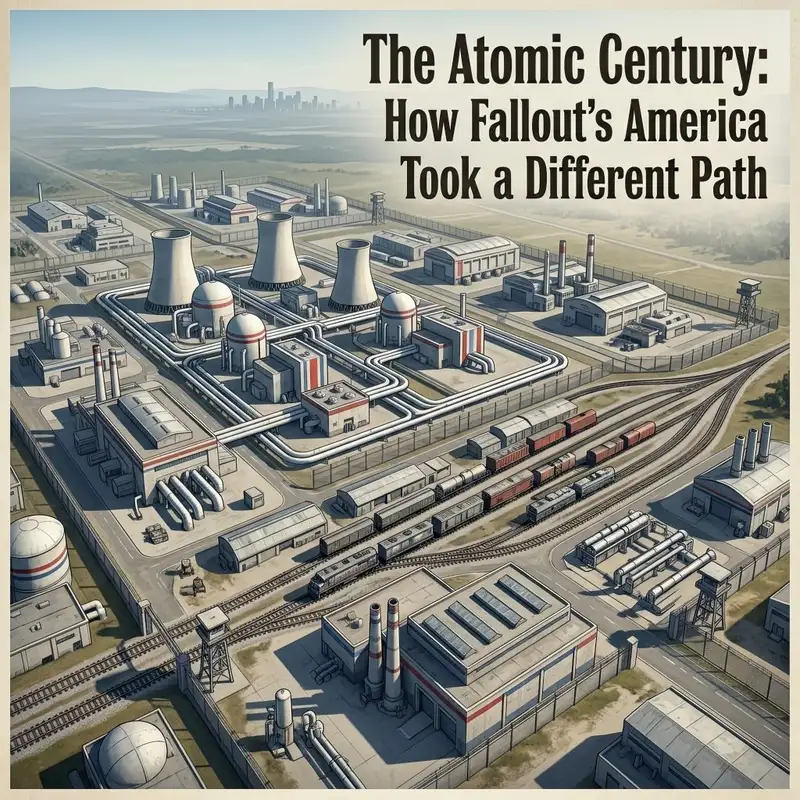
The Atomic Century: How Fallout’s America Took a Different Path
On October twenty-third, twenty seventy-seven, the United States possessed household robots, atomic cars, advanced medical machines, power armor, missile defenses, automated factories, and shelters built beneath its cities. It also possessed rationing, labor unrest, disease scares, political fear, censorship, military occupation abroad, and a population taught to expect nuclear annihilation as a practical problem of household preparedness. The contradiction is the starting point. Fallout’s America was not destroyed because it lacked technology. It was destroyed after technology had become more capable, more widespread, and more deeply woven into daily life than ever before.
The Atomic Century is a useful name for that contradiction. It is not an official period label used by the people of pre-War America. It describes a society that made atomic power into an organizing principle. Atomic systems moved goods, supported industry, armed soldiers, powered robots, shaped urban life, and promised comfort to consumers. Yet those same systems depended on institutions that were becoming more secretive, more centralized, more militarized, and less able to solve the political problems beneath the machinery.
The Great War cannot be reduced to a single morning when deterrence suddenly failed. The nuclear exchange was the final catastrophe, but it was not the beginning of the crisis. By the time the warnings came, the United States had spent decades building a national order in which technical solutions repeatedly stood in for political reform. When resources grew scarce, the country did not become less dependent on centralized power. It became more dependent on it, and more willing to use that power against rivals abroad and dissenters at home.
Fallout is often described as a future where the nineteen-fifties never ended. The description captures something real. The setting preserves chrome appliances, suburban optimism, patriotic advertising, civil-defense films, crooners, mascots, and the polished confidence of postwar American consumer culture. But it can also mislead. Fallout’s United States was not frozen in an old decade, like a museum that kept adding televisions. It developed along a different and increasingly dangerous path.
Its science, industry, computing, communications, weapons, and energy systems evolved in ways that do not neatly match our own history. The exact point where the timelines began to diverge is not established by the surviving record, and there is no complete technical genealogy for every device that appears before the bombs. What the setting clearly shows is cumulative difference. Familiar institutions and cultural symbols continued, while the material world beneath them took another direction.
That direction placed unusual faith in atomic technology. The result was not simply a different collection of gadgets. It was a different political economy. A nation that can build domestic robots, power armor, advanced reactors, and automated military systems must also sustain laboratories, mines, refineries, factories, transport networks, trained technicians, software specialists, security forces, and a procurement system large enough to coordinate them. The shining appliance on a kitchen counter represented an industrial system behind it.
The old visual language mattered because it concealed this transformation. Pre-War America continued to market itself through the reassuring imagery of a comfortable middle-class future. Smiling families were shown enjoying automated homes while distant wars and domestic shortages pressed closer. The advertisements did not prove that everyone shared in that comfort. They showed what the system wanted citizens to believe about comfort, order, and national success.
This was a society that continued to speak the language of abundance even as it entered an age of scarcity. It promised that science would solve every inconvenience, that industry would produce every necessity, and that national power would defend every standard of living. Those promises became harder to keep. Rather than admit that the political and economic order could no longer distribute security fairly, many of its leading institutions doubled down on technology, secrecy, and force.
Atomic power was central to that choice. In Fallout’s America, nuclear energy was not kept at the edge of society in distant power stations and strategic arsenals. It entered transportation, industrial facilities, consumer goods, robotic labor, military equipment, and civil infrastructure. The exact performance of every reactor, car, or machine is not the important point. The important point is that atomic energy had become ordinary enough to shape expectations about how Americans lived and what the state could provide.
RobCo built computing and automation systems that reached from offices to military installations. General Atomics supplied robots designed for domestic work, industrial labor, and security. West Tek became deeply involved in military research. Poseidon Energy, Mass Fusion, REPCONN, and other corporations occupied different positions in the energy and aerospace economy. Their projects did not all serve the same purpose, and they were not one unified secret organization. But together they reveal a broader structure in which corporate research, public infrastructure, and national defense increasingly overlapped.
That overlap created real capabilities. Automation could reduce some kinds of labor. Advanced reactors could support facilities that would otherwise be impossible to operate. Power armor gave the military a way to protect and strengthen individual soldiers in demanding environments. Energy weapons and robotics promised new methods of fighting. The United States had formidable industrial depth, and it could translate research into strategic power more effectively than many of its rivals.
But technical possibility was not the same as universal prosperity. A robot in one household did not guarantee food security in another. A fusion-powered facility did not resolve the question of who controlled its output. A military laboratory could build advanced weapons without creating affordable housing, honest government, or trust between citizens and their institutions. The Atomic Century expanded what America could do. It did not settle who benefited, who paid, or who would be protected when the system came under strain.
The dependence on complex systems also created vulnerabilities. Advanced machines required maintenance, replacement parts, specialized labor, secure facilities, and reliable energy. A power armor program needed more than armored suits. It needed training, repair capacity, doctrine, transport, and a supply chain that could survive wartime disruption. Robots needed power, programming, spare components, and someone with the authority to direct them. Automation could concentrate capability, but concentration made failures more consequential.
In a stable and legitimate society, that concentration might have supported broad public investment. In Fallout’s America, it increasingly supported emergency rule and competition for scarce resources. Atomic abundance did not remove scarcity. It changed the tools available to those trying to manage it. When energy, raw materials, and strategic access became harder to secure, the same industrial system that produced consumer comfort could be redirected toward coercion.
The Resource Wars of the early twenty-fifties formed the wider setting for that shift. Global energy reserves declined. Raw materials became harder to obtain. States and alliances competed for what remained. Conflicts in the Middle East, the breakdown of international cooperation, and the widening struggle over fuel turned scarcity from an economic problem into a strategic one. The exact sequence of every diplomatic collapse is less important than the pattern. Institutions designed to manage international disputes proved too weak, too divided, or too late.
The crisis was not merely about oil, uranium, food, or minerals in isolation. It was about the systems dependent on them. Modern militaries require fuel, parts, transport, and industrial inputs. Cities require energy, water, food distribution, and public order. Factories require supply chains. A government that cannot guarantee these things begins to lose legitimacy long before it loses territory. Scarcity therefore became a political condition. It reshaped foreign policy, domestic law, labor relations, and public fear.
Leaders could seize a field, secure a port, or defend a pipeline, and still fail to solve the underlying problem. A captured resource route might buy time. It might keep factories running or armies supplied. It could not create a durable global order if every major power treated the remaining reserves as an existential prize. The logic of emergency encouraged governments to view compromise as weakness and neighbors as either corridors, reservoirs, or obstacles.
The United States was not outside this process. Its industrial strength gave it more options than many states, but it also gave it immense requirements. A large atomic-industrial economy needed materials, energy, shipping, technical labor, and secure access to distant sites. The government increasingly treated those requirements as matters of national survival. In practice, this meant that resource security became a justification for expanding military and political control beyond the country’s borders.
American pressure in Mexico is one early sign of that wider policy. The surviving information does not provide a complete operational history of every action or agreement, and the details should be handled with caution. What is clear is that the United States used its power in the region to secure access to resources before the conflict in Alaska became the defining war of the era. Resource competition had already begun to turn American security policy outward.
Canada provides the clearer and more consequential example. Its territory became essential to the defense of Alaska, to the movement of forces and supplies, and to access surrounding the Trans-Alaskan Pipeline. As war pressures increased, Canada became less a sovereign neighbor in American planning and more a strategic rear area. Troops, equipment, infrastructure, and routes through Canadian territory mattered to the ability of the United States to sustain operations in the north.
That military logic produced occupation. Canadian resistance, American security measures, and the demands of wartime logistics created a cycle in which control became increasingly coercive. The United States formally announced the annexation of Canada on June third, twenty seventy-two. The announcement did not simply represent a border change on a map. It showed what had happened to the meaning of defense. A government that claimed it was protecting North America had moved into direct imperial control over a neighboring country.
From an operational perspective, annexation offered obvious advantages. It reduced uncertainty about routes, infrastructure, and rear-area access. It made it easier to move supplies toward Alaska and harder for resistance groups to disrupt those movements. But operational advantage does not erase political cost. Occupation creates enemies. It requires policing, intelligence, transport, detention, and constant force protection. It can secure a corridor while undermining the legitimacy of the power that occupies it.
For Canadians, the issue was not an abstract adjustment in American logistics. It was the loss of sovereignty under the pressure of a larger state fighting for resources and strategic access. The same was true, in different forms, for communities affected by American resource policy elsewhere. They were not simply features of a military map. They were societies forced to live with the consequences of another government’s emergency.
The invasion of Alaska by China in twenty sixty-six brought those pressures into open war. China sought access to the remaining major oil reserves in the region. It was an act of aggression, but it did not emerge from a vacuum. The conflict grew out of a world in which energy scarcity, national insecurity, collapsing diplomacy, and military preparation had already narrowed the choices available to governments. Both sides treated strategic resources as inseparable from national survival.
That made the Sino-American War more than a contest over territory. It became a test of industrial capacity, political endurance, and the ability to mobilize society under conditions of fear. The United States could draw on factories, laboratories, military contractors, continental transport networks, and a large defense establishment. Its advantages included advanced weapons, robots, power armor, and the ability to integrate science with military procurement.
None of those advantages made war simple. Alaska is distant, difficult, and dependent on supply routes. Forces operating there required food, shelter, ammunition, medical support, communications, repair facilities, and transportation through demanding terrain. Equipment designed for harsh conditions still had to be maintained. A pipeline could be strategically vital, but it also became a vulnerable line of communication. The more an army depended on complex systems, the more it depended on the people and infrastructure that kept those systems alive.
The United States eventually celebrated victory in Alaska as proof of national resilience and technological superiority. The image became especially powerful in later military memory. But the most famous representation of the campaign, Operation Anchorage, must be treated carefully. It is a simulation, shaped by those who created and used it. It reflects an American story about the war: disciplined soldiers, bold technology, clear objectives, and national triumph.
That story may preserve elements of the campaign’s public memory, but it is not a neutral battlefield archive. Simulations select what matters. They simplify terrain, motives, confusion, casualties, and failure. They are useful evidence of how the United States wanted later generations to understand the Alaska campaign. They are far less reliable as exact evidence for every maneuver, unit, or turning point in the real conflict.
The distinction matters because victory narratives can hide the deeper problem. Power armor and advanced weapons could help win a campaign. Industrial mobilization could restore a threatened front. But battlefield success did not recreate the international institutions that had collapsed before the war. It did not make global resources less scarce. It did not remove the fear that drove both governments toward increasingly destructive choices.
Instead, the war escalated. It drew more heavily on science, industrial production, intelligence, and political control. It became tied to national legitimacy. Once a government tells its population that survival depends on victory, compromise becomes harder to defend. Once an enemy is presented as the source of every hardship, leaders gain incentives to continue the war even when its strategic purpose becomes less clear.
The American counter-invasion of mainland China in twenty seventy-four shows how far the conflict had moved beyond immediate defense. The full scale of the operation, its force structure, and all of its political objectives are not securely documented. But its existence is significant. The United States had shifted from defending Alaska to carrying the war into Chinese territory. That choice reflected retaliation, strategic pressure, and the belief that military action could compel a solution to a crisis rooted in resource scarcity.
An invasion can impose costs on an enemy. It can disrupt production, force redeployment, and demonstrate resolve. It can also harden political commitment on both sides. It may expand the war’s geography while reducing the room for diplomacy. In a nuclear-armed confrontation between insecure governments, escalation creates its own momentum. Each side becomes more convinced that defeat would be intolerable, and more fearful that the other side may strike first.
The counter-invasion also complicated any claim that the United States remained purely defensive. China had invaded Alaska. That fact remained central. But wars change the states that fight them. The longer the conflict continued, the more American strategy moved from defense of territory toward punishment, expeditionary warfare, and the pursuit of decisive advantage. A country can begin a war protecting a frontier and end it trying to reshape an enemy’s homeland.
The foreign war changed the United States at home as well. The pressures of disease, shortages, infiltration fears, and military mobilization gave emergency politics a permanent place in public life. The New Plague deepened fear and suspicion. Rationing and economic stress made daily life more uncertain. Protest, labor conflict, and civil unrest became matters not only for local government but for national security institutions.
The Atomic Century becomes most politically revealing at this point. America had automated domestic labor and built machines capable of extraordinary tasks. Yet it struggled to distribute trust, food, safety, and accountability. The problem was not that technology had failed to advance. The problem was that institutions used technological power to manage symptoms while avoiding the harder work of reforming how wealth, risk, and authority were distributed.
Federal agencies, military commands, intelligence organizations, contractors, and corporate executives all operated within this environment, but they should not be treated as one mind. Their interests overlapped, conflicted, and changed over time. A military commander responsible for protecting a supply route did not necessarily know what a corporate laboratory was developing. A company executive seeking a government contract did not control every federal policy. A civil-defense official could believe sincerely in public protection while working inside a system built on secrecy and exclusion.
Even so, the boundaries between public power and private power became increasingly difficult to see. Corporations built weapons, robots, reactors, communications systems, experimental facilities, and shelters. Government contracts brought private research into national security planning. Military need shaped industrial priorities. The state depended on corporate capability, while corporations depended on state protection, procurement, and access to strategic resources.
This arrangement could produce impressive results. It could build advanced systems quickly and direct vast resources toward war. It also weakened accountability. When a public necessity is carried out through layers of classified contracts, emergency authority, and private management, responsibility becomes diffuse. Failures can be hidden inside bureaucracy. Profits can be protected as secrets. Citizens can be told that sacrifice is necessary without being allowed to know who benefits from it.
Fear of subversion intensified these tendencies. A society facing war and disease often searches for internal enemies. Fallout’s pre-War America developed a political culture in which surveillance, propaganda, censorship, and coercive policing could be justified as defenses against foreign threats. Some threats were real. Espionage existed. Rival governments sought military and scientific advantage. But real danger does not make every emergency measure wise, lawful, or effective.
A government can become so focused on detecting disloyalty that it mistakes dissent for sabotage. It can treat criticism of shortages, war policy, or corporate power as evidence of enemy influence. That approach may create temporary compliance, but it damages the trust necessary for a society to endure crisis. Citizens who believe institutions are lying to them will not necessarily trust those institutions when the warning sirens begin.
The later Enclave legacy should be understood in this context, not as proof that every pre-War official belonged to one complete conspiracy. It represents a continuity-of-government mentality taken to an extreme: the belief that a selected remnant of national authority could preserve the nation while much of the nation itself became expendable. The idea was not created in a single bunker. It grew from a political culture that increasingly separated security for the state from security for the public.
Civil defense stood at the center of that separation. Publicly, Project Safehouse and the Vault program promised survival. They offered shelter from nuclear attack, a way to preserve families, and a plan for continuity after catastrophe. In a world moving toward war, such preparation was not irrational. Governments do have a duty to plan for emergencies. Families facing the possibility of nuclear attack had every reason to seek protection.
But civil defense is never only about concrete and steel. It is also a system of selection: who receives a place and reliable information, who is placed in command, who controls food, water, medical care, and security after the doors close, and who is judged essential when capacity runs out. Those are political choices even when they are presented as technical decisions.
Vault-Tec occupied a distinctive role in this system. It was a private corporation operating within a government-sponsored civil-defense program. Its public image was built around safety, family protection, and an orderly future beneath the surface. Yet the released games establish that many Vaults served purposes beyond ordinary shelter. Some were tied to social experiments, corporate interests, secret research, or continuity plans whose ethical standards were profoundly compromised.
The Vaults did not all follow one design. Not every Vault was experimental. Not every experiment operated as intended. Not every resident understood the true purpose of the facility in which they lived. Nor is it established that every official connected to the program knew the full range of projects involved. The system was too large, too compartmentalized, and too secretive for such easy claims.
The important point is not that every shelter was a trap. The important point is that a program presented as universal protection became a mechanism for sorting populations, gathering data, and preserving selected forms of authority. The shelter system promised survival while accepting that survival would be unequal. It prepared citizens for the aftermath of catastrophe without confronting the policies helping to make catastrophe more likely.
There is a grim administrative logic in this. A government that cannot guarantee peace may try to guarantee a place in line. A corporation that cannot stop nuclear war may sell the means to endure it. A bureaucracy facing impossible choices may turn human beings into categories: essential personnel, research populations, security risks, approved residents, excluded applicants. The paperwork can become very efficient at recording a failure it was never empowered to prevent.
Civil defense also normalized the idea that annihilation was manageable. Emergency broadcasts, shelters, drills, continuity plans, and sealed facilities gave nuclear war a procedural shape. They did not make it survivable for everyone, and they did not make it politically controllable. But they made it imaginable as something institutions could administer. That was one of the most dangerous illusions of the Atomic Century.
By October twenty-third, twenty seventy-seven, deterrence had failed inside an environment of extreme mistrust, compressed decision time, vast arsenals, and incomplete information. The exact sequence of the first launch remains unresolved in released canon. Claims that China struck first, that the United States struck first, that automated systems determined the outcome, or that Vault-Tec alone caused the war all go beyond what the established record can prove.
What is certain is terrible enough. Strategic weapons existed. Warning systems existed. Emergency authorities existed. Continuity plans existed. Civilian shelters existed. Governments had spent years preparing to fight, survive, and retaliate under nuclear conditions. Yet none of those preparations produced the one thing that mattered most: a stable political relationship in which leaders could trust that restraint would not mean destruction.
The Great War was distinct from the Resource Wars and distinct from the eleven-year Sino-American conflict. It was not merely another campaign in a long series of resource disputes. It was the destruction of the international order that had failed to contain those disputes. In a matter of hours, cities, governments, military installations, supply systems, and families were consumed by a conflict whose precise first decision remains obscured.
The civilian consequences cannot be reduced to a map of blast zones. Some people reached shelters. Some were denied entry. Some were caught in transit, at work, in military service, or in homes that had offered no real protection. Others survived only to face contaminated water, ruined infrastructure, famine, disease, displacement, and the collapse of public authority. Nuclear planning had always been unequal. Nuclear survival was unequal as well.
The bombs destroyed much of the old world, but they did not erase its institutional inheritance. In Appalachia, twenty-five years later, the residents of Vault Seventy-Six emerged into a region shaped by pre-War industry, military projects, corporate systems, environmental damage, and failed emergency planning. The ruins were not empty evidence of a vanished civilization. They were active political terrain, filled with dangerous technologies, damaged records, automated defenses, and unfinished experiments.
In later centuries, communities across the continent inherited similar problems. They encountered Vaults that had preserved people, harmed them, manipulated them, or left them with terrible legacies. They found military bunkers that still contained weapons but not necessarily wisdom. They found corporate machines still following old instructions long after the people who wrote those instructions were dead. They found power systems, laboratories, and factories that could be valuable only if someone could repair, staff, and govern them.
This inheritance shaped post-War politics. Many factions claimed legitimacy through old-world technology, old-world symbols, or control of pre-War infrastructure. Yet a bunker, reactor, archive, or stockpile of weapons did not automatically create a durable society. Durability depended on harder tests: feeding people, protecting trade routes, settling disputes without terror, repairing the systems a community relied on, and sharing power without collapsing into factional conflict.
The post-War world repeatedly demonstrates that technology alone cannot answer those questions. Advanced equipment can give a group an edge in battle. An automated facility can provide temporary security. A water system or energy source can sustain a settlement. But machinery becomes political power only when institutions can maintain it, distribute its benefits, and persuade people that its control is legitimate.
That is the true legacy of the Atomic Century. It left behind tools capable of preserving fragments of civilization, but it also left behind the habits that destroyed the old order: secrecy, extraction, militarized scarcity, corporate dominance, and the belief that safety belongs first to those with access. Later societies do not simply scavenge weapons and machines. They inherit arguments about who deserves protection and who gets to decide.
Fallout’s America became capable of putting nuclear power into homes, vehicles, robots, armor, and industry because it possessed enormous scientific talent, industrial capacity, and administrative ambition. Those achievements were real. The tragedy is that the country treated its technical strength as proof that its political system was healthy. It mistook capability for wisdom, production for justice, and preparedness for security.
When scarcity tightened, technological progress became a way to postpone reform. Instead of reducing dependence, leaders sought stronger control over resources. Instead of rebuilding diplomacy, they expanded military power. Instead of restoring public trust, they expanded secrecy and surveillance. Instead of protecting all civilians equally, they built systems that selected who might survive the failure of government.
The Atomic Century did not fail because its machines were too weak. Its machines were often remarkable. It failed because the institutions directing them had learned to preserve power more effectively than they could preserve a shared political order. By the time the bombs fell, America had built devices capable of carrying fragments of civilization through the fire, but it had already abandoned the harder task of making civilization worth preserving.