The Charleston Raiders: David Thorpe, Rose, and the Five Gangs
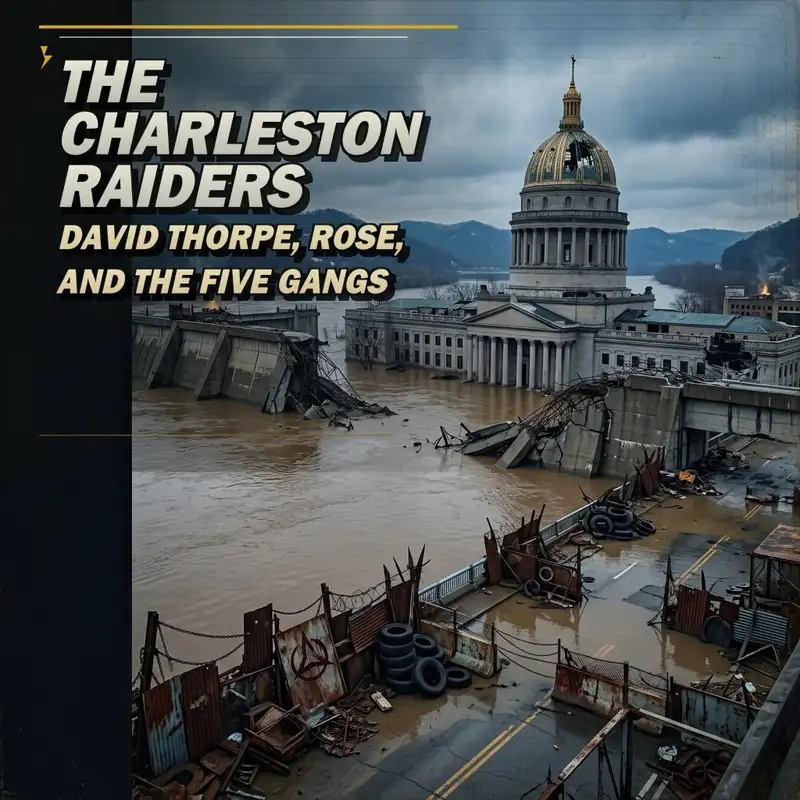
On Christmas Day, twenty eighty-two, Charleston learned what the Appalachian Raiders could do when they chose not to take a city, but to break it. David Thorpe had obtained mini nukes through the thefts of the Blackwater Bandits. He used them against Summersville Dam, upstream from Charleston. The resulting flood devastated the city below, shattered a Responder center already strained by refugees and shortages, and killed or displaced an unknown but catastrophic number of people. It also killed Rosalynn Jeffries, Thorpe’s partner and field commander, who was still being held in the Charleston Capitol Building.
That contradiction is the key to Thorpe’s raider alliance. It possessed enough reach, intelligence, and stolen firepower to destroy vital infrastructure. It did not possess the information, restraint, or political purpose needed to turn destruction into power. Charleston was not occupied. Its people were not governed. Its markets, supplies, workshops, and medical capacity could not be folded into a raider economy. A retaliatory strike meant to answer Rosalynn’s capture instead destroyed a city, deepened the region’s misery, and demonstrated that Thorpe’s coalition could ruin institutions more easily than it could build any of its own.
The original Appalachian Raiders were not one uniform mass of desperate people in mismatched armor. They were a loose alliance of five gangs with different leaders, different habits, and different ways of extracting what they needed from a damaged region. The Cutthroats relied on direct violence and intimidation. The Blackwater Bandits specialized in infiltration and theft. The Trappers turned difficult terrain into a weapon. The Diehards tried, with limited success, to set boundaries around violence. The Gourmands made human beings into a food source.
Together, those groups gave Thorpe something more flexible than a conventional army. They could steal, ambush, threaten, scout, trap, and prey upon travelers across a broad stretch of Appalachia. But their strengths were also the reason they failed. They had no durable agriculture, no dependable industry, no common law, no medical system equal to a regional emergency, and no succession plan that could survive the loss of their leaders. Thorpe assembled a predatory coalition. He never transformed it into a society.
The road to that coalition began in places built for a very different kind of emergency. The ski resorts of the Savage Divide offered shelter, stocked kitchens, staff facilities, service roads, and the appearance of order. In the first months after the Great War, wealthy guests, workers, and other survivors gathered in resort country expecting that some larger authority would return. The old world had trained them to imagine rescue as a scheduled service. There would be a convoy, a government directive, a military patrol, a relief distribution point, perhaps a carefully branded assurance that the situation was under control.
Instead, the supplies began to run down.
Resorts are logistical systems disguised as leisure. Their kitchens, heating systems, bars, lifts, guest rooms, and maintenance departments depended on regular deliveries from outside. Food arrived on trucks. Replacement parts came through supply chains. Fuel, medicine, linens, cleaning materials, and seasonal labor all moved through networks that the Great War had erased. A ski lodge may look self-contained when its lights are on and its pantries are full. It becomes a trap when the roads fail, the weather turns, and every stored meal has to be counted.
By November, survivors in the resort country had sought aid and supplies from Charleston. Charleston itself was struggling to absorb displaced people and preserve some form of emergency government. Its leaders faced demands that exceeded what they could distribute. The refusal or inability to provide relief carried political consequences far beyond one failed request. Harland McClintock’s elected survivor leadership had asked people to endure scarcity within a framework of shared rules. But rules are difficult to defend when hungry people believe the rules have delivered nothing.
The winter of twenty seventy-eight made that failure sharper. Cold, isolation, and shrinking stocks did not automatically create raiders. Plenty of people in Appalachia endured hardship without making predation into a way of life. But scarcity changed the political argument. A leader who promised orderly sacrifice could be accused of passivity. A man who promised immediate supplies through force could present himself as practical. David Thorpe understood that distinction. He did not need to prove that violence was moral. He only had to prove that it could produce results before anyone else could.
Thorpe’s rise was not merely a descent into individual cruelty. It was a challenge to the idea that the resort survivors should remain a community at all. The surviving records describe a break with the Responders that became personal and bloody. Two Responders came to offer assistance. Thorpe killed them. Harland and Margie McClintock attempted to subject him to trial and exile. That response mattered because it represented an effort to preserve authority through process. Thorpe’s answer was to make process look weak.
The group split. Margie McClintock became associated with the Diehards, who retained some attachment to restraint and self-defense. Thorpe consolidated the Cutthroats at Pleasant Valley. From there, he built influence through intimidation, charisma, personal violence, and control of the strongest gang in the emerging alliance. He could offer what an exhausted emergency government could not always provide. Food taken from someone else. Weapons taken from an abandoned cache. Shelter taken from an occupied building. Safety purchased by making another group less safe.
Years later, Rose would describe the five gangs in the language of tactics and personality. Rose had been built from a modified Miss Nanny unit and carried selected aspects of Rosalynn Jeffries’s personality or memory. She was not Rosalynn returned from the dead. She was a machine shaped by Thorpe’s grief, possessiveness, and desire to preserve something of the woman he had lost. Her account of the gangs is valuable because it preserves their identities. It is unreliable because Rose enjoys the story too much.
The Cutthroats were Thorpe’s instrument of direct coercion. Based around Pleasant Valley and the Top of the World, they provided the alliance with its political center, such as it was. Their power rested on visible threat. Checkpoints, occupied sites, armed patrols, and sniper positions suggested that the raiders were trying to control movement through parts of the region. They did not need to govern every settlement or road. They only needed travelers and smaller communities to believe that resistance would be costly.
The Blackwater Bandits, led by Freddie Lang, did different work. They were thieves, infiltrators, and scavengers of high-value equipment. Their most consequential success was the theft of Brotherhood materiel, including mini nukes. That theft showed the strategic importance of a small group with access to intelligence, stealth, and timing. A band of infiltrators did not need to outfight the Brotherhood in a pitched battle. It only needed to find a weakness in security and exploit it.
The Trappers under Walter Griswold used terrain, explosive bait, hidden hazards, and anti-tracking methods. Their approach was well suited to the mountains and broken routes of the Savage Divide. A trap is inexpensive compared with a fortified position. It can slow pursuit, deny a trail, injure a better-armed enemy, or force a traveler into ground chosen by the defender. The Trappers were not an army of engineers in any formal sense. But they understood that in a fractured landscape, control of movement often mattered more than control of a building.
The Diehards occupied a more uncomfortable position. Margie McClintock tried to keep violence bounded by self-defense. That did not make the Diehards a peaceful community. They still relied on theft, intimidation, and the pressure that armed desperation places on weaker people. Yet they represented an alternative to Thorpe’s belief that cruelty itself was a governing principle. The Diehards were trying to survive without becoming entirely defined by predation. Their failure would show how difficult that was without food security, dependable allies, and an economy that did not require someone else to lose.
The Gourmands took the raider economy to its most grotesque conclusion. Operating from Bolton Greens, Morris and Edie Stevens turned human flesh into a source of food. This was not colorful raider eccentricity. It was a system of predatory consumption. In a world where crops, livestock, trade, and medical care had become uncertain, the Gourmands treated other people not as neighbors, workers, or potential allies, but as stores of calories. Their behavior was an atrocity. It was also an illustration of what happens when scarcity is answered by stripping away every limit on whom a group may exploit.
The alliance’s logistical model made its weaknesses worse. The raiders lived by salvage, theft, extortion, seized food, captured supplies, abandoned resorts, mines, and the vulnerability of travelers. That model could support mobility and local violence. It could not reliably sustain a regional organization through prolonged crisis. Loot is not production. A stolen weapon is not a workshop. A captured cache of ammunition is not a supply chain. A fortified lodge is not a hospital. A roadblock is not a tax system that can fund public works, repairs, or famine relief.
The alliance did maintain a territorial security network of sorts. Raider positions, bases, checkpoints, and overwatch sites indicate that the gangs understood the value of roads, passes, and approaches to their strongholds. But there is no basis for treating them as a standardized military force. Their manpower is not securely established. Their ranks were not a documented professional structure. Their supply system was opportunistic. Their communications were personal and vulnerable. They could threaten movement through the region, but they could not guarantee safe movement for their own people when the environment, rival factions, or disease turned against them.
Civilians stood at the center of this economy. They were not scenery between raids. Travelers carried supplies. Settlements offered food, tools, shelter, information, and potential recruits. Prisoners could be coerced. Refugees could be robbed. Isolated people could be frightened into cooperation. But civilians were also the source of every form of legitimacy the raiders lacked. A group that protects a road can earn trade. A group that distributes water can gain support. A group that mediates disputes can become an authority. Thorpe’s coalition repeatedly chose extraction over that slower and more difficult path.
Charleston exposed the cost of that choice. By twenty eighty-two, the raiders had expanded beyond the Savage Divide and into greater conflict with the Responders. Charleston mattered because it was more than a collection of buildings. It was an emergency center with medical, civic, and relief functions. It was trying to absorb the strain of displaced populations while preserving the machinery of collective survival. Its resources were limited, but its existence represented a rival model of authority. The Responders claimed that people could survive through mutual aid, training, medicine, communication, and organized relief. Thorpe claimed that people survived by taking what they could hold.
On the night of December twenty-fourth, Rosalynn Jeffries led a raid toward Charleston. Rosalynn was not merely Thorpe’s partner. She was the Cutthroats’ second-in-command and an operational leader in her own right. The raid failed. Raider losses were serious, though their exact scale is not established. Responders were also killed and wounded. Rosalynn was captured and badly injured.
The Responders detained her in the Charleston Capitol Building. Melody Larkin considered using the prisoner as leverage, perhaps to negotiate with Thorpe or to draw him into a more favorable situation. That decision had its own risks. Holding the second-in-command of a hostile raider coalition might create bargaining power. It might also provoke retaliation against a city already under pressure. In a crisis, emergency authorities often have to choose between justice, intelligence, deterrence, and immediate civilian safety. Charleston had few good options.
Thorpe’s response appears to have been shaped by incomplete or false information. He believed Rosalynn had been killed, or at least believed there was no meaningful prospect of recovering her. The precise state of his knowledge remains uncertain. What matters is the choice he made under that uncertainty. Rather than seeking confirmation, attempting negotiation, conducting reconnaissance, or planning a limited recovery operation, he chose infrastructure destruction on a catastrophic scale.
The mini nukes stolen by the Blackwater Bandits made that possible. Thorpe directed them against Summersville Dam. A dam is not simply a target. It is stored force. It holds back water that supports, threatens, or shapes every community downstream. Destroying it transformed a raider reprisal into a disaster affecting people who had never taken part in the raid, people who could not flee in time, and people whose homes, supplies, and institutions stood in the flood’s path.
Charleston was devastated. The flood destroyed crucial supplies and forced surviving Responders to relocate toward Morgantown. The city’s ability to function as a center of relief and government was broken. The number of dead cannot be stated with confidence, but the losses were severe enough to mark the event as one of Appalachia’s great post-War civilian catastrophes. People died in the water. Others lost shelter, family, stores, records, and whatever fragile security Charleston had still offered.
Rosalynn died in the Capitol Building with them.
The Christmas Flood revealed the deepest weakness in Thorpe’s system. He could use captured technology to break another institution. He could not replace that institution after it was gone. His alliance had no equivalent of the Responders’ medical network, training programs, relief stores, or civic mission. It could take. It could threaten. It could retaliate. When the region needed rescue, repair, and public authority, it had nothing to offer.
The Order of Mysteries recognized the raiders as a threat that could not be handled through one conventional battle. The Order was a clandestine organization, not a field army marching under a flag. Its members used reconnaissance, intercepted communications, infiltration, and targeted attacks. After the flood, they began a sustained campaign against raider positions and personnel. The campaign continued through the winter of twenty eighty-two and twenty eighty-three, then into the years that followed.
This was counterinsurgency in reverse. The Responders and other civilian institutions had been forced to defend communities from raider predation. The Order adopted methods suited to an enemy that had no single front line and no centralized headquarters that could be captured to end the conflict. They gathered information. They watched routes. They identified vulnerabilities. They disrupted operations and attacked where the raiders were exposed. In a landscape of ruins and scattered settlements, intelligence could be more valuable than massed firepower.
Thorpe’s coalition was vulnerable to that pressure because its command system depended so heavily on personal relationships. Fear travels quickly, but so do rumors. A decentralized alliance can be hard to destroy in one blow, yet it can also be hard to defend. Each gang had different local interests. Each leader had information that might not reach the others. Each raider base was a possible source of intelligence for enemies, defectors, prisoners, or frightened civilians. The same loose structure that made the coalition adaptable also made it difficult to secure.
The Order did not remain untouched by the struggle. Its secrecy imposed isolation, and its losses created strain. By twenty eighty-six, Olivia Rivers betrayed the Order and worked through Brody Torrance to contact Thorpe. That betrayal is not evidence that Thorpe had mastered Appalachia or that the Order had somehow been defeated as a force. It is evidence that clandestine warfare corrodes its own institutions. People working in compartments, under fear of exposure and death, can lose faith in the cause, in their leaders, or in one another.
Still, the Order’s campaign mattered because it imposed costs that Thorpe’s model could not easily absorb. A government can replace some lost personnel through recruitment, training, public loyalty, and administration. A raider gang that loses an experienced scout, a local leader, or a trusted infiltrator may lose an entire network of relationships. The alliance had no deep reserve of institutional capacity. Every death, defection, and broken line of communication mattered more.
The Blackwater Bandits offer the clearest example of both raider capability and raider fragility. Freddie Lang’s group had stolen equipment from a Brotherhood position, a remarkable achievement for a gang without the Brotherhood’s armor, doctrine, or formal supply apparatus. Their success was not magic. It came from stealth, planning, and the ability to exploit a gap in security. Small groups can have strategic influence when they acquire weapons that exceed their normal means.
The mini nukes used against Summersville Dam proved that point. A limited theft helped enable a regional catastrophe. But the Bandits’ success also illustrates a common failure of post-War power. Acquiring technology is not the same as controlling it. It is not the same as understanding its risks, maintaining the environment around it, protecting the people who handle it, or ensuring that its use serves a coherent political objective.
Blackwater Mine became the Bandits’ graveyard. The mine’s automated uranium extraction system and the radiation associated with it created conditions the gang could not manage. The surviving records and the mine’s later state establish the broad outcome. The Blackwater Bandits disappeared under the weight of contamination, inadequate technical control, and the absence of meaningful medical support. The exact sequence of exposure and transformation is less clear than the central fact. They operated inside a dangerous industrial environment without the institutions needed to make that environment survivable.
The mine was an old-world machine continuing a process after the society that had built and supervised it was gone. That is a recurring danger in Appalachia. Automation can preserve production, surveillance, and destruction long after it stops serving human needs. The Bandits were skilled thieves. Skill at theft did not make them radiation engineers, medical workers, or industrial safety officers. Their destruction removed one of Thorpe’s most capable specialist groups and exposed how little redundancy the raider system possessed.
The Trappers failed for a different reason. Walter Griswold’s gang had made indirect action into its survival method. They used traps, explosive bait, concealed approaches, and the dangerous geography around Devil’s Backbone. Their methods could frustrate pursuit and make armed outsiders pay for every step through unfamiliar ground. Against a larger force, that kind of local knowledge can be decisive. It allows a small group to avoid a fair fight, which is usually wise when fairness is measured in ammunition and casualties.
But the Trappers were tied too closely to Walter’s leadership and expertise. When he was captured by super mutants and taken toward Huntersville, the gang lost more than a commander. It lost the person around whom its practices, confidence, and local coordination were organized. The surviving Trappers scattered or fled. Their fate demonstrates the difference between a skilled group and a durable institution. A durable organization can retain knowledge, promote replacements, preserve communications, and continue after a leader disappears. The Trappers had techniques. They did not have enough depth to survive the loss of the person who made those techniques cohere.
Huntersville also shows how Appalachian threats overlapped without requiring one master conspiracy. The super mutants there were connected to the region’s broader history of experimentation and Enclave activity, but the Enclave did not command the raiders or orchestrate their collapse. The immediate reality for the Trappers was simpler and more brutal. A hostile force seized their leader. The gang had no reliable rescue capacity, no reserve command structure, and no secure rear area from which to recover.
The Gourmands turned inward with equal predictability. At Bolton Greens, Morris and Edie Stevens oversaw a group that had made cannibalism part of its survival system. Even within that system, the gang attempted to establish a limit. Members were not supposed to eat other members. That rule was not an expression of morality in any broad sense. It was a minimal effort to preserve internal trust. A gang can terrorize outsiders only as long as its own members believe they will not become the next available resource.
Morris violated that rule. He was discovered killing and consuming fellow Gourmands. He and Edie were expelled. The immediate incident was a breakdown of discipline, but the larger significance was institutional. The Gourmands had built their survival around treating people as consumable. Once that principle became normal, it was difficult to maintain a stable boundary between outsider and insider. Rules cannot hold for long when the entire group’s economy teaches that human beings are meat, tools, or threats.
Morris later became a wendigo in the Wendigo Cave. In Appalachia, that transformation is an established part of the grim and inconsistent biology of the wasteland. It should not be turned into a universal rule that cannibalism always produces wendigos. Fallout does not support that neat equation. What the event does show is that the Gourmands’ internal collapse was not merely metaphorical. Their predation consumed the social boundary that had allowed them to function as a gang at all.
The Diehards offer the clearest alternative to Thorpe, and the clearest proof that good intentions alone could not solve the raiders’ material problem. Margie McClintock had opposed Thorpe’s path from the beginning. Her faction at Sunnytop Ski Lanes was less aggressive, and she tried to limit violence to self-defense. In the context of the original raider alliance, that mattered. Margie recognized that violence used without limit would turn every nearby community into an enemy and every raider into a future victim.
But the Diehards were still trapped inside a predatory economy. They needed food, weapons, medicine, and shelter. They relied on theft and intimidation even when their leader tried to restrain their use. They could not sustain a moral boundary simply by declaring one. Restraint requires support. It requires enough food that members are not forced to prey on the weak. It requires discipline that can punish abuse. It requires allies who can provide trade, refuge, and medical care. It requires some confidence that tomorrow will not destroy the people who chose not to steal today.
The Palace of the Winding Path provided the Diehards with a degree of protection and access to chems. That relationship was valuable, but fragile. Drugs can numb pain, create dependency, or serve as currency. They cannot replace political stability. When the Palace disappeared from the Diehards’ support network, Margie’s already strained position deteriorated. Loss accumulated. Her effort to hold a line against Thorpe’s model had been undermined by scarcity, isolation, and the failure to build an independent material base.
Margie eventually died from a chem overdose. That death should not be treated as a moral fable or a casual detail about wasteland vice. It was the end of a leader carrying a fragile political ethic through conditions that gave every advantage to harsher rivals. The Diehards could not become a stable refuge while remaining dependent on the same theft and fear that sustained the other gangs. They showed that restraint mattered. They also showed that restraint without institutions, resources, and security could be overwhelmed.
By the later years of the alliance, the Cutthroats remained the strongest surviving component. Thorpe still held Pleasant Valley and the symbolic height of the Top of the World. But the coalition around him had been hollowed out. The Blackwater Bandits were gone. The Trappers had fragmented. The Gourmands had been consumed by their own logic. The Diehards had lost their leader and their precarious source of support. The Order of Mysteries had imposed years of disruption. Thorpe’s authority looked formidable from a distance because it was built around threat. Up close, its support structure was collapsing.
Then the Scorched Plague changed the entire strategic environment. Until that point, the raiders had operated in a landscape where human groups competed for routes, supplies, and shelter. The Scorched threat created a regional survival emergency. It demanded medical knowledge, collective defense, communication, quarantine, disciplined movement, and cooperation between communities that might otherwise distrust one another. Those were precisely the capabilities Thorpe’s system had neglected.
The Scorched could not be intimidated into paying tribute. They could not be easily absorbed into a protection racket. They did not offer a market to loot, a city to threaten, or a rival leader to bargain with. A force built around predation faced an enemy that turned predation into irrelevance. The raiders had weapons, strongholds, and experience with violence. They did not have the resilient logistics, medical capacity, or shared command needed to coordinate a response across Appalachia.
Thorpe himself was infected and became Scorched. There is an obvious grim symmetry in the fate of a man who had built authority through fear becoming part of an inhuman force that spread fear without purpose or negotiation. But the event should not be reduced to poetic justice. His infection represented a practical command failure. A leader-centered alliance had no credible succession mechanism. There was no evidence of an orderly transfer of authority, no unified emergency plan, and no durable institution capable of coordinating the remnants.
By the spring of twenty ninety-seven, what remained of the original raider system was fleeing in search of shelter. The collapse had many causes. Leadership losses mattered. Environmental hazards mattered. The destruction of supply nodes mattered. The Order of Mysteries imposed pressure over time. The gangs’ separate identities made unified action difficult. The Scorched crisis overwhelmed a coalition that had never learned to provide collective security. No single battle destroyed the Appalachian Raiders. Their structure failed under strategic pressure because it had been designed for extraction, not endurance.
Rose remained after the alliance did not. From the Top of the World, she preserved an edited version of the old raider story. Her memories and mannerisms connected her to Rosalynn Jeffries, but they did not restore Rosalynn’s judgment, experience, or humanity. Rose turned the five gangs into a collection of methods. Theft became a lesson. Traps became a lesson. Violence became a lesson. The dead became examples in a raider education program delivered by a cheerful machine with a taste for mayhem.
When Vault Seventy-Six opened in twenty one hundred and two, Appalachia was entering a different phase. The emergence of Vault Dwellers helped make parts of the region safer. In twenty one hundred and three, surviving raiders associated with the Diehard tradition, led by Meg Groberg, returned and established Crater. That group inherited the raider legacy, but it was not Thorpe’s original five-gang alliance preserved intact. The Cutthroats, Bandits, Trappers, Gourmands, and Diehards had not marched together through history as one surviving organization.
Crater’s existence instead shows that the need for shelter, trade, status, and armed self-protection did not vanish when Thorpe’s system collapsed. The question was whether later raiders could build something more durable than fear and scavenged ammunition. David Thorpe’s alliance became powerful because it combined theft, ambush, coercion, and damaged infrastructure across a fractured region. It failed because none of those methods could feed, heal, replace, protect, or govern its own people. Charleston proved that Thorpe could destroy a city without holding it. The Scorched crisis proved that fear and salvage could not substitute for institutions when Appalachia needed collective survival.