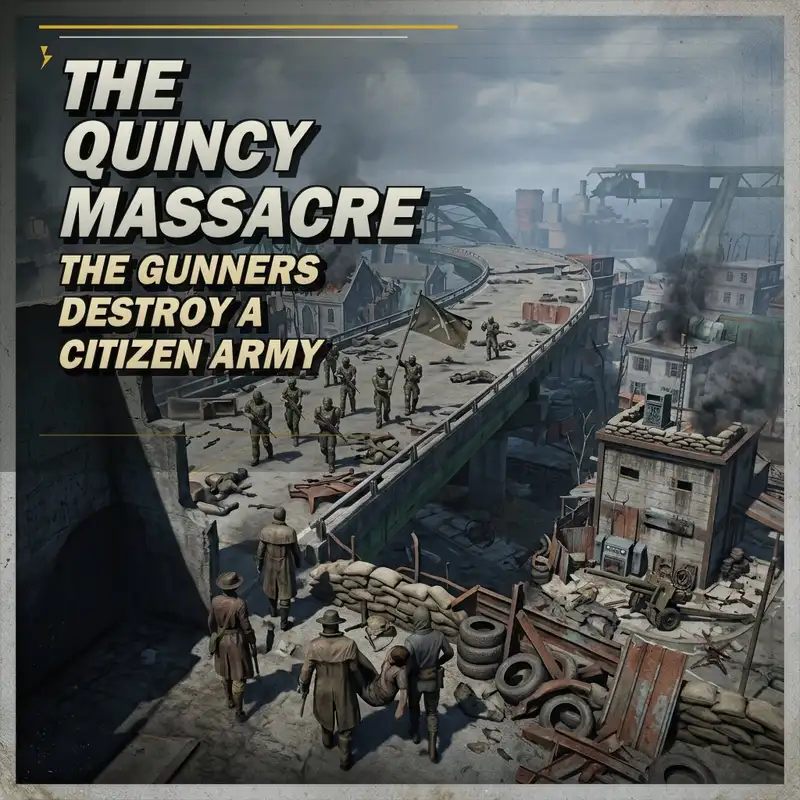
The Quincy Massacre: The Gunners Destroy a Citizen Army
Lieutenant Clint arrived at Quincy’s gate carrying the shape of relief. Colonel Ezra Hollis knew him as a Minuteman veteran, a man who had spent roughly ten years in the organization. Quincy had been under repeated pressure from the Gunners. Hollis had sent requests for help. No relief column had appeared. So when Clint came to the walls, Hollis had reason to believe that at last another Minutemen force had answered the call.
It was not relief. Clint had defected to the Gunners. He came with a demand that Hollis and Mayor Jackson surrender the town. The moment carried a special kind of cruelty. Quincy was already threatened by an organized enemy outside its defenses. Now it learned that the institution meant to protect it could also be penetrated from within. Clint was not the sole cause of what followed. The town was undermanned before he appeared. Its appeals for aid had already failed. But his arrival exposed the deeper danger. Quincy was not simply facing a stronger attacking force. It was facing the failure of trust inside a citizen army.
The Quincy Massacre occurred shortly before the opening of Fallout Four, probably around September of the year twenty-two eighty-seven, though the exact date is not firmly established. By then, the Commonwealth had no functioning regional government capable of guaranteeing security. Communities survived through local arrangements, trade, private defense, and organizations that rose or fell according to their own capacity. The Minutemen had once offered something more ambitious. Their ideal was mutual protection. A settlement in danger could call for help, and armed volunteers from elsewhere would answer.
That model gave the Minutemen legitimacy. They were not supposed to be a distant army collecting taxes from behind a fortified capital. They were neighbors, farmers, traders, laborers, and veterans who took up arms when another community needed them. Their strength was local knowledge and local consent. Their weakness was that consent did not automatically create command authority, supply systems, replacement personnel, reliable communications, or an enforceable duty to respond. The system could work when crises were limited and communities remained willing to cooperate. It became fragile when emergencies multiplied.
Quincy mattered because it was more than an isolated cluster of ruins. Before its fall, it was a substantial and comparatively prosperous Commonwealth settlement. It had civilian leadership under Mayor Jackson, residents with homes and trades, workshops, defensive preparations, and enough accumulated resources to become valuable. Prosperous in the Commonwealth did not mean wealthy by pre-War standards. It did not mean insulated from hunger, raiding, disease, or the uncertainty of travel. It meant that Quincy had achieved something difficult in the post-War world. It had built a functioning community worth defending and, therefore, worth taking.
That prosperity also made Quincy a target. Organized predatory forces do not need to occupy every settlement in a region. They need only seize the places that offer shelter, defensible ground, salvage, transport access, labor, supplies, and political influence. A town that can feed itself, repair equipment, and serve as a base is more useful than an empty street full of irradiated debris. The Gunners did not need to possess a formal state or a recognized government to understand that. They needed the ability to concentrate force, break resistance, and keep enough personnel in place to hold what they had seized.
Quincy’s people were not merely spectators waiting for uniformed outsiders to determine their fate. They requested assistance. They worked on defenses. They attempted to flee when survival demanded it. Their families, homes, tools, and accumulated security were the stakes of the battle. The Minutemen came because Quincy’s emergency fit the organization’s purpose. But the civilians of Quincy would bear the greatest cost if that purpose failed. In a citizen-defense system, the line between civilian and defender is often thin. The same people repairing walls may also be feeding the militia, carrying ammunition, tending the wounded, or deciding when their children must run.
Colonel Ezra Hollis brought a Minutemen detachment to Quincy after the Gunners began attacking the town. His surviving reports show a commander who understood both the urgency of the situation and the limits of his force. On arrival, Hollis’s people ambushed the attackers. He reported that the action killed about one-third of the Gunner force confronting them. The exact number of Gunners is not established, and Hollis was writing from the defender’s perspective. Still, the report matters. It shows that the Minutemen were not simply swept aside in their first encounter.
The ambush temporarily relieved the pressure on Quincy. It demonstrated that trained, determined local defenders could hurt the Gunners when they had surprise, favorable conditions, and a coherent immediate objective. It also demonstrated the difference between winning a clash and securing a settlement. The Gunners had suffered losses, but they had not ceased to be a threat. Quincy’s approaches remained vulnerable. The town still needed defenders at gates, on walls, near homes, along streets, and at any elevated point an attacker might use to fire into the settlement. A tactical success bought time. It did not solve the larger problem.
Hollis appears to have recognized that distinction clearly. His reports do not read like the confidence of a commander who believed one ambush had ended the campaign. They show a man trying to turn a temporary reprieve into a defensible position. The Minutemen and Quincy residents began improving the town’s defenses. Preston Garvey helped reinforce the walls. Sturges, Quincy’s mechanic, worked on elevated walkways. There was even discussion of restoring power armor owned by the town’s mechanic for use in the defense.
Those preparations reveal both ingenuity and desperation. Better walls could slow an assault. Elevated walkways could give defenders observation points, firing positions, and a means to move above obstructed streets. A restored suit of power armor, if it could be made operational, might provide protection and morale at a critical point. But none of these measures could manufacture manpower. Fortifications are not soldiers. They are tools that require people to occupy them, repair them, watch from them, and defend the gaps between them.
A settlement defense is especially demanding because the defender is protecting more than a single fortified line. Civilians need shelter. Water and food must remain accessible. Wounded people need care. Fires must be controlled. Gates, rooftops, streets, workshops, and escape routes all become military concerns. Every person placed on a wall is one less person moving supplies or helping families evacuate. Every improvised platform requires time, tools, and labor that might otherwise be used to build barricades or prepare withdrawal routes. Quincy was preparing under pressure, not constructing an ideal fortress in peacetime.
The possible power armor illustrates the same point. Advanced equipment can alter a local fight, but it does not erase the support system behind it. A suit must be repaired, powered, maintained, and operated by someone capable of using it. The surviving record does not establish that Quincy’s power armor was restored, fielded, or decisive in the battle. What matters is that the defenders considered it because they were searching for any means to offset a shortage of people. Technology was being treated as a force multiplier. It could not become a substitute for an absent relief force.
Hollis’s decisive problem was not a lack of courage among the people immediately around him. It was that Quincy could not defend itself indefinitely with the people immediately around him. He sent requests to other Minutemen groups. Later, he recorded the result with painful clarity. The attacks were coming almost daily. Supplies were sufficient to wait for a while. Yet not a single reinforcement group had arrived. That is the central operational fact of the Quincy Massacre.
Why no one arrived remains uncertain. The available record does not prove that every Minutemen company deliberately abandoned Quincy. Some may have been dealing with their own emergencies. Some may have lacked the men, supplies, or leadership to move. Travel through the Commonwealth was dangerous, communications were uneven, and a local group could have been delayed, scattered, or destroyed before reaching the town. Some may have refused. Some may have received the request too late. The evidence does not settle the question, and inventing a single explanation would make the history cleaner than it is.
But uncertainty about the causes does not reduce the importance of the outcome. A mutual-defense organization exists to turn a request for help into collective action. Quincy called. Hollis waited. No reinforcement arrived before the town fell. That failure revealed a weakness that had been growing for years. The Minutemen still had scattered members, local memory, and the language of common protection. What they lacked was a dependable mechanism for coordinating action across the Commonwealth when a major settlement faced sustained attack.
The organization had already been weakened by leadership crisis. General Becker, the Minutemen’s last recognized general before the final collapse, died in the year twenty-two eighty-two. After his death, the Minutemen failed to agree on a successor. That did not instantly erase every local company or every armed volunteer. Institutions rarely disappear in one dramatic moment. They fray. Authority becomes disputed. Old obligations become negotiable. Local commanders begin asking whether they are responsible for distant settlements when their own communities are insecure.
By the time Quincy came under attack, the Minutemen still had brave individuals and functioning fragments. Hollis could respond to the initial plea. Preston could help organize defenses. Other members existed somewhere in the Commonwealth. Yet the organization no longer possessed the political cohesion to act reliably at regional scale. There was no accepted higher command that could order reinforcements, allocate scarce resources, punish refusal, or guarantee that a company leaving home would receive support in return. The Minutemen had retained the language of a federation while losing many of the practical instruments that make a federation endure.
The Gunners did not need to destroy every Minutemen group one by one. They only needed to concentrate before the Minutemen could do the same. This is where Quincy’s defenders met an adversary built for a different kind of conflict. The Gunners were an organized mercenary force, not a formal Commonwealth army and not a government recognized by the people they occupied. But they possessed hierarchy, discipline, equipment, regional bases, and the ability to assemble a substantial attack force for a specific objective.
That organization should not be mistaken for unlimited capacity. The Gunners were not shown as a single unified machine with identical equipment, perfect discipline, or a complete industrial system stretching across the continent. Their equipment varied. Their internal relationships had friction. Their authority structure was not fully visible from Quincy alone. Still, the evidence at the town shows a force able to coordinate an assault, maintain a chain of command, and establish a garrison afterward. In a fragmented Commonwealth, those were considerable advantages.
The local Gunner command at Quincy included Clint, Tessa, and Sergeant Baker. Baker’s holotape indicates that Clint’s authority was connected to Captain Wes, a Gunner superior who supported or approved his role in the operation. The full extent of Wes’s command is not established. What can be said is that the Gunners possessed enough hierarchy for Clint’s defection and local command to matter beyond a personal feud. He was not simply a lone raider who happened to know the town. He was integrated into an organization able to use his knowledge.
Their advantage was not merely better gear. Equipment matters only when an organization can move, maintain, and employ it. The Gunners could gather fighters around a common mission. They could accept losses in one encounter and return with renewed pressure. They could assign leadership and exploit a captured settlement as a base. Quincy’s Minutemen had local legitimacy but no reliable regional reinforcement. The Gunners had no legitimate claim to protect Quincy, but they had concentration, initiative, and a chain of command sufficient to impose themselves by force.
Clint made that advantage more dangerous. His years as a Minuteman veteran gave him knowledge of the culture he had abandoned. He understood that Quincy would expect relief. He understood the political value of convincing a town that its protectors had failed. He likely knew how Minutemen defenders thought about walls, citizen volunteers, and calls for aid. The sources do not establish that he possessed every defensive plan or personally designed every element of the attack. But he knew enough to help turn a military assault into an intelligence-enabled operation.
His surrender demand was itself a weapon. It told Hollis and Mayor Jackson that the Gunners were not merely probing the town. They were confident enough to offer terms before the final blow. It also forced the defenders to confront a humiliating possibility. If a Minutemen lieutenant stood with the attackers, what did that say about the unity of the organization? Hollis refused to surrender. That decision preserved the principle Quincy was trying to defend, but it could not alter the military balance already developing around the town.
Clint’s own records describe the Gunners’ plan in terms of strength and domination. He presented the seizure of Quincy as proof that force creates order and that weakness deserves to be displaced. That account should not be read as neutral military history. It is the self-justifying record of the victor, written by a man who had betrayed former comrades and would later execute Hollis. Yet it is still useful evidence of his worldview. Clint did not describe civilian protection, consent, or public responsibility. He described possession. The town was valuable because it could be taken and held.
That distinction mattered politically. The Minutemen’s claim to authority rested on answering calls for help. The Gunners’ authority rested on their ability to make resistance costly. In the short term, coercion can be more efficient than voluntary association. It does not require debate, elections, or shared purpose. It requires weapons, discipline, fear, and enough logistics to keep the armed group supplied. But the difference between holding ground and governing people remains important. The Gunners could transform Quincy into a stronghold without becoming a legitimate public institution.
The final assault centered on terrain. Clint’s account states that the Gunners intended to destroy a support structure on the elevated highway, seize the high ground, and then overrun Quincy. Preston Garvey later described the Gunners taking the highway and firing down on the town. The surviving accounts do not provide a complete minute-by-minute reconstruction, nor do they establish exact weapon positions or ranges. They do establish the crucial military fact. Once the Gunners controlled the elevated position, the defenders below were exposed.
Elevation matters because it changes what a force can see and what it can threaten. From above, attackers can observe movement in streets and open areas. They can fire into positions that defenders built to face outward. They can disrupt communication between sections of a town. They can force defenders to divide their attention between the perimeter and the ground already inside their defensive depth. In a built-up settlement, high ground can turn ordinary streets into channels of fire and movement rather than safe routes between homes.
For Quincy’s defenders, that problem was magnified by numbers. Improvised walls, rooftops, and walkways could support a determined defense while the enemy remained outside and disorganized. They could not compensate indefinitely for a force able to seize commanding terrain and attack from multiple directions. The defenders had prepared for the Gunners as best they could. But preparation is not the same as control. Once the attackers took the initiative, the Minutemen were compelled to react to threats they could no longer contain.
The collapse of the defense was therefore not a simple story of one wall failing or one squad being defeated. It was the unraveling of a system under pressure. Hollis lacked enough people to hold all necessary positions. Quincy had received no reinforcements. The Gunners were able to return in strength. Clint’s knowledge helped them exploit the settlement’s vulnerabilities. The elevated highway gave them a commanding position. Each factor intensified the others. The loss of high ground was devastating because there were too few defenders to adapt. The shortage of defenders was fatal because no larger Minutemen structure arrived to replace them.
Tactically, the Gunners broke Quincy’s defense. Operationally, they gained a defensible base in the southern Commonwealth. The distinction matters. Winning the battle meant driving off, killing, or capturing the people who resisted. Turning Quincy into a stronghold meant converting a settlement’s physical assets into an enduring military position. The streets, buildings, rooftops, walls, and elevated terrain that had once supported civilian life could now support Gunner patrols, firing positions, storage, and command.
The defenders’ defeat opened the town to catastrophe. The record supports mass killing, capture, and flight. It does not establish an exact civilian death toll. It does not prove that every resident died. Some people escaped, and others appear to have been taken prisoner. But Quincy’s civilian society was shattered. Homes ceased to be homes. Workshops ceased to serve their original community. Families were separated. People who had expected the Minutemen to help defend their town discovered that the organization’s promise had failed at the moment it mattered most.
Colonel Hollis was captured alive. Clint later executed him. The killing had practical and symbolic significance. Practically, it removed the senior Minutemen commander who had organized Quincy’s defense. Symbolically, it demonstrated that the Gunners were not merely taking a town. They were destroying the authority that had stood against them. Hollis’s death was an act of personal betrayal, but it was also institutional decapitation. A local defense force can survive casualties. It struggles to survive the loss of leadership when there is no larger structure capable of appointing, supporting, and recognizing a successor.
The civilians who fled faced a different form of danger. Leaving a collapsing settlement does not mean reaching safety. Refugees must move through hostile territory with limited food, water, medical care, shelter, and protection. They may be pursued. They may lose contact with family members. They may have to abandon possessions that represent years of labor because carrying them would slow the group down. A town’s destruction continues long after the shooting stops. It follows people along roads, through ruins, into temporary shelters, and into every decision about whom they can trust.
Preston Garvey escaped Quincy with a small mixed group of survivors. It included civilians and surviving Minutemen, along with Sturges and others who had been part of the town’s defense or community. It was not a clean military withdrawal. It was a refugee column assembled from the people who happened to survive the collapse and remain together. Preston’s authority in that group was practical. He was not elected to replace Hollis through any intact Minutemen procedure. He became responsible because responsibility had fallen onto the survivors who could still act.
Clint’s records claim that a Gunner detachment pursued the escapees and killed more of them before losing the group near Jamaica Plain. As with Clint’s other writing, the account comes from the attacking side and should be read critically. Yet Preston’s later description of the refugees confirms the broader reality of continued attrition. The group did not leave Quincy and immediately find sanctuary. It kept shrinking. People died, disappeared, broke away, or were lost as the survivors moved through a Commonwealth that offered few secure routes and fewer reliable allies.
Preston later described the group as having been around twenty people at one stage, then reduced to eight, and finally to five by the time it reached the Museum of Freedom in Concord. Those figures should not be used as a casualty count for Quincy itself. The refugee group changed over time, and not every person encountered in its later journey necessarily escaped the massacre. What the numbers reveal is the scale of collapse in human terms. A community defense force had become a handful of exhausted people sheltering in a museum.
That transition captures the difference between an institution and a remnant. An institution can replace losses, organize resources, communicate with allies, and sustain obligations beyond the people immediately present. A remnant carries memories, symbols, skills, and perhaps a moral claim, but it may no longer possess the ability to fulfill its original mission. Preston’s group preserved the Minutemen ideal. It could still speak of protecting settlements. But it could no longer protect even itself without extraordinary luck and local assistance.
For that reason, Quincy nearly ended the Minutemen as a credible Commonwealth institution. The massacre did not erase every person who had ever worn Minutemen colors. It did not prove that every local company was cowardly or corrupt. It did not make the organization’s underlying ideal meaningless. What it did was expose the gap between the Minutemen’s public promise and their demonstrated capacity. A settlement had called for aid. A Minutemen commander had answered. He had fought well. He had requested reinforcement. And when the crisis became too large for his detachment, nobody came.
That sequence was devastating because citizen armies depend heavily on confidence. A centralized state can sometimes survive a military defeat if it retains taxation, bureaucracy, command structures, and the ability to raise another force. The Minutemen had much less institutional depth. Their authority rested on the belief that communities would support one another. If settlements concluded that the call for help would go unanswered, then contributing people and supplies to the organization became harder to justify. If local volunteers believed other companies would not come when needed, their willingness to leave home declined further.
Former Minutemen abandoned the organization in disgust. Preston later described the group as effectively finished. The bitterness was not only about defeat. It was about abandonment, mistrust, and the loss of a shared obligation. General Becker’s death and the succession crisis had weakened the Minutemen years before Quincy. The failure to reinforce Hollis revealed that weakness in the harshest possible way. Clint’s betrayal made it feel personal. The massacre made it visible to civilians who had trusted the Minutemen with the security of their town.
The result was a downward spiral. Fragmentation made coordinated defense harder. Failed defense reduced public trust. Reduced trust made recruitment, supply, and cooperation more difficult. That further weakened the ability to answer future emergencies. The Minutemen were not defeated because local people lacked courage. Hollis, Preston, and Quincy’s defenders provided ample evidence of courage. They were defeated because courage at the point of contact could not compensate for absent coordination beyond it.
The Gunners, meanwhile, transformed Quincy into one of their major Commonwealth strongholds. Clint remained in command there. Tessa and Sergeant Baker were among the senior Gunner personnel associated with the captured town. Their presence demonstrated that the operation was not a passing raid. The Gunners intended to hold and militarize Quincy. A captured settlement offered cover, storage, defensible buildings, access to elevated terrain, and a southern foothold from which armed personnel could project power into nearby areas.
Holding Quincy also demonstrated a limited but real logistical capacity. The Gunners could keep fighters stationed there and sustain a command presence after the assault. That does not prove they had unlimited supplies, standardized equipment, or control over the entire Commonwealth. It does not show that they could provide ordinary residents with legitimate administration, justice, or security. A garrison can occupy a town without governing it in any meaningful civic sense. But the Gunners had achieved something the Minutemen could no longer contest at that moment. They had converted local military success into a durable position.
Their victory was therefore both narrower and more consequential than a claim of regional conquest. The Gunners did not become the Commonwealth’s government by taking Quincy. They did not resolve the region’s political fragmentation. They did not gain consent from the people they displaced. What they gained was a base and a reputation. In a land where many settlements could not count on outside help, the ability to seize a well-defended town sent a message. It told potential employers, rivals, and frightened communities that the Gunners could concentrate force and make their presence stick.
For the people of Quincy, that message was paid for with lives, captivity, displacement, and the loss of a community they had built from the remains of the old world. Their destruction cannot be reduced to a convenient background event for a later Minutemen revival. It was a civilian disaster. It showed what happens when a settlement’s defenses are overwhelmed, when relief fails to arrive, and when an organized armed group sees a town not as a community with rights and memories, but as infrastructure to be seized.
Clint’s role remains central, but it should not be allowed to simplify the history. One traitor did not create the Minutemen’s leadership crisis. One surrender demand did not stop reinforcements from arriving. One elevated highway did not make the town impossible to defend under all circumstances. Clint mattered because he entered a system already weakened by fragmentation and turned its vulnerabilities against it. His betrayal was decisive because the Minutemen had lost the institutional resilience that might have contained the damage.
Quincy also shows why informal mutual defense is not inherently futile. Local militia systems can protect communities when they have trusted leaders, clear obligations, reserve capacity, working communications, supply arrangements, and a political structure capable of resolving disputes. They fail when every unit must decide alone whether another community’s crisis is worth the risk. The Minutemen’s ideal required more than goodwill. It required a way to transform goodwill into timely movement, accountable command, and sustained collective action.
The Gunners won the tactical fight by concentrating force, seizing commanding terrain, and exploiting insider knowledge. They won the operational contest by turning Quincy into a stronghold. But the deeper defeat belonged to the Minutemen. Their legitimacy rested on answering calls for help, and their collapse became unavoidable once Quincy called, waited, and received no one.