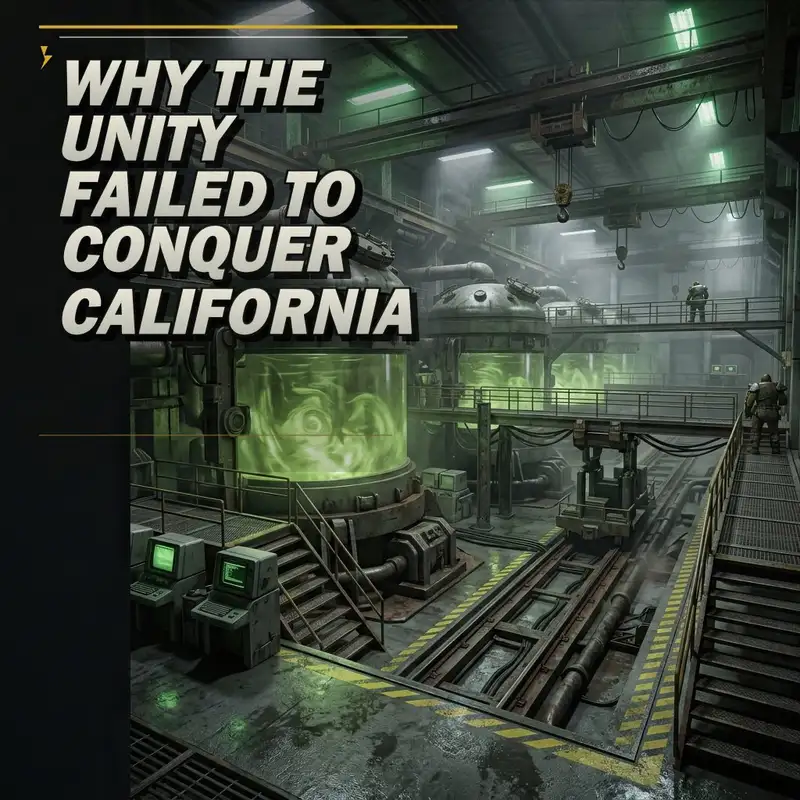
Why the Unity Failed to Conquer California
In the Brotherhood of Steel’s medical laboratory at Lost Hills, a dead super mutant provided the most important intelligence report of the campaign. The corpse did not reveal a new weapon, a hidden route, or the location of an enemy command post. It revealed sterility. The Master’s army, which seemed to be the beginning of a hardier species built for the radioactive world, could not reproduce. That finding did not make the mutants less dangerous. It did not empty their rifles, shut down their vats, or free the people already taken by force. But it exposed the strategic weakness at the center of the Unity’s entire project. The Master was not merely raising an army to conquer California. He was trying to replace humanity with a single transformed people, one that would no longer suffer from ordinary human weakness, division, disease, or war. Yet his supposedly permanent future depended on continuously capturing the very humans he intended to supersede. In the year twenty-one sixty-one, that contradiction was not obvious to most people living in California. They saw missing caravans, disappearances, strange religious missionaries, armed mutants, and settlements under pressure. What they did not yet see was one connected system. The Unity had formidable troops, advanced weapons, covert agents, and a plan for expansion. Against isolated towns, it could appear almost unstoppable. But winning local fights is not the same thing as conquering a region, and conquering a region is not the same thing as building a society that can survive its founder.
The Unity failed because it created a powerful machine for conversion, intimidation, and short-term military expansion. It never created a durable state. Its population could not reproduce. Its supply system depended on captives. Its political order rested on coercion. Its institutions were concentrated in a few critical places. And its many different parts were held together by one irreplaceable mind.
California was not a country waiting to be captured. It was a patchwork of communities, routes, ruins, and institutions that had survived the Great War in different ways. The Hub had merchants, caravans, and a growing commercial life. Shady Sands was a small agricultural settlement trying to establish order beyond its walls. Necropolis was home to ghouls struggling over water, security, and survival. The Boneyard contained old ruins, local communities, and the beginnings of new social arrangements. Lost Hills sheltered the Brotherhood of Steel, a guarded military order with access to technical knowledge and equipment that most Californians could not match. There were raiders, traders, scavengers, religious groups, farmers, armed guards, and people simply trying not to become somebody else’s labor force or somebody else’s target. These places traded, fought, and exchanged rumors, but they did not answer to one government or one army. The New California Republic had not yet emerged as the regional power it would later become. There was no California-wide command structure receiving reports, assigning patrols, and coordinating a defense against a common enemy. That fragmentation helped the Unity at first. A caravan disappearing on the road did not automatically indicate a strategic campaign. A missing scout could be blamed on raiders, radiation, wildlife, or bad luck. A religious mission offering healing and certainty could pass through communities that had no reason to recognize it as part of a larger military organization. But fragmentation also created a problem for the Master.
There was no capital whose fall would deliver California. No parliament could be dissolved. No national army could be defeated in one climactic battle. Every settlement presented a separate intelligence problem, a separate supply problem, and a separate population to control. The Master could terrify California without necessarily possessing it. His movement was built to exploit isolation, but California’s political disorder denied him the kind of decisive victory that conventional conquerors often seek.
The Unity answered this fractured environment with a hybrid method of war. It was not simply an army of super mutants marching under a single banner. It was a combined political, military, biological, and clandestine system. At its center stood the Master, whose authority was strategic, ideological, and personal. The Lieutenant directed the Unity’s military arm and represented its confidence in mutant strength, discipline, and firepower. Super mutants formed the principal assault force. They were physically formidable, capable of using heavy weapons, and better suited than many ordinary humans to harsh conditions in the post-War world. Nightkin added a different capability. Their association with stealth technology and special operations made them useful for reconnaissance, infiltration, intimidation, and internal security. The Children of the Cathedral served another purpose entirely. They were human-facing. Their robes, hospitals, missionaries, and language of healing gave the Unity access to communities that might have fled from an openly mutant force. They could recruit followers, observe local conditions, gather information, and conceal the movement’s violent purpose behind a religious promise of unity and salvation. Behind both the soldiers and the missionaries stood Mariposa, where Forced Evolutionary Virus, or F E V, could turn captured humans into super mutants. This was not ordinary territorial expansion. The Master did not intend merely to annex settlements, collect taxes, or impose a military occupation. He intended biological unification. Humanity, in his view, had failed because it was weak, divided, vulnerable, and incapable of ending its own conflicts.
The Unity would solve that problem by making people into something else. Those who accepted transformation would join the new race. Those who resisted could be controlled, sterilized, or killed. It was a chillingly coherent idea in its own terms. It recognized that California’s scattered settlements were vulnerable. It recognized that open warfare could provoke resistance before the Unity was ready. And it used secrecy, religion, and selective violence to keep its enemies uncertain. But the plan also made every human community both a political target and a source of raw material. That decision shaped every weakness that followed.
The Unity’s expansion depended on people it could seize. This was not an incidental cruelty at the edge of an otherwise sustainable system. Captivity was the system’s fuel. The Master’s mutants could not simply raise new generations in their own communities. They needed more human beings to convert. The Unity therefore required intelligence about settlements, roads, Vaults, caravans, and isolated populations. It needed patrols or covert agents to locate targets. It needed the ability to abduct people, transport them, guard them, expose them to F E V, equip survivors, and direct them into an expanding military structure. It needed secure access to its biological facilities. It needed technicians, guards, weapons, ammunition or energy cells, maintenance, and enough discipline to keep the entire pipeline functioning. The exact scale of this machinery is not established. There is no reliable census of the Master’s army, no confirmed production rate for the vats, and no authoritative total for the people taken. What is clear is the direction of the operation. Later testimony from Lily Bowen confirms that Vault Seventeen was raided and that its inhabitants were taken for conversion into an army intended to conquer California. That account matters because it shows how the Unity viewed protected human populations. A Vault was not merely a refuge to be captured. It was a concentrated reserve of potential recruits, especially valuable because its residents had been shielded from some of the wasteland’s harsher conditions. But a system based on conversion has a built-in appetite.
It must keep finding people. It must keep taking them. It must keep spending security forces and intelligence resources to acquire them. And every abduction creates fear, grief, suspicion, and resistance among those left behind. For the civilians caught in this process, the threat was not only military defeat. It was disappearance. It was imprisonment. It was the loss of bodily autonomy under an ideology that called forced transformation salvation. The Unity claimed to offer humanity a future, yet it could expand only by consuming human communities faster than those communities could understand the threat. That could produce rapid growth for a time. It could not produce a stable demographic foundation.
The Unity’s military advantages were real, and dismissing them would miss why it became such a serious danger. A super mutant force could overwhelm ordinary local defenders through strength, resilience, weapons, and shock. A small farming settlement or caravan guard detachment could not assume it could meet such troops in an open fight. The presence of Nightkin meant the Unity was not limited to blunt-force attacks. It had tools for scouting, infiltration, and surprise. The Master’s forces also drew upon advanced pre-War equipment, though the surviving record does not establish an unlimited supply or a vast post-War industrial base. Their effectiveness came from a combination of quality, concentration, and terror. They could strike at vulnerable communities, pressure key sites, and exploit the fact that many Californians did not know they were facing a coordinated organization. Necropolis offers a useful example. The Unity’s presence around the city and its water infrastructure showed that the Master’s forces could seize or dominate a vital local resource. Water was not merely another piece of property in the wasteland. It shaped settlement survival, public health, trade, and the balance of power inside the community. Control of that infrastructure gave the Unity leverage over the ghoul population and over Set’s local authority. Yet coercing one city through a garrison and a water system was not the same as administering California. Holding ground requires more than defeating its defenders. It requires food, water, medical care, repair facilities, communications, reliable patrols, and some way to manage disputes among civilians who may hate the occupier.
It requires road security between strongpoints. It requires replacements when troops are killed, wounded, reassigned, or simply unable to maintain order. It requires a political arrangement more durable than fear. The Unity clearly possessed the capacity to menace individual settlements. The released record does not show that it possessed a mature system for regional taxation, civil administration, courts, agricultural distribution, or civilian governance. Its campaign was operationally dangerous, but its reach should not be inflated into omnipotence. The Master had an army that could take things. He had not demonstrated that he could make the people living around those things accept his rule, feed his forces, or carry his system forward.
The intelligence contest was therefore central to the Unity’s early success and to its eventual defeat. The Children of the Cathedral were among the Master’s most effective instruments because they reduced the visibility of his campaign. A mutant patrol advertised danger. A human missionary offering medicine, spiritual purpose, and a place in a larger community could gather information without announcing the military structure behind it. Hospitals and religious institutions are places where people reveal vulnerabilities. They discuss sickness, family, travel, local disputes, food shortages, and rumors. In a fractured California, that access had value. The Children could recruit believers, identify potential collaborators, and help the Unity understand where human populations could be found. Their public message also gave frightened people an explanation for suffering. The wasteland rewarded anyone who could promise protection from chaos, even if the promise came with an invisible chain attached. Against that network, California’s defenders had serious information problems. Brotherhood scouts investigated reports of mutant activity and disappearances, but the Brotherhood’s leadership did not initially possess a full picture of the threat. John Maxson speaks of scouts sent north who vanished, while an eastern report described an encounter with roughly twenty mutants. That was alarming, but it was not yet enough to make every elder accept that California faced a coordinated campaign of biological conquest. The Brotherhood’s caution was not evidence of cowardice. It reflected the limits of an isolated organization trying to distinguish a new strategic danger from the many lethal uncertainties of the wasteland.
The Brotherhood contributed investigation, technology, and scientific analysis. It did not defeat the Unity by leading a large conventional army across California. The decisive intelligence breakthrough came when scattered evidence could be connected. The Vault Dweller’s investigation linked the Cathedral, the mutant army, Mariposa, threatened Vault populations, and Brotherhood research into a coherent picture. The Unity had benefited from the fact that no single settlement saw the entire system. It was ultimately endangered when someone did. Yet the Master’s greatest intelligence failure was not that opponents found his facilities. It was that he had never adequately tested the biological premise on which his entire strategy rested. He knew how to make mutants. He did not know whether he had made a people capable of enduring.
Vree’s examination exposed the consequences of that failure. The Master’s mutant population was sterile. This finding should be kept within its proper scope. It concerns the super mutants created through the Unity’s process and the evidence available in that period. It does not establish one universal rule for every F E V strain, every super mutant population, or every later region. But for the Master, it was devastating. His project depended on the belief that the Unity represented the next stage of humanity. Instead, it represented a population that could grow only by converting outsiders. Every battle loss, every accident, every internal dispute, and every future expansion would have to be offset by taking more humans. That changed the meaning of conquest. A normal state can imagine a future in which it stabilizes its borders, raises children, trains officials, and gradually shifts resources from war toward ordinary life. The Unity could not reach that point. If it stopped converting humans, it began to decline. If it continued converting humans, it consumed the population from which it derived its future. If it killed those who resisted and prevented unconverted humans from reproducing, it narrowed its own source of replacements further. The Master had designed a system in which endless expansion was not a choice but a requirement. That is a strategic trap. It turns every peace into a risk and every surviving independent community into both a threat and a resource to be seized.
It also made the Master vulnerable to argument in a way that many tyrants are not. His authority did not rest only on force. It rested on a mission. He believed that forced transformation would end the cycle of human conflict and create a unified species fit for the wasteland. Once sterility demonstrated that this species had no natural future, the mission collapsed on its own terms. A battlefield defeat can be survived. A setback can be explained away. But a leader whose entire program has been revealed as demographically impossible faces a deeper crisis. The problem was not merely that the Unity’s methods were cruel. They were. The problem was that cruelty had been built into an enterprise that could never complete the future it promised. The Master’s vision required permanent coercion because it could not reproduce the order it claimed to create.
Still, identifying the flaw did not by itself dismantle the Unity. The movement had physical centers of power, and they were unusually concentrated. Mariposa was the biological and military heart of the project. Its vats gave the Unity the ability to transform captives into mutants and replenish its fighting force through conversion. The Cathedral served a different but equally important role. It was the public face, the ideological center, the recruiting network, and the human access point. Beneath its religious image lay command infrastructure and the Master himself. Together, Mariposa and the Cathedral formed a dual system. One produced the bodies required for the army. The other helped find those bodies, organize human followers, conceal the movement’s intentions, and give its violence a language of salvation. The Master’s personal authority tied both centers together. This was a formidable arrangement when it remained hidden and intact. It was not resilient. The Unity had access to advanced pre-War facilities, but possession of old technology is not the same as institutional depth. The released evidence does not show a dispersed industrial network capable of replacing Mariposa if it were lost. It does not show multiple independent conversion centers, a broad civilian economy under Unity control, or an established chain of succession that could absorb the Master’s death. Human followers, mutant soldiers, and Cathedral believers had different roles and likely different expectations. They were unified by the Master’s vision and command, not by a proven constitutional order, shared political participation, or a durable administration.
The difference matters because authoritarian systems can look strong right up to the moment their central mechanism fails. A secure bunker, a laboratory, or a religious headquarters can create the appearance of permanence. But if too much authority, knowledge, and production is concentrated in a few places, the destruction of those places can have consequences far beyond the immediate battlefield. The Unity was not defeated because its facilities were unimportant. It was defeated in part because they were too important.
The final defeat struck each part of that system. The precise route taken by the Vault Dweller is not fixed history. The available methods of confronting the Master varied, and the details of the operation belong to different possible player experiences. What later history establishes is the result. The Master was defeated. The Cathedral was destroyed. Mariposa’s mutant-producing vats were destroyed. Those outcomes had related but distinct effects. The Master’s defeat shattered the Unity’s central command and its ideological coherence. Without him, the movement lost the mind that had framed forced transformation as a universal solution and directed its strategic purpose. The destruction of the Cathedral removed the public front that had given the Unity access to human communities. It crippled recruitment, intelligence collection, concealment, and the institutional bridge between mutant power and human followers. The destruction of the vats at Mariposa was equally essential because it neutralized the continuing production capacity behind the army. Killing a leader without destroying the means to create replacements might have left California facing a succession struggle inside a still-growing military machine. Destroying the vats without breaking the Master’s command might have left an existing force capable of adapting, raiding, and terrorizing the region for years. The combined loss of leadership, cover, and production transformed the campaign. This was extraordinary mission-level success. It should not be mistaken for a normal capability that Shady Sands, the Hub, or any isolated settlement could have routinely deployed.
California was not saved by a broad, coordinated conventional counteroffensive. It was saved when a rare investigation reached the vulnerable center of a covert movement and disrupted the institutions that made its expansion possible. That difference is important. The Unity was capable of crushing many ordinary defenders. It was not prepared for its entire strategic system to be exposed, challenged, and struck at the points where it could not replace losses.
The aftermath confirms that the Unity was more than an army and less than a state. Fallout’s ending material makes clear that the Master’s death was a major turning point, while the destruction of the vats prevented the mutant threat from continuing in the same form. Later accounts show that not every super mutant vanished with the Unity. Survivors remained. In Fallout 2, former members of the Master’s army appear in scattered remnants and communities. By the time of Fallout: New Vegas, individuals such as Marcus and Lily Bowen show that former Unity mutants could live very different lives, form relationships, remember trauma, work with human societies, or seek communities of their own. Their existence is a necessary correction to the simplest possible interpretation. Super mutants did not fail because they were incapable of social life. Nor did every individual created by the Unity remain loyal to the Master’s ideology. The institution that failed was the Unity’s centralized project of forced biological conquest. Once the Master, the Cathedral, and the vats were gone, the movement did not reveal a robust civilian government waiting beneath its military surface. It fragmented. Some survivors became isolated. Some found new communities. Some retained parts of their old identity. Some moved through the wasteland carrying the memory of an army that had promised unity and delivered captivity. That scattering reveals the absence of a durable succession system. The Master had built command loyalty around himself.
He had not built a political order with accepted procedures for leadership transfer, independent institutions, a shared economy, or a legitimate relationship with the people under his control. A state can survive the death of a leader when authority is distributed through offices, laws, local institutions, and habits of cooperation. The Unity had not reached that stage. It had soldiers, agents, facilities, and doctrine. It did not have a stable framework that could turn those assets into a continuing society after the center was removed.
The deepest failure, then, was political. The Master’s diagnosis of post-War California was not entirely wrong. Human communities were divided. Disease, radiation, violence, scarcity, and fear made ordinary life precarious. Settlements competed over water, land, trade, and security. The old world had demonstrated, with terrible finality, that technological progress and national power did not automatically produce wisdom or peace. The Master looked at that landscape and concluded that humanity’s problem was humanity itself. His answer was to remove difference through forced transformation. It was an answer with administrative simplicity. One species, one purpose, one command structure, no competing nations, no biological weakness, and no independent future outside the Unity. But this apparent simplicity was purchased through abduction, surveillance, coercion, killing, and the treatment of persons as material for a program. It offered survival only on terms established by the Master. It offered unity by eliminating the right to refuse it. That made his regime politically thin. Fear can compel obedience in a captured settlement. It cannot easily create trust between occupier and occupied. It cannot make merchants confident that trade routes will remain open under arbitrary rule. It cannot persuade local leaders to share information voluntarily. It cannot create civic participation among people who know that their bodies may be seized and remade if they become inconvenient. Many communities did not need a unified resistance movement to undermine the Unity. They needed only reasons to conceal people, flee, withhold information, distrust missionaries, or cooperate under duress while waiting for an opportunity to escape.
The Master could seize water infrastructure, take captives, and frighten settlements into submission. What he could not demonstrate was that California’s people would become willing participants in his order. His ideology treated conflict as a defect that could be removed by erasing human plurality. In practice, it created a regime that required conflict at every stage of its expansion. The Unity’s promise of peace depended upon permanent war against anyone who remained outside it.
That is why the Unity failed to conquer California despite its powerful troops, advanced weapons, covert network, and genuine strategic momentum. On the ground, its mutant forces could overwhelm isolated defenders. Across the wider campaign, it could infiltrate communities, raid vulnerable targets, exploit poor communications, and seize selected infrastructure. But at the strategic level, sterility made endless expansion mandatory. The Unity could not reproduce itself. It had to replace losses by capturing more human beings, even as its ideology sought to eliminate independent humanity. For the institution itself, its strength was concentrated in the Master, the Cathedral, and Mariposa. Once command, concealment, and production were destroyed, the movement had no demonstrated capacity to regenerate itself as a coherent political order. At the civilian level, its methods made durable consent impossible. California’s settlements were divided, but they were not empty terrain. They contained families, trade networks, local knowledge, religious life, economic interests, memories, fears, and reasons to resist being turned into somebody else’s biological resource. The Master had built an army capable of ending a battle. He had not built the farms, laws, supply systems, successor institutions, and voluntary relationships required to end a war. His project was an extreme version of an old political temptation. Faced with disorder, he believed that security could be achieved by concentrating power, abolishing difference, and treating human beings as components of a larger design. The result was not a durable civilization. It was a conversion machine that consumed the society it claimed to save. California survived not because one battle magically solved every danger, but because the Unity could never transform conquest into a society.